
xpFlock
xpFlock mimics the behaviors and reactions of creatures within a flock, with particles interacting with each other and reacting to stimuli.
There are three tabs within xpFlock: Behaviors, Reactions and Avoidance.
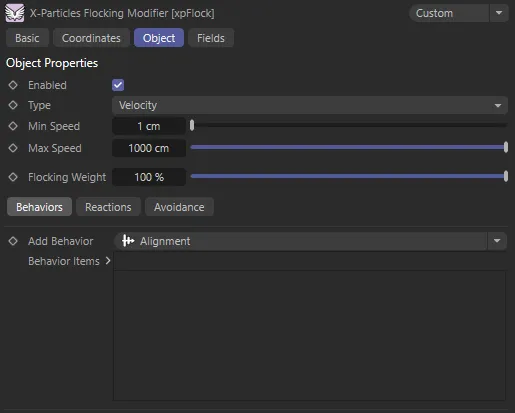
xpFlock parameter settings.
Enabled
Section titled “Enabled”On, by default, this box can be unchecked to disable xpFlock.
Set as Velocity, by default.
The alternative option is Force.
Velocity
Section titled “Velocity”Here, the xpFlock modifier takes complete control of the particle movement.
If you add another modifier, which also influences particle speed and direction (eg. xpTurbulence), you will find that it has little or no effect on the particle.
In this mode, the change in velocity caused by this modifier contributes to, but does not control, the final particle velocity.
Adding a modifier (eg. xpWind or xpTurbulence) will also contribute to the final result.
This is the mode to use if you want to add some other kind of movement to the particle as well as the flocking effect.
Min Speed
Section titled “Min Speed”The minimum speed that a particle may have when affected by the modifier.
Max Speed
Section titled “Max Speed”The maximum speed that a particle may have when affected by the modifier.
Flocking Weight
Section titled “Flocking Weight”The overall strength of the complete effect, including the result of any behaviors, reactions or avoidance.
Behaviors tab
Section titled “Behaviors tab”There are seven behaviors that can be selected: Alignment, Separation, Cohesion, Chaos, Periphery, Swarming and Natural Limits.
These all have different effects on the particle motion.
You can add as many behaviors to the Behavior Items list as you like and they will be blended together to give the final result.
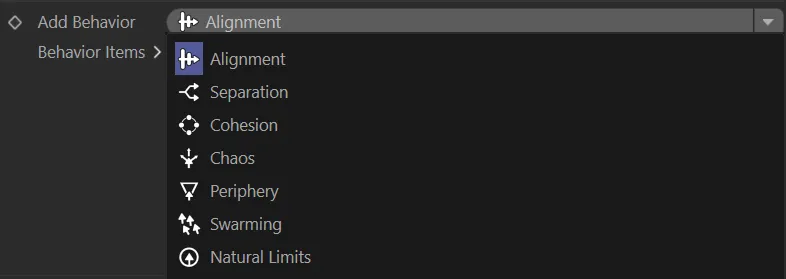
Behavior Items menu.
Add Behavior
Section titled “Add Behavior”Select the behavior you want, using this menu button.
Behaviour Items
Section titled “Behaviour Items”The list of behaviors in use will appear in this list.
You can temporarily disable a behavior by unchecking the box next to the behavior’s name.
Each behavior has its own set of options (described below), which are shown when the behavior is selected in the Behavior Items list.
Alignment
Section titled “Alignment”This behavior causes the particle velocity (speed and direction) to change to match the average velocity of other nearby particles in the flock.
‘Nearby’ particles are defined by the particle radius and/or the Velocity Matching Radius setting.
Flock Alignment
Section titled “Flock Alignment”Use Particle Radius
Section titled “Use Particle Radius”Enabled by default, the particle radius is combined with the Velocity Matching Radius when determining which other particles should be included in the calculation of the average velocity of the particle’s neighbors.
Velocity Matching Radius
Section titled “Velocity Matching Radius”This value is used to determine which other particles are neighbors and should be included in the calculation of the average velocity.
It is combined with the particles’ radius if Use Particle Radius is checked.
Animations to show the effect of the Velocity Matching Radius parameter. In this first one, the particles never fall within the 20cm value set and so there is no alignment.
In this animation, with the Velocity Matching Radius increased to 80cm, as soon as particles begin to fall within this value of each other, their velocity begins to align and they clump closely together.
Velocity Speed
Section titled “Velocity Speed”Only available if the modifier Type is set to Force.
Increasing this value will increase the speed with which the velocities are aligned.
Velocity Matching Weight
Section titled “Velocity Matching Weight”The strength of the velocity matching effect.
Global Alignment
Section titled “Global Alignment”Center Velocity Speed
Section titled “Center Velocity Speed”Only available if the modifier Type is set to Force.
It will have no effect unless Center Velocity Weight is greater than 0 (zero) cm, then it will increase the speed with which the velocities from all particles from the same emitter are aligned.
Center Velocity Weight
Section titled “Center Velocity Weight”If greater than 0 (zero) %, this will match the velocities of all the particles from the same emitter, even if they fall outside of the ‘neighbor’ radius.
In this animation, the Center Velocity Weight is at 0 (zero) %, so none of the particle velocities are aligned and particles are doing their own thing.
This second video demonstrates the effect of increasing the Center Velocity Weight, to 650%, globally aligning the velocities.
Separation
Section titled “Separation”This behavior causes the particles to maintain a distance from other nearby particles in the flock.
‘Nearby’ particles are defined by the particle radius and/or the Separation Radius setting.
Flock Separation
Section titled “Flock Separation”Use Particle Radius
Section titled “Use Particle Radius”Enabled by default, the particle radius is combined with the Separation Radius value.
Separation Radius
Section titled “Separation Radius”This value is the distance that should be kept between a particle and its neighbors.
It is combined with the particle’s radius if Use Particle Radius is enabled.
Demonstrating the Separation Radius, this first animation shows the particles kept apart to a low value of only 20cm
In this second animation, the Separation Radius is increased to 80cm, clearly separating the particles.
Separation Speed
Section titled “Separation Speed”Only available if the modifier Type is set to Force.
Increasing this value will increase the speed with which the position changes to maintain distance.
Separation Weight
Section titled “Separation Weight”The strength of the separation effect.
Resolve Particle-Particle Collisions
Section titled “Resolve Particle-Particle Collisions”This is a simple check to move particles away from one another if they are intersecting.
Cohesion
Section titled “Cohesion”The cohesion behavior makes particles draw together.
Particles which are closer than the Cohesion Radius value and/or the particle radius will draw closer together.
Flock Cohesion
Section titled “Flock Cohesion”Use Particle Radius
Section titled “Use Particle Radius”Enabled by default, the particle radius is combined with the Cohesion Radius value.
Cohesion Radius
Section titled “Cohesion Radius”Particles which are closer together than this value will be drawn together.
It is combined with the particles’ radius if Use Particle Radius is enabled.
Increasing the Cohesion Radius, is demonstrated in these animations, with Use Particle Radius enabled, In this first video, the Cohesion Radius is set at 40cm, so only particles within that distance are drawn together.
Here, in this second animation, the Cohesion Radius is increased to 90cm, making more particles cohesively bond to other particles, in clumps, within greater distances.
Cohesion Speed
Section titled “Cohesion Speed”Only available if the modifier Type is set to Force.
Increasing this value will increase the speed with which the particles converge.
Position Matching Weight
Section titled “Position Matching Weight”The strength of the effect in changing the particles’ position.
Animation to demonstrate the effect of the Position Matching Weight parameter set at 20%.
In this animation, the Position Matching Weight value is raised to 80% giving more cohesion with particles in clumps.
Mass Matching Weight
Section titled “Mass Matching Weight”The particles can be moved to the average center of mass using this parameter.
It is set to 0 (zero) % by default, so the center of mass of the particles is not taken into account, but you can use this as well as, or instead of, the average center position.
Global Cohesion
Section titled “Global Cohesion”Center Position Speed
Section titled “Center Position Speed”Only available if the modifier Type is set to Force.
It will have no effect unless Center Position Weight is greater than 0 (zero) cm, then it will increase the speed with which the positions from all particles from the same emitter converge.
Center Position Weight
Section titled “Center Position Weight”If greater than 0 (zero) %, this will converge the positions of all the particles from the same emitter, even if they fall outside of the cohesion radius.
Increasing the Center Position Weight value, even by small amounts, makes all particles cohesive, with their positions globally converged.
This behavior introduces some chaotic movement into the particles.
Flock Chaos
Section titled “Flock Chaos”Chaos Scale
Section titled “Chaos Scale”Larger scale settings will damp down the movement of the particles, giving smoother movement.
By contrast, a smaller scale will produce more chaotic movement.
This animation demonstrates the Chaos Scale parameter set at 20%.
Here the Chaos Scale is raised to 90%, producing a more chaotic movement of the particles.
Chaos Frequency
Section titled “Chaos Frequency”This setting changes the frequency of the internal noise generator used by the modifier, so the higher the value, the more rapid the chaos.
Chaos Multiplier
Section titled “Chaos Multiplier”Multiplies the force generating the chaotic movement.
The higher the value, the greater the change in velocity.
Chaos Weight
Section titled “Chaos Weight”The strength of the chaos effect.
Periphery
Section titled “Periphery”This behavior is used in conjunction with other behaviors, such as Alignment or Cohesion.
A particle will then only be affected by other particles which are within its field of vision.
Peripheral Vision
Section titled “Peripheral Vision”Peripheral Vision Angle
Section titled “Peripheral Vision Angle”The effects of any behaviours will only be applied to other particles within a particle’s field of vision. This angle can be adjusting using this setting.
In this animation, the Peripheral Vision Angle is set at 40 degrees.
This animation has the Peripheral Vision Angle raised to 250 degrees, the particles are aware of more particles in the scene, and the Behavior Items (Periphery, Cohesion and Alignment) begin to be applied between them.
Swarming
Section titled “Swarming”This behavior makes separate emitters or particle groups tend to congregate with others in the same group or from the same emitter, while remaining part of a flock.
It requires at least two emitters or two particle groups, which must be added to the Swarming Emitters (or Swarming Groups) list.
Enable Swarming
Section titled “Enable Swarming”Enabled by default, uncheck to disable.
Others Make Me Happy
Section titled “Others Make Me Happy”When unchecked, neighboring particles from the same emitter (or group) make the particle ‘happy’.
If it is checked, particles from different emitters (or groups) make it happy.
‘Happiness’ is a state which affects particle movement; a particle can either be happy or unhappy.
Use Particle Radius
Section titled “Use Particle Radius”Enabled by default, the particle radius is combined with the value in Neighbor Radius.
Neighbor Radius
Section titled “Neighbor Radius”The radius around the particle to be searched for neighboring particles.
It is combined with the particle radius if Use Particle Radius is enabled.
Happiness Ratio
Section titled “Happiness Ratio”This value determines when a particle becomes ‘happy’.
If you set this too high, most particles will be happy and if Speed When Happy is low (which it is by default), they will not move very quickly.
But if you set it too low, all the particles may be unhappy and, with the default settings, may move too fast.
Speed When Happy/Speed When Unhappy
Section titled “Speed When Happy/Speed When Unhappy”The speed of the particle when it is happy, or unhappy, respectively.
You can select whether to use different emitters or different groups from the same emitter with this menu.
The two settings are: Emitter and Group.
Swarming Emitters (or Swarming Groups)
Section titled “Swarming Emitters (or Swarming Groups)”Drag the emitters or particle groups to use into this link field.
Natural Limits
Section titled “Natural Limits”This behavior is intended to stop the flipping of a particle, which can occur when it chases another particle and makes a sharp direction change.
It is intended to help reproduce the behavior of predators, such as a shark chasing a shoal of fish.
Enable Natural Limits
Section titled “Enable Natural Limits”Enabled by default, uncheck to disable.
Maximum Angle
Section titled “Maximum Angle”This is the maximum angle which a particle is allowed to change within a frame.
Blend Percentage
Section titled “Blend Percentage”The previous frame’s direction and the new frame’s direction can be interpolated to make movement smoother and more natural.
This setting controls the amount of blending between frames.
Reactions tab
Section titled “Reactions tab”Reactions cause the particle to react to a variety of stimuli or reactors.
Each reactor will create a new object in the Object Manager as a child of the flocking object.
Reactions Weight
Section titled “Reactions Weight”The overall strength of all reactors.
Setting this to zero will mean no effect from any reactor.
Add Reaction
Section titled “Add Reaction”Select the rector you want to add using this menu button.
The options are: Pursuit, Flee, Arrive and Orbit.
Reaction Items
Section titled “Reaction Items”The list of reactors in use.
You can temporarily disable a reactor by unchecking the checkbox next to the reactor’s name.
Each has its own set of options which are shown when the reaction is selected in the Reaction Items list.
To delete a reactor, select it and press the Delete key, or right-click it and select Remove or Remove All from the context menu.
If you want to use the reactor again, simply drag it back into this list.
Reactor Settings
Section titled “Reactor Settings”All reactors have this set of common properties:
Enabled
Section titled “Enabled”Enabled, by default.
Uncheck to disable.
Flock Reaction Weight
Section titled “Flock Reaction Weight”The strength of this reactor.
This does not affect other reactors in the list.
Display
Section titled “Display”Choose the viewport representation of the reactor from this list.
The options are: Sphere, Box, Cross and None.
If Activation Range is set to Distance, the size of the display shows the active area of the reactor.
Activation Range
Section titled “Activation Range”Set as Distance, by default.
The reactor acts on a particle if that particle is within the Distance setting of the reactor.
The alternative is Infinite, when the reactor becomes active at any distance from a particle.
Distance
Section titled “Distance”The distance to use when Activation Range is set to Distance.
Timing Mode
Section titled “Timing Mode”Set as Always, by default, this menu controls when the reactor is active.
Other options are: Before, After, On, Pulse and Between.
Always
Section titled “Always”The reactor is always active.
Before
Section titled “Before”The reactor is only active before the time in the At Frame setting.
The reactor is only active after the time in the At Frame setting.
The reactor is only active at the time before the time in the At Frame setting; not before or after.
The reactor will become active with each multiple of the time in the At Frame setting.
For example, if At Frame is set to 10, the reactor will work on frames 10, 20, 30, etc. but not at other times.
Between
Section titled “Between”The reactor is active between the times given in the At Frame and To Frame settings.
At Frame/To Frame
Section titled “At Frame/To Frame”Time settings used for the Timing Mode options.
Pursuit
Section titled “Pursuit”Particles will pursue the object or other particles.
Animation to demonstrate the Pursuit reactor mode, with particles from xpEmitter 1 chasing the particles from xpEmitter 2.
Pursuit Settings
Section titled “Pursuit Settings”Pursuit Type
Section titled “Pursuit Type”The pursuit reactor can operate in several ways.
In all cases, except Static Position (the default setting), the reactor requires two or more emitters - one or more of which are the pursuers, and one or more which are the ones being chased.
If required, you can use particle groups instead of emitters, in which case you will need at least two groups.
In this reactor, the particles which are pursuing should be added to the Friendly Emitter List (or Friendly Group List).
Those being chased should be added to the Enemy Emitter List (or Enemy Group List).
Static Position
Section titled “Static Position”This does not require another emitter.
The particles simply chase after the pursuit object, which can be animated, if desired.
Center Position
Section titled “Center Position”The pursuing particles aim for the average position of all the chased particles.
Center of Mass
Section titled “Center of Mass”The pursuing particles aim for the average center of mass of all the chased particles.
The pursuing particles chase the first of the chased particles.
The pursuing particles chase the last the chased particles.
Nearest
Section titled “Nearest”Each of the pursuing particles chases the nearest chased particle to itself.
With this menu you can opt to use separate emitters or different groups.
The two options are: Emitter or Group.
Pursuit Offset
Section titled “Pursuit Offset”You can use this to offset the target point for the pursuing particles.
Distance
Section titled “Distance”Only available if Pursuit Type is set to Nearest.
A pursuing particle must be within this distance of a chased particle for it to chase that particle.
If the distance subsequently exceeds this value, chasing will stop.
Friendly Emitter List (or Friendly Group List)
Section titled “Friendly Emitter List (or Friendly Group List)”Drag the emitter(s) or particle group(s) that are to do the chasing into this list.
Enemy Emitter List (or Enemy Group List)
Section titled “Enemy Emitter List (or Enemy Group List)”Drag the emitter(s) or particle group(s) that are to be chased into this list.
This reactor is the same as the pursuit reactor except that the ‘friendly particles’ are those being chased and will try to evade the pursuer.
The ‘enemy particles’ are those doing the chasing.
As with the pursuit reactor, the particles will flee from the flee object itself if you set Pursuit Type to Static Position.
Otherwise, all settings are the same as Pursuit settings, above.
In this animation, demonstrating the Flee reactor type, particles from xpEmitter 1 are fleeing from particles from xpEmitter 2, which is dropped in the Enemy Emitter List.
Arrive
Section titled “Arrive”Particles will move towards the object and slow down as they get closer.
This animation demonstrates the Arrive reactor type.
Arrive Settings
Section titled “Arrive Settings”The particles’ speed will be changed to this value, as they enter the activation range of the reactor, then slow down to nearly zero when they arrive at the object.
Particles will orbit around the object.
In this animation, the particles are orbiting around the Sphere, once they reach it.
Orbit Settings
Section titled “Orbit Settings”Strength
Section titled “Strength”The strength which the object exerts on the particles to make them orbit.
The higher this value, the faster the particles will orbit.
Avoidance tab
Section titled “Avoidance tab”The particles will avoid objects dragged into the Avoid Items list.
With all three Spheres in the Avoid Items list, the particles are avoiding them, in this animation.
Weight
Section titled “Weight”The overall strength of the avoidance effect.
Distance
Section titled “Distance”Particles must be closer to the object than this distance before starting to move to avoid it.
Set as Soft, by default (the alternative is Hard).
This controls how the particles avoid the object.
The particles will move to flow around an object but not move away from it.
The particles will move strongly away from the object, almost as if they have rebounded from it.
Avoid Items
Section titled “Avoid Items”Drag any objects in the scene into this list; they will be avoided, as a result.
This animation shows an emitted group of blue particles with the Chaos, Swarming and Cohesion Behaviors, as well as the Orbit, Pursuit and Flee Reactions applied. They are set up to avoid all three Spheres at a Distance of 125cm. The red particles join the scene and, immediately, the blue particles’ Flee Reactions begin to be displayed, as they try to escape the predatory red particles, which are pursuing them.
Fields tab
Section titled “Fields tab”You can use the Fields options to control where xpFlock operates.
Copyright © 2026 INSYDIUM LTD. All rights reserved.