

tfBrush
tfBrush is a unified tool, used to manipulate the control grids of tfGrid and tfWarp.
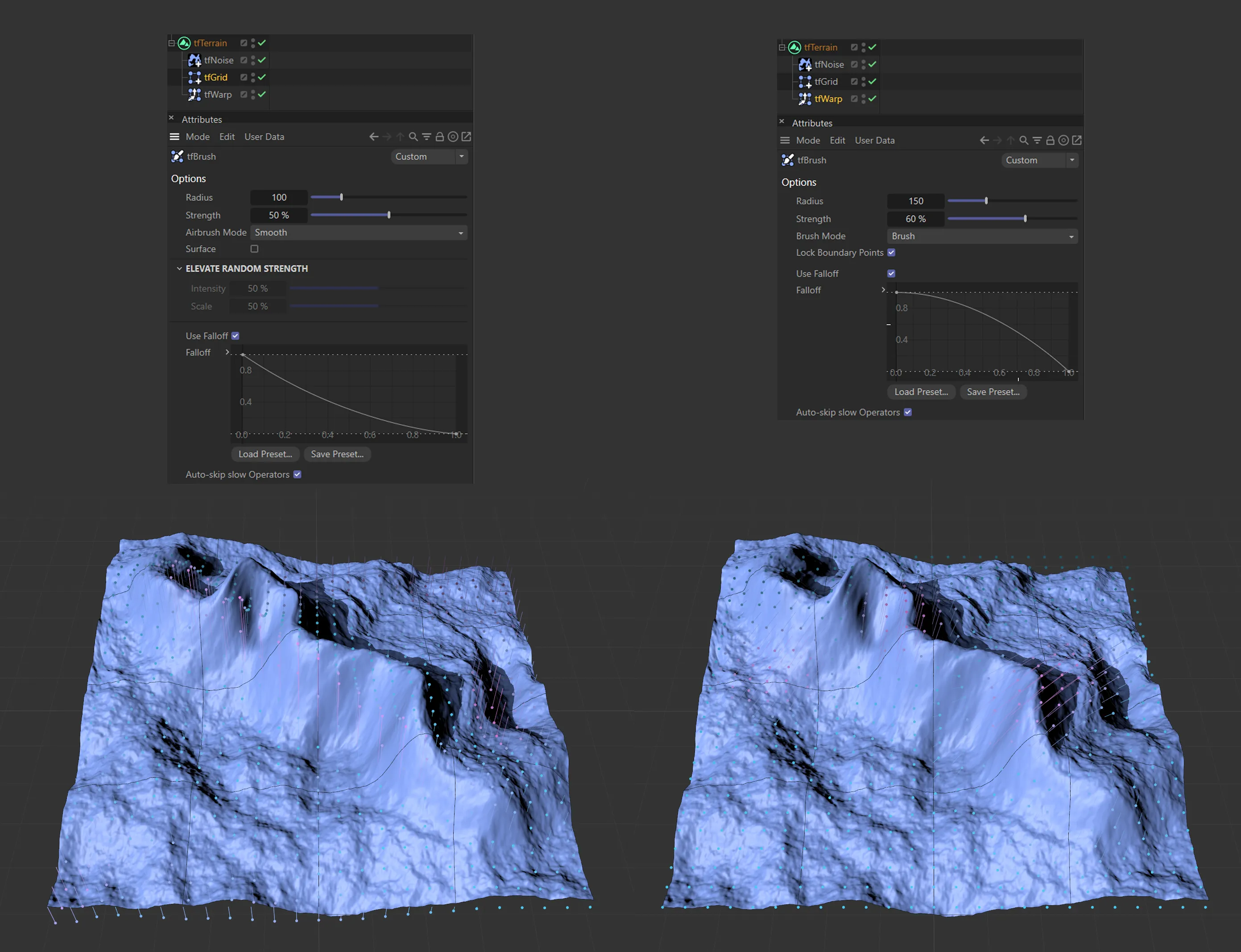
tfBrush operating in tfGrid, on the left, and tfWarp, on the right.
Options
Section titled “Options”Radius
Section titled “Radius”This slider increases and decreases the radius of the Brush.
The radius can also be adjusted by holding down the middle button on your mouse and dragging horizontally.
Strength
Section titled “Strength”Set at 50%, by default, this can be reduced to give a lighter touch or increased to give a heavier touch to the deformation.
The strength can also be adjusted by holding down the middle button on your mouse and dragging vertically.
Airbrush/Brush Mode
Section titled “Airbrush/Brush Mode”Depending on how you access tfBrush, the default setting will be Elevate in tfGrid, or Brush in tfWarp.
The other settings in tfGrid are: Off, Smooth, Set and Transfer.
In tfWarp, the other settings available are: Pinch, Bulge and Relax.
tfGrid options
Section titled “tfGrid options”Off mode
Section titled “Off mode”This gives you a very responsive and precise deformation control.
Animation demonstrating the Airbrush Mode in Off.
Elevate mode
Section titled “Elevate mode”Holding the left mouse button and moving the tool over the terrain will elevate the grid points within the tool radius.
The longer you hold down the mouse, the more elevation you will get.
Holding CTRL will negate the tool strength, inverting the effect, hence lowering the points.
Holding SHIFT will temporarily switch to Smooth mode.
Holding SHIFT and CTRL will temporarily switch to Smooth mode and negate the tool strength, making it a ‘contrast’ tool.
This animation shows the effect of the Elevate mode.
Elevate Random Strength
Section titled “Elevate Random Strength”Only available in the Elevate mode, this will apply a noise to the grid points, giving some natural variation.
The noise pattern will change with every brush stroke.
Intensity
Section titled “Intensity”Increases or decreases the intensity of the Random Strength settings.
Increases or decreases the scale of the Random Strength settings.
Animation to illustrate the Random Strength settings of Scale and Intensity.
Smooth mode
Section titled “Smooth mode”The tool will gradually and gently smooth out the terrain within the tool radius, by blending the current height with the average height of all points currently within the tool radius.
The longer you hold down the mouse, the more the points will be smoothed to an average deformation elevation based on the points within the grid brush.
Holding CTRL will negate the tool strength, inverting the effect, hence increasing local contrast between mountains and valleys.
Holding SHIFT will temporarily switch to Elevate mode.
Holding SHIFT and CTRL will temporarily switch to Elevate mode and negate the tool strength, making it a ‘lower’ tool.
In this animation, the Smooth mode is being used to blend the heights of the terrain.
Set mode
Section titled “Set mode”In Set mode, tfBrush will blend the control grid points between their current altitude and a precise altitude that can be set in tfBrush’s attributes, to manually create plateaus, terraces and plains.
Holding SHIFT will temporarily switch to Transfer mode and apply the average altitude of the points within tool range at the time of starting the brush stroke.
Animation to show the effect of the Set mode, in conjunction with a reduction in the Radius value.
Transfer mode
Section titled “Transfer mode”In Transfer mode, tfBrush behaves almost like in Set mode, but instead of applying the altitude set in tfBrush’s attributes, it will use the average altitude of the points within tool range at the time of starting the brush stroke.
This makes it possible to click on any area of the terrain and propagate that altitude to other areas, matching their altitude with the one from the brush stroke’s starting point.
Holding SHIFT will temporarily switch to Set mode and apply the altitude set in tfBrush’s attributes.
This animation demonstrates the Transfer mode.
Surface
Section titled “Surface”By default, tfBrush will use all tfGrid points that are within the tool range in screen space.
This can result in distortions if the user paints while looking at the terrain at a flat angle.
If the Surface option is activated, tfBrush will instead use the points that are within tool range in 3D space.
This frees the tool from being dependent on the view angle and it will change the mouse cursor display to a 3D sphere.
In this animation, the effect of activating the Surface option is illustrated.
tfWarp options
Section titled “tfWarp options”Brush mode
Section titled “Brush mode”Lets you brush the warp grid points, similar to combing hair.
Animation to demonstrate the Brush mode in tfWarp.
Pinch mode
Section titled “Pinch mode”Pulls warp grid points towards the brush.
This animation shows the Pinch mode in tfWarp.
Bulge mode
Section titled “Bulge mode”Pushes warp grid points away from the brush.
In this animation, you can see the effect of the Bulge mode.
Relax mode
Section titled “Relax mode”Softly blends the warp grid back to its initial state.
Animation to illustrate the effect of the Relax mode.
Use Falloff
Section titled “Use Falloff”This is on, as the default setting.
Falloff
Section titled “Falloff”The Falloff curve determines the effect on the elevation patterns.
This will be further amplified by the deformation settings you have chosen.
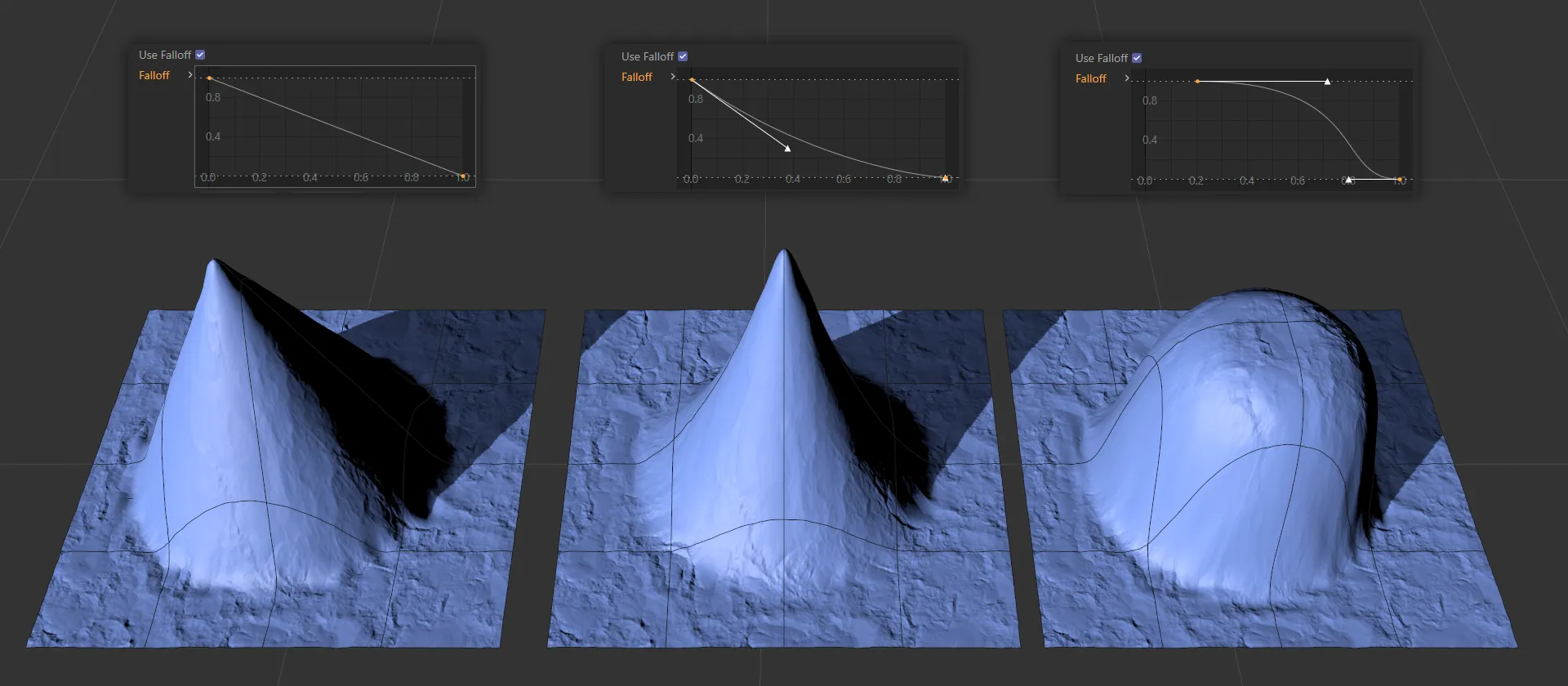
In this first image, there are three terrains being driven by the tfGrid Falloff curve settings. The first, a linear curve, giving an even deformation; in the center, the default curve; finally an exaggerated bell curve, which results in a flatter hill top and steep decline to the ground.
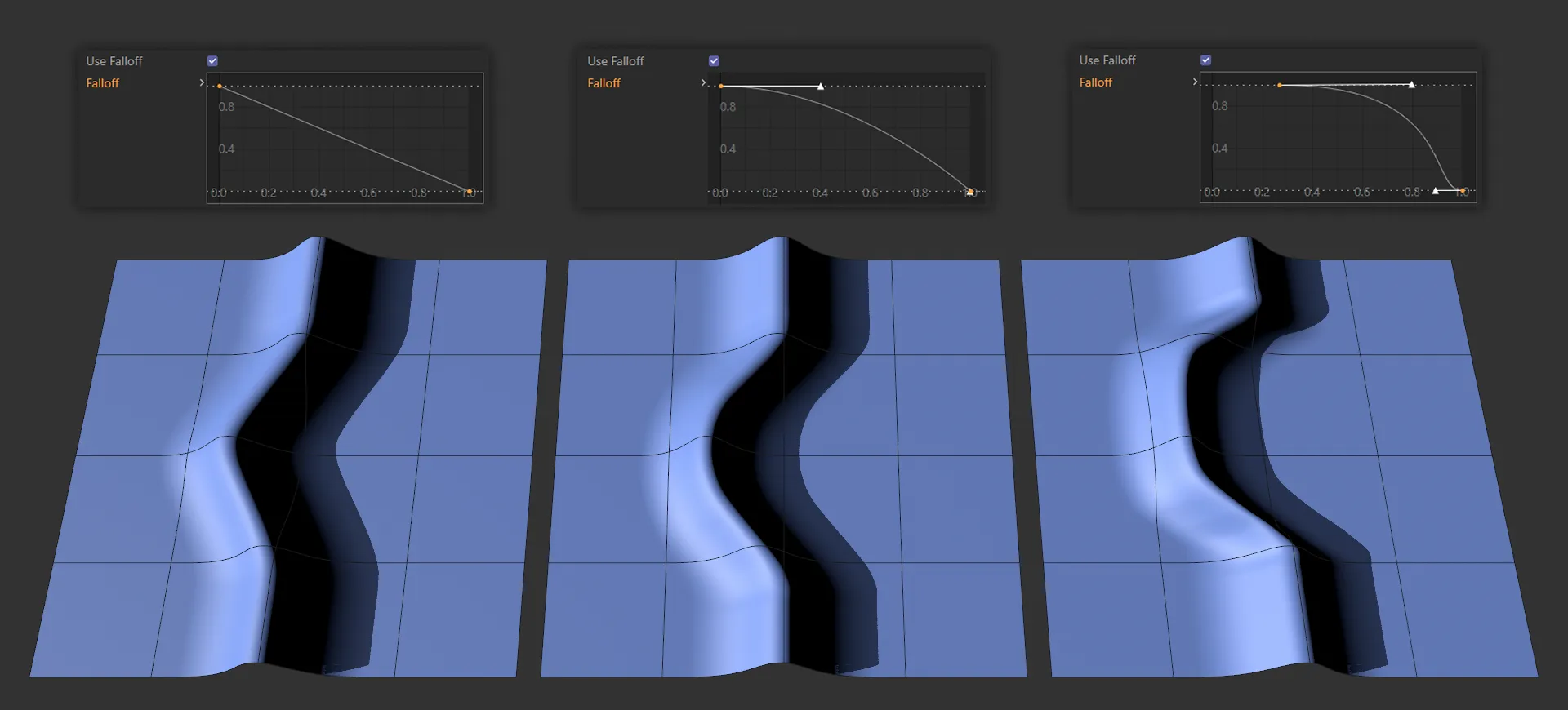
Here there are three terrains being driven by the tfWarp Falloff curve settings. The first, a linear curve; in the center, the default curve and, finally, an exaggerated bell curve.
Load Preset
Section titled “Load Preset”There are various preset falloff shapes available to load in from here.
Save Preset
Section titled “Save Preset”It is possible to save your custom falloff shapes for future use.
Auto-skip slow Operators
Section titled “Auto-skip slow Operators”The Auto-skip slow Operators option will temporarily deactivate successive operator objects that calculate too slowly.
This results in a (temporarily) less truthful viewport display, but it tremendously increases performance while making a brushstroke.
Reset Grid
Section titled “Reset Grid”This will reset the grid to the original state.
Copyright © 2026 INSYDIUM LTD. All rights reserved.