
Petal
Clicking on Petal in the Flower Parts drop-down menu will add it to the Flower Layers list.
When Petal is highlighted in this list, the following attributes will all be accessible.
Main tab
Section titled “Main tab”Petal Type
Section titled “Petal Type”Set as Standard, by default.
The alternative is Cone, which has some different parameter options.
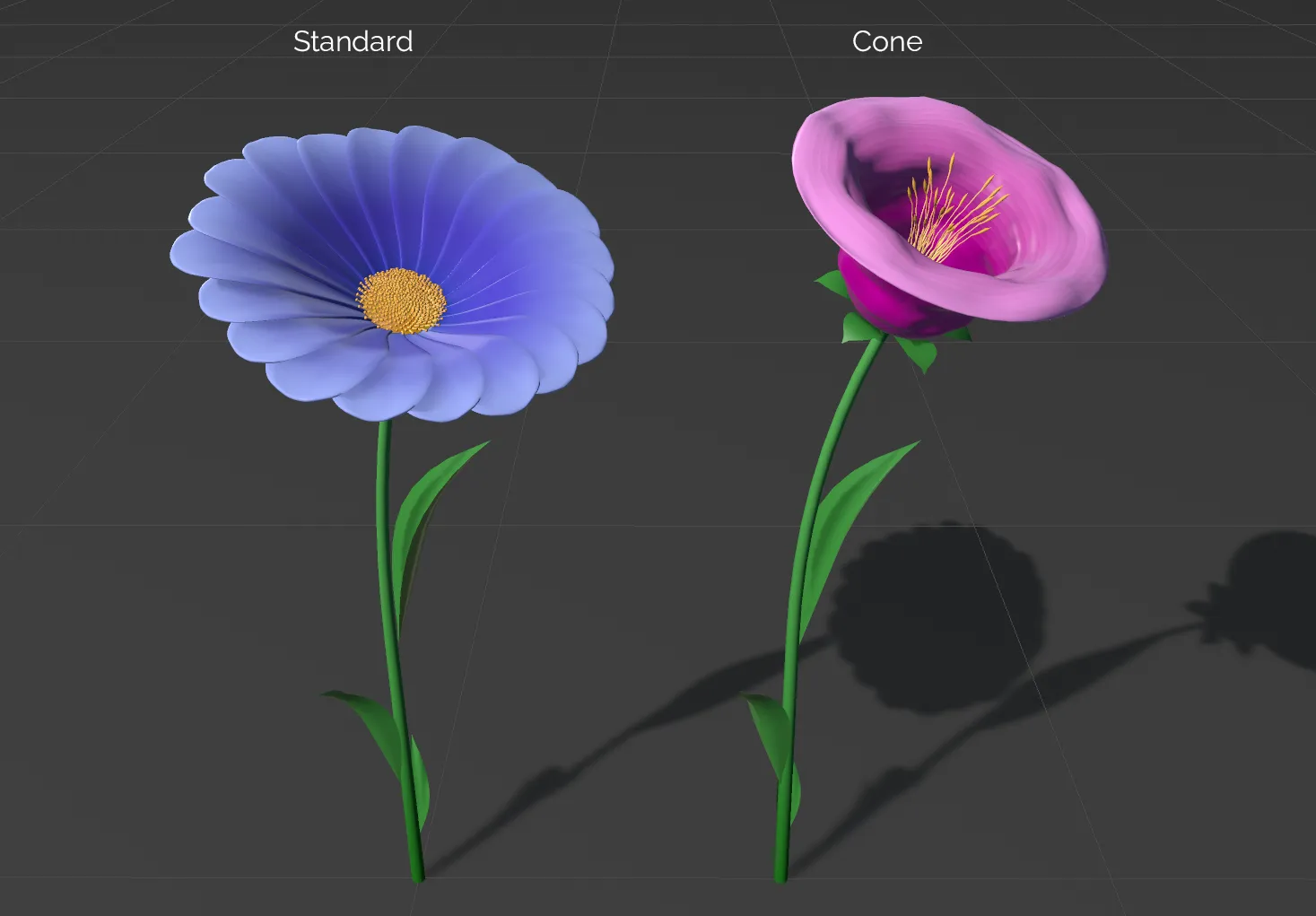
The two Petal Type settings of Standard and Cone.
Main tab - Standard petal settings
Section titled “Main tab - Standard petal settings”Gives a different, random arrangement, based on the other values set.
This can be increased or decreased.
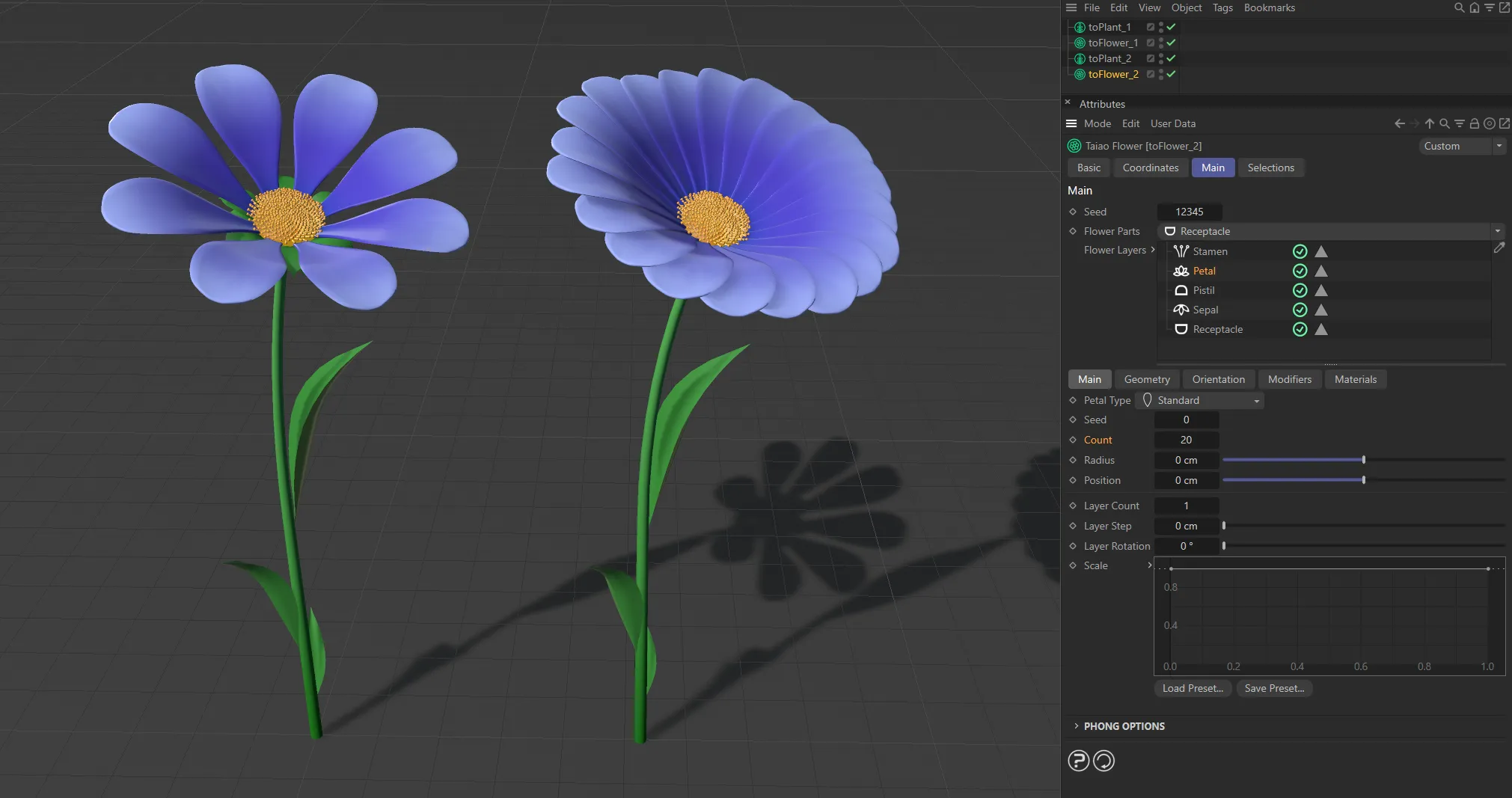
Count set at 8 on the left and 20 on the right.
Radius
Section titled “Radius”This slider will adjust the radius of the petals.
Position
Section titled “Position”The position of the petals can be raised or lowered.
Layer Count
Section titled “Layer Count”This is set to one layer, by default, but you can add more layers, which will have an identical number of petals.
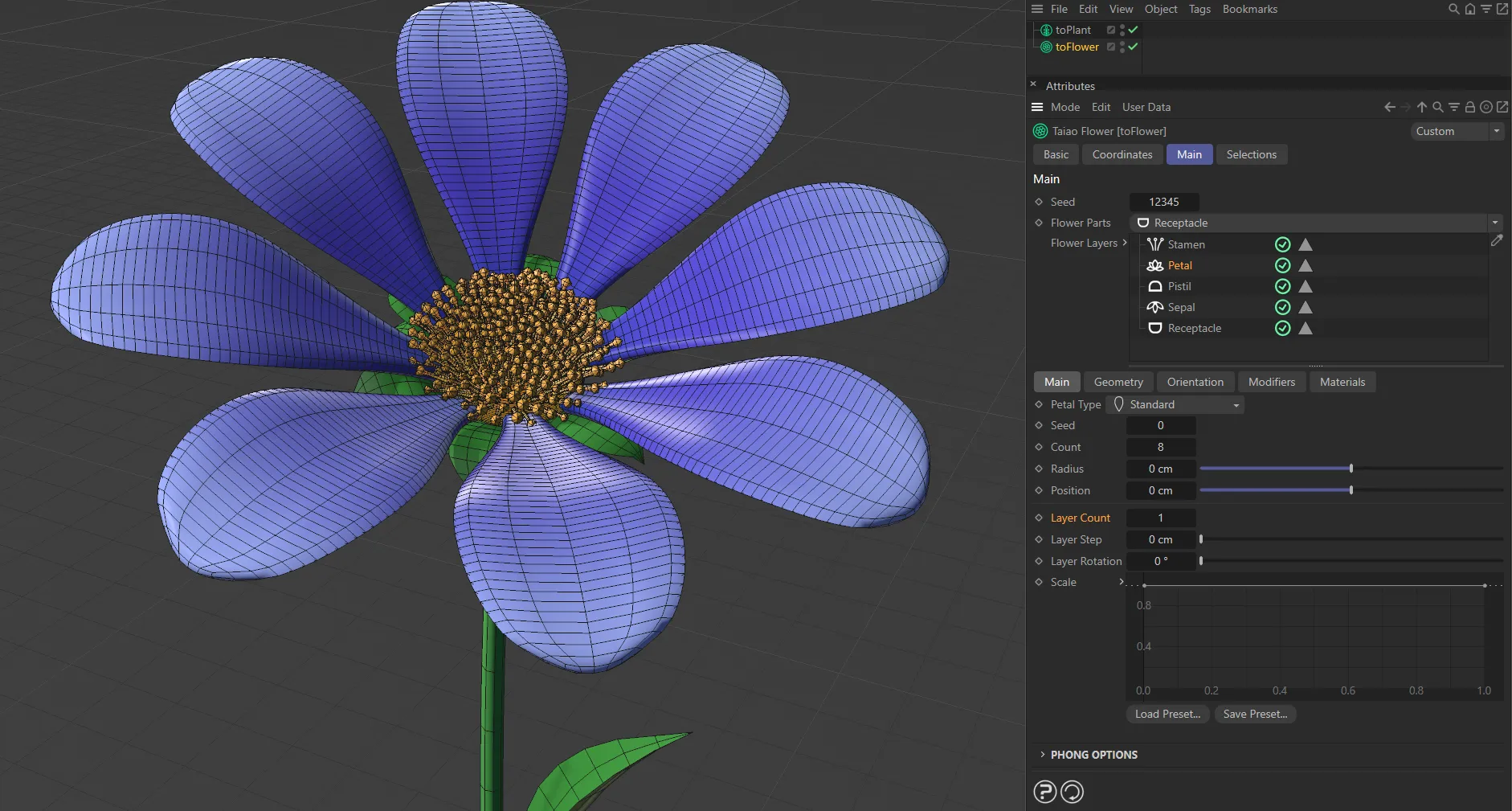
The Layer Count is 1 here.
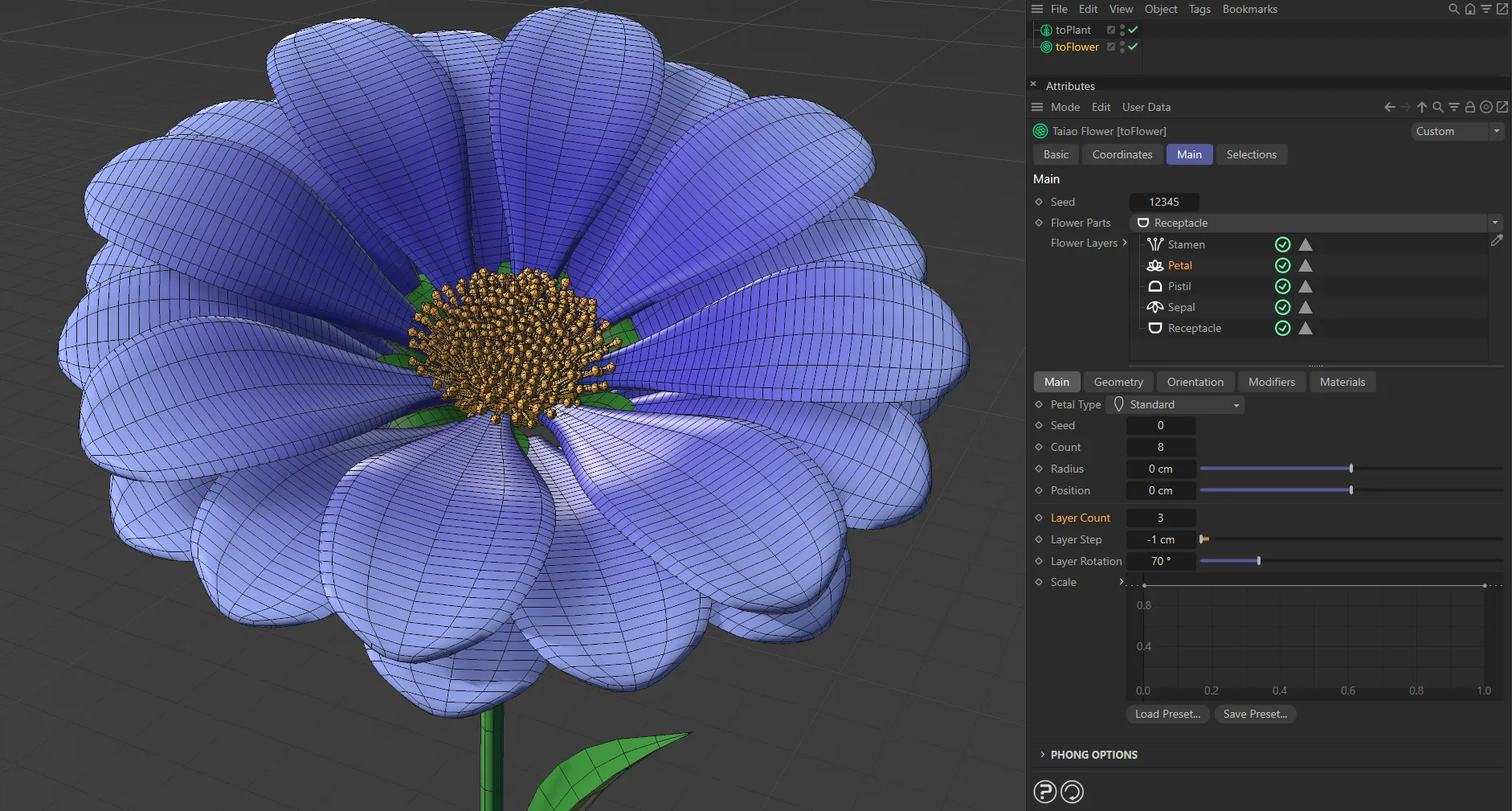
Layer Count raised to 3, providing three layers of petals.
Layer Step
Section titled “Layer Step”Increasing this will place a gap between the layers.
Layer Rotation
Section titled “Layer Rotation”You can rotate the layers, in order to make them all visible.
This spline curves gives you finer detailed control over the sizes of the individual layers you have on your flower.
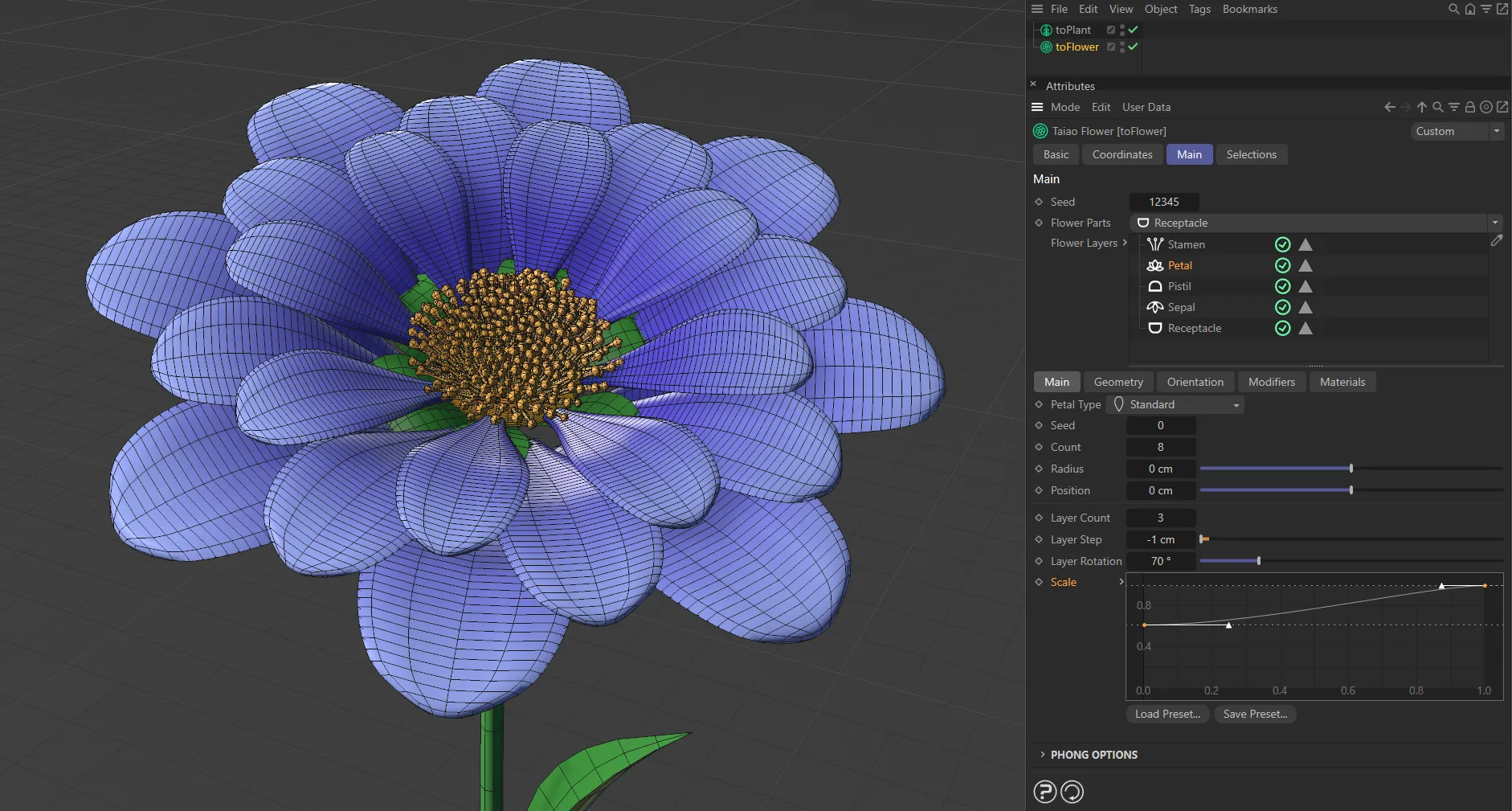
This rising Scale spline curve, makes the petals bigger on the lower layers.
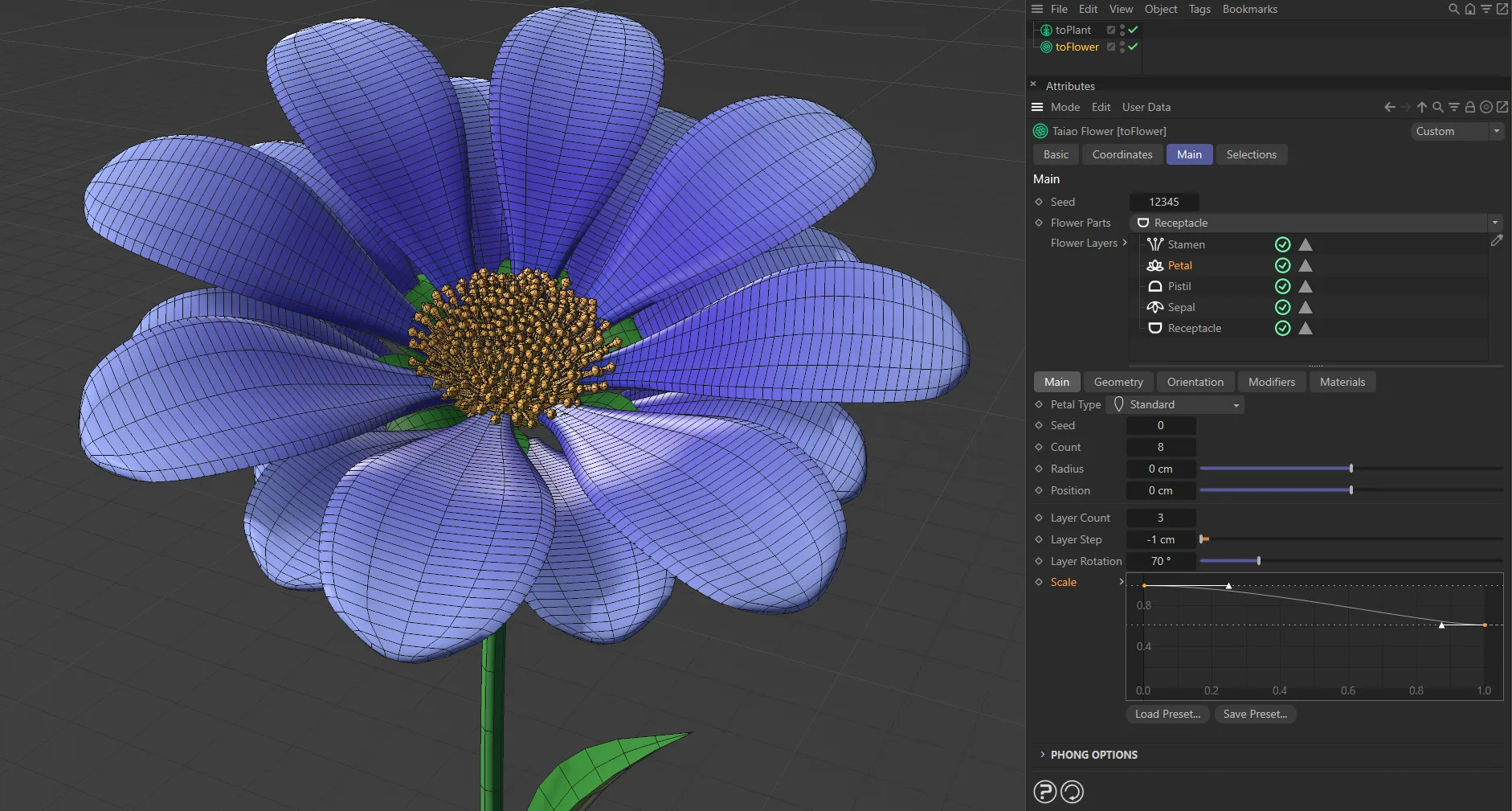
This Scale curve is the inverse of the first, giving larger petals on the upper layers.
Phong Options
Section titled “Phong Options”These options allow you to adjust the smooth shading between neighboring polygons.
Smooth shading can be applied across all polygons, or it can be restricted using the Angle Limit and Phong Angle settings. **
Angle Limit
Section titled “Angle Limit”When activated, this will use the Phong Angle value to **restrict where smoothing occurs. **
Phong Angle
Section titled “Phong Angle”You can change this to set the angle limit, up until which the neighboring surfaces will be smoothed.
phong options here too
Geometry tab
Section titled “Geometry tab”You can increase or decrease petal sizes.
Size Variation
Section titled “Size Variation”In order to make things look more organic, you can add variation here.
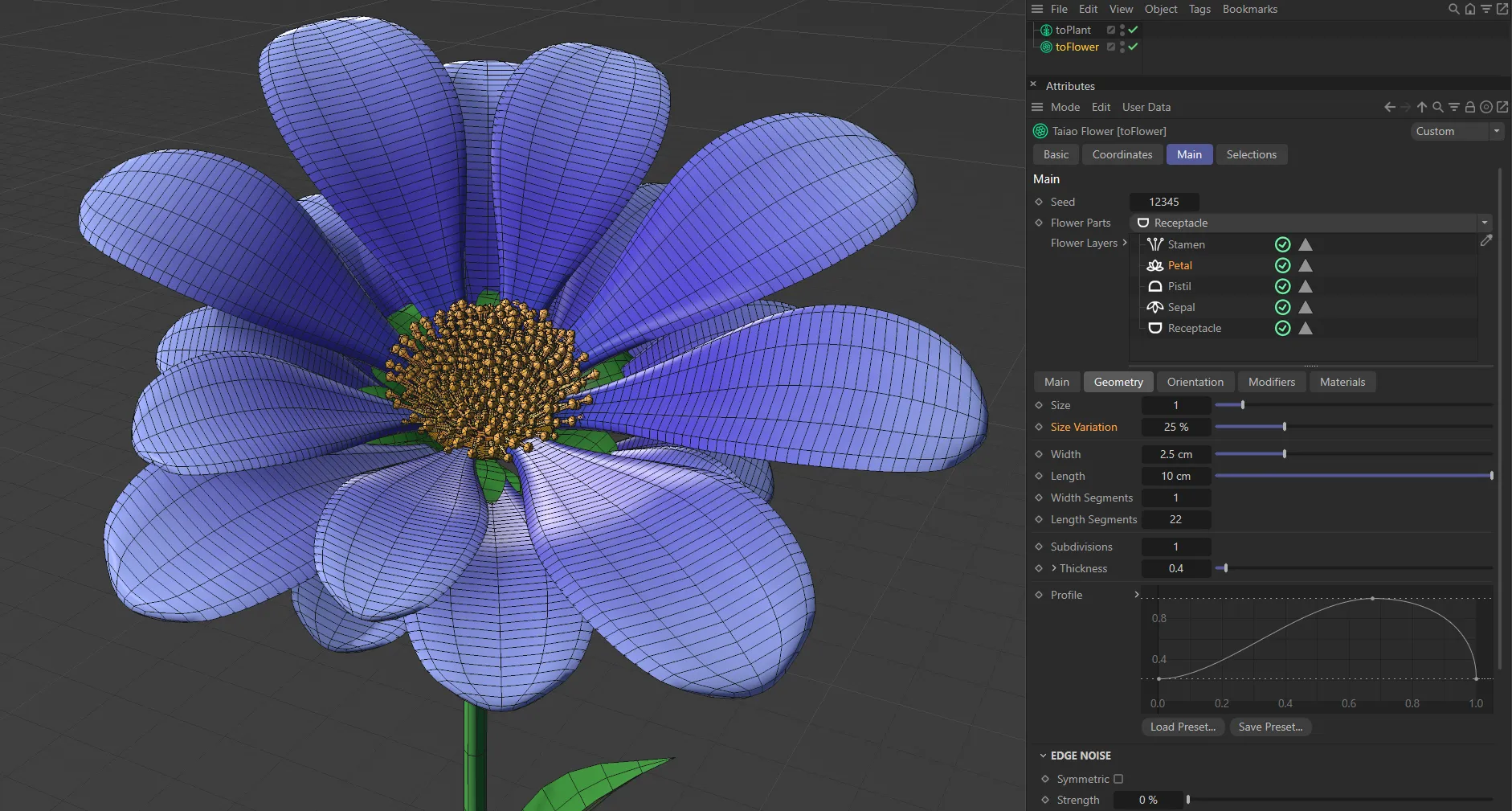
Increasing the Size Variation value will randomly change the scale of each petal.
This will change the width of your petals.
Length
Section titled “Length”Similarly, changes the length of your petals.
Width Segments
Section titled “Width Segments”In order to alter the geometry, you can add width segments.
Length Segments
Section titled “Length Segments”Similarly, you can add length segments.
Subdivisions
Section titled “Subdivisions”To smoothen out your petals, you can add subdivisions to give more geometry and round edges.
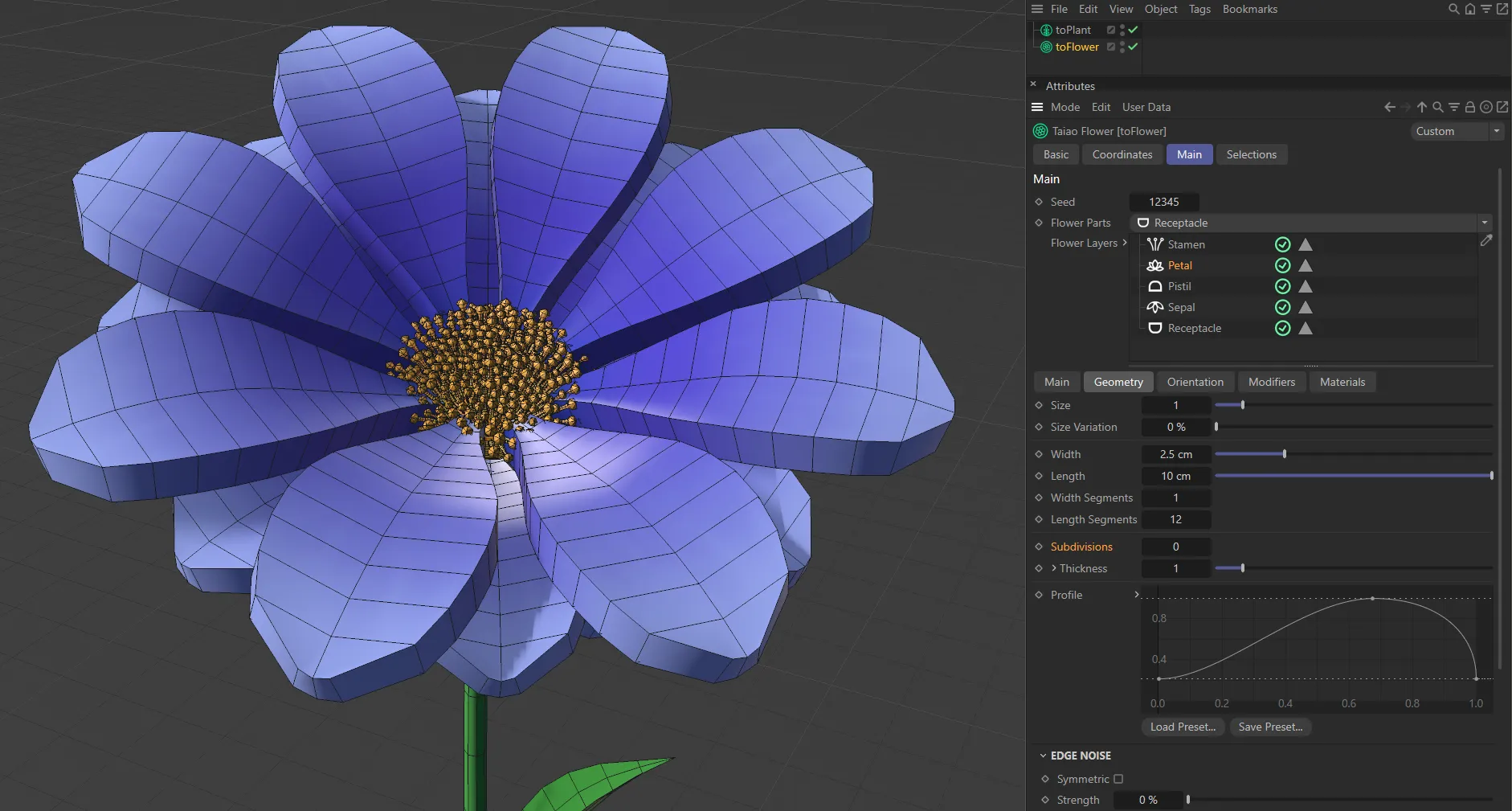
In this image, Subdivisions is set at 0 (zero).
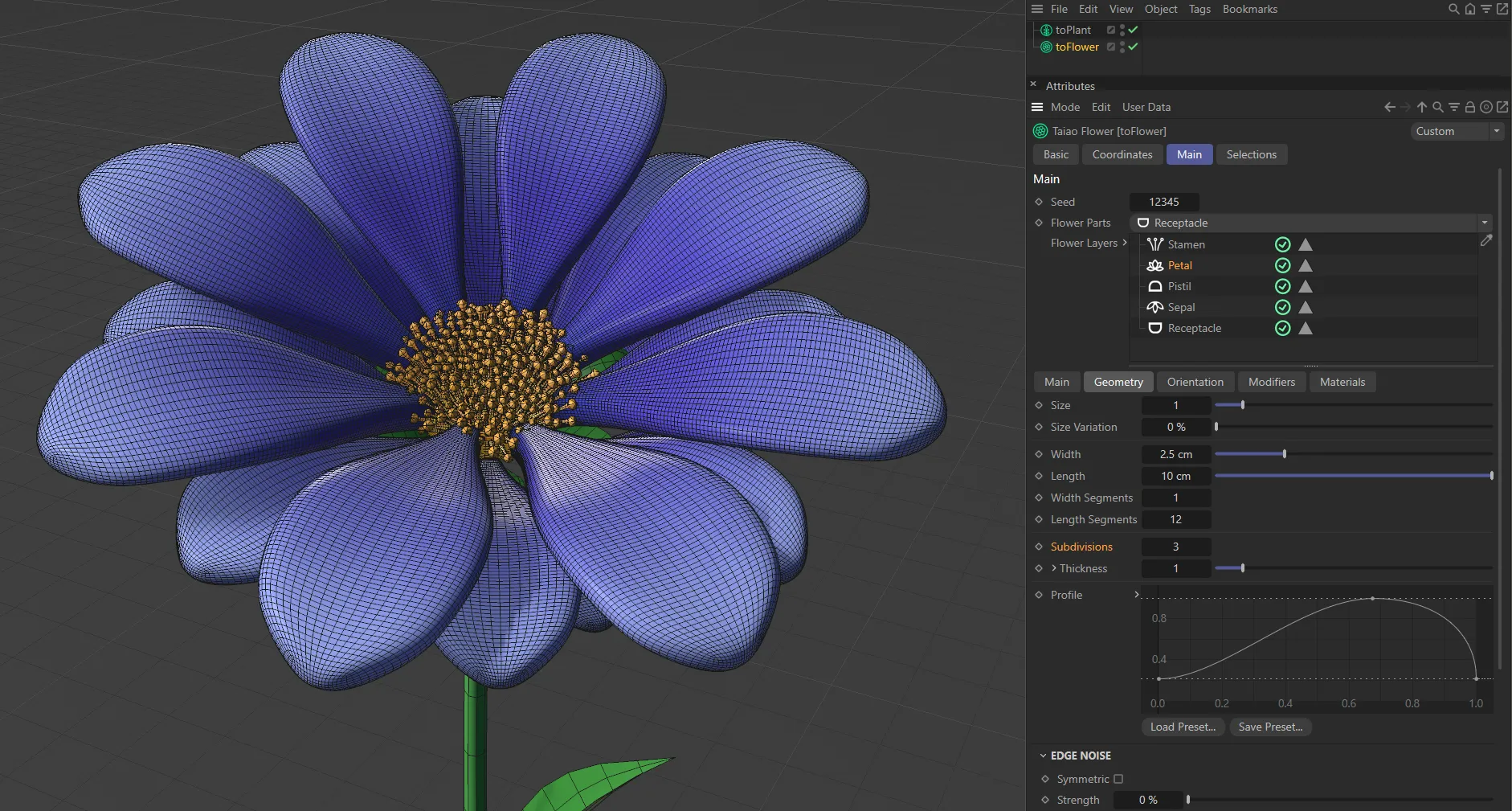
The Subdivisions value is 3 here.
Thickness
Section titled “Thickness”Adding thickness will give your petals depth.
Unfolding the drop-down arrow will reveal a Depth spline curve.
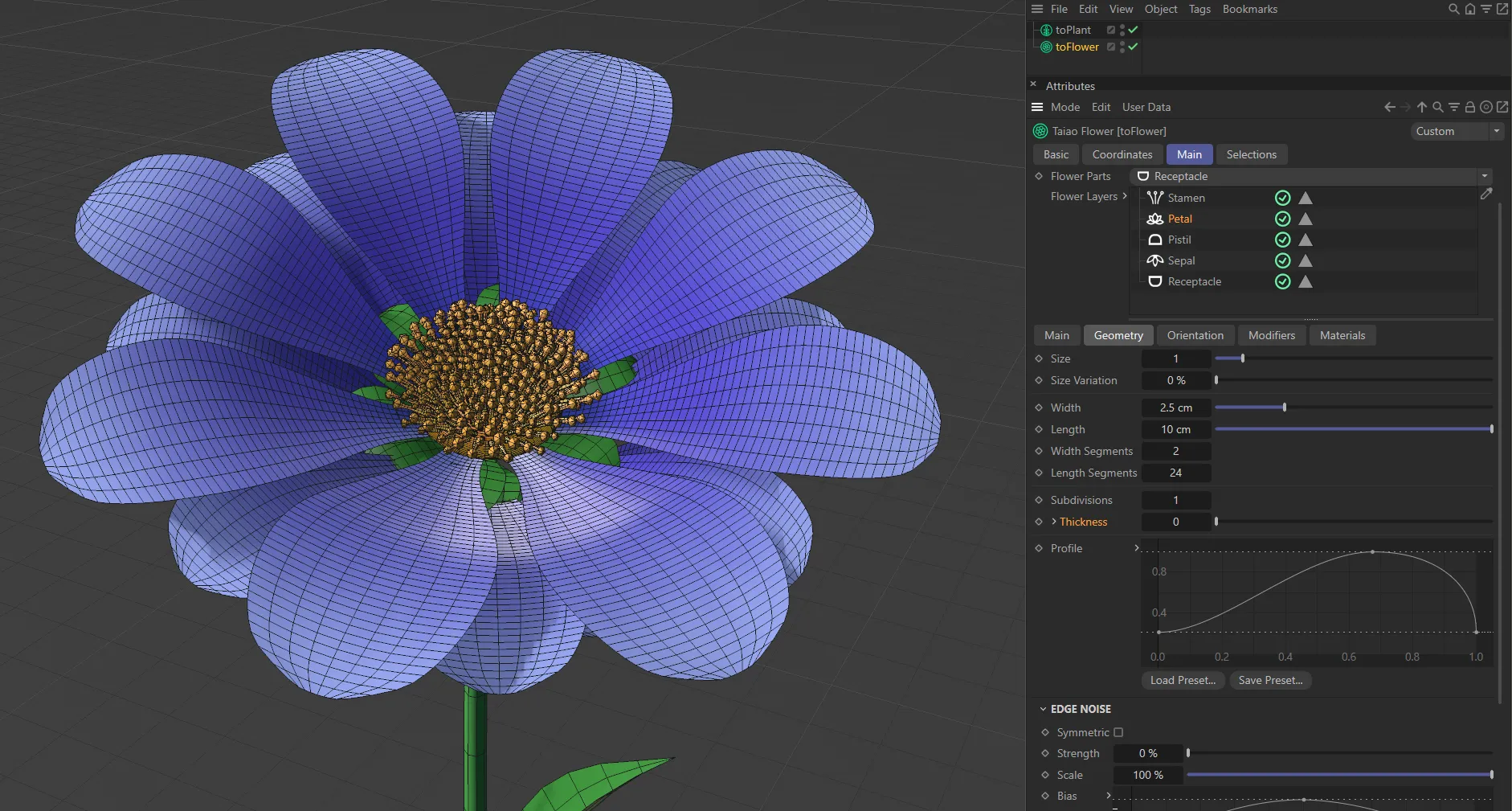
There is no (zero) Thickness set here.
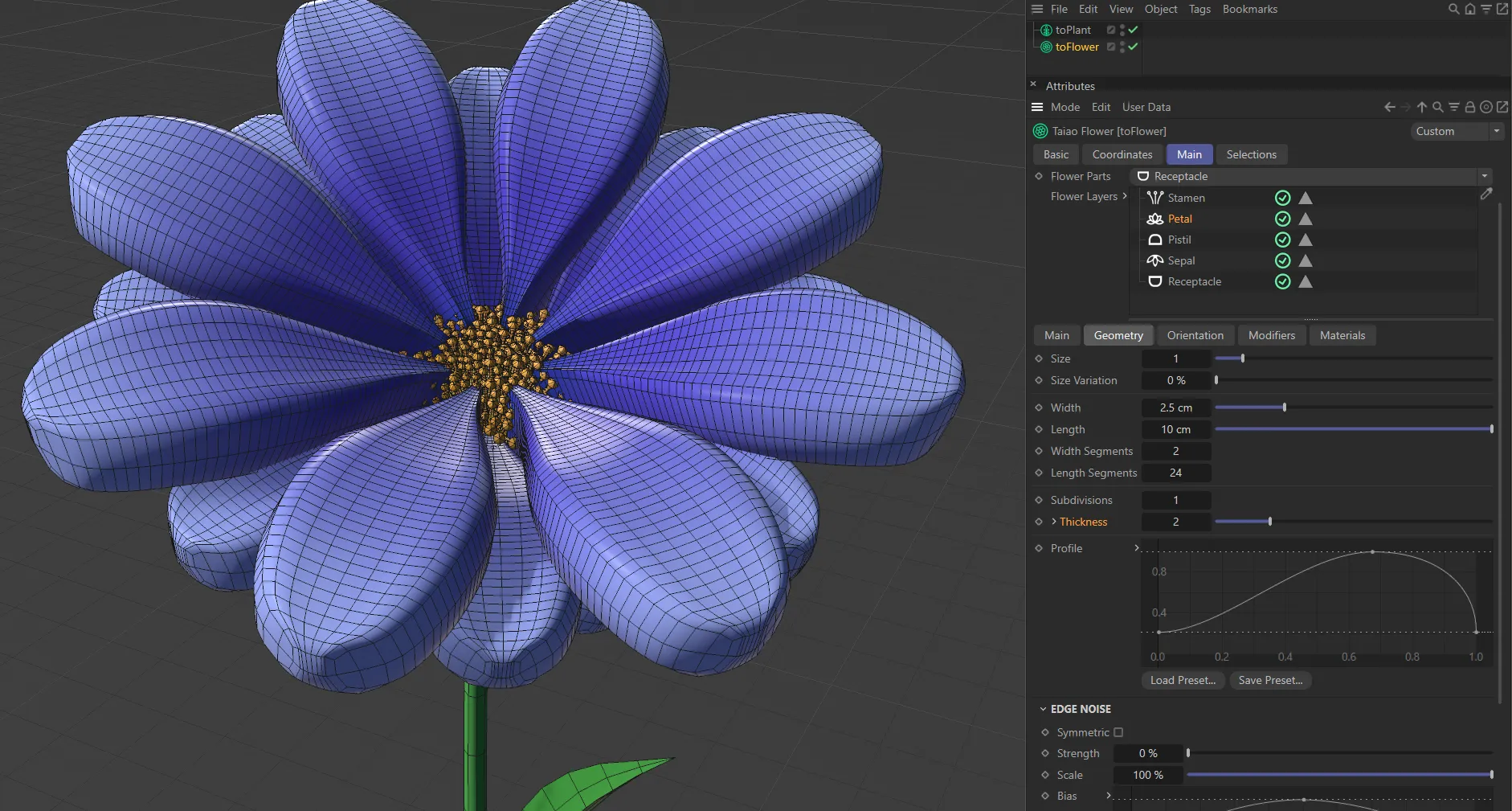
Thickness value of 2.
Symmetric
Section titled “Symmetric”Enabling this will apply a symmetry to the Thickness settings across the Petal layer.
You can shape the Depth profile to meet your needs and, similarly, you can use Load Preset to call up earlier saved designs and Save Preset to save any new petal creations.
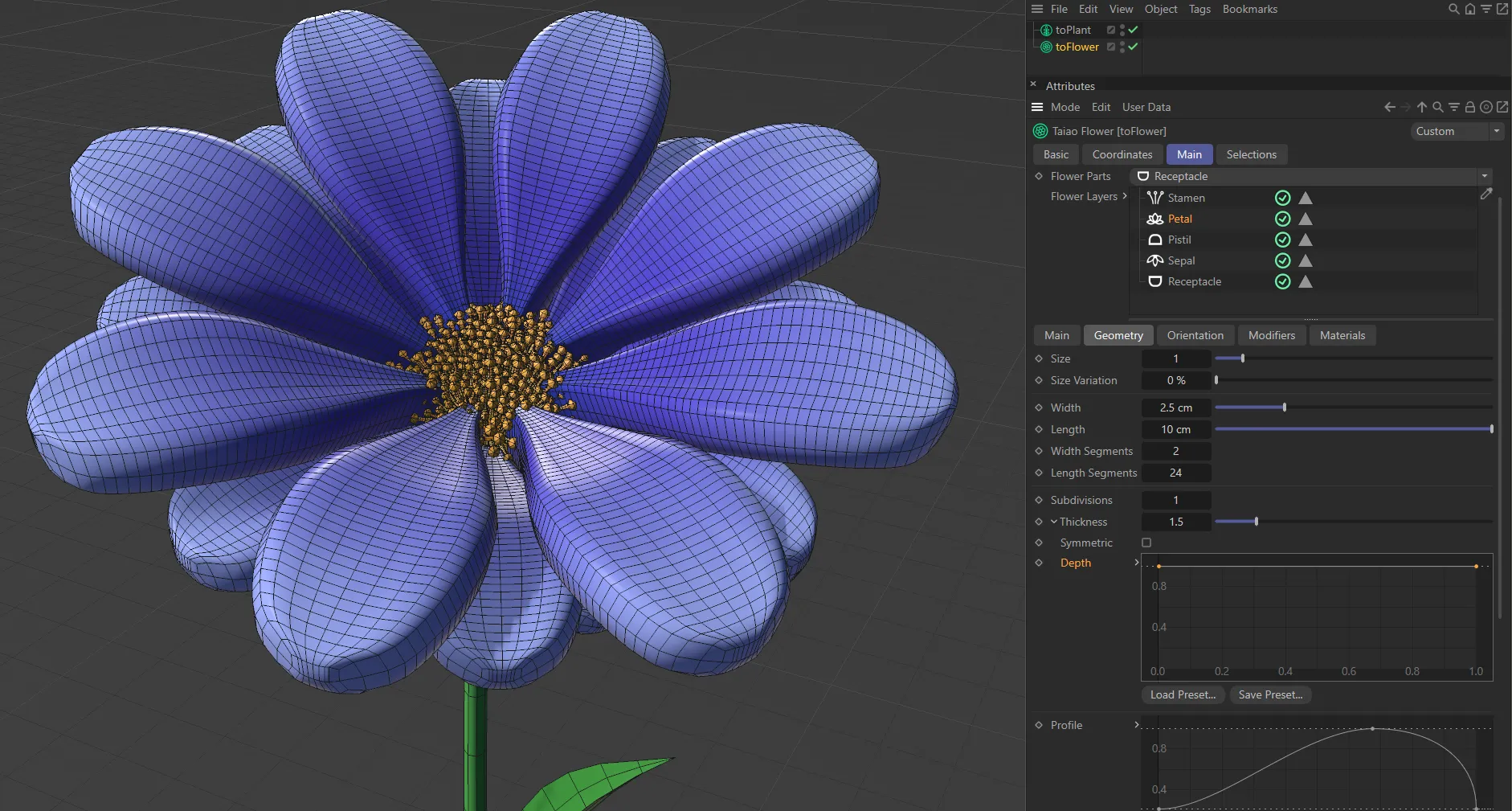
Petal depths can be driven by the Depth spline curves; here it is at full strength, driven by the Thickness setting.
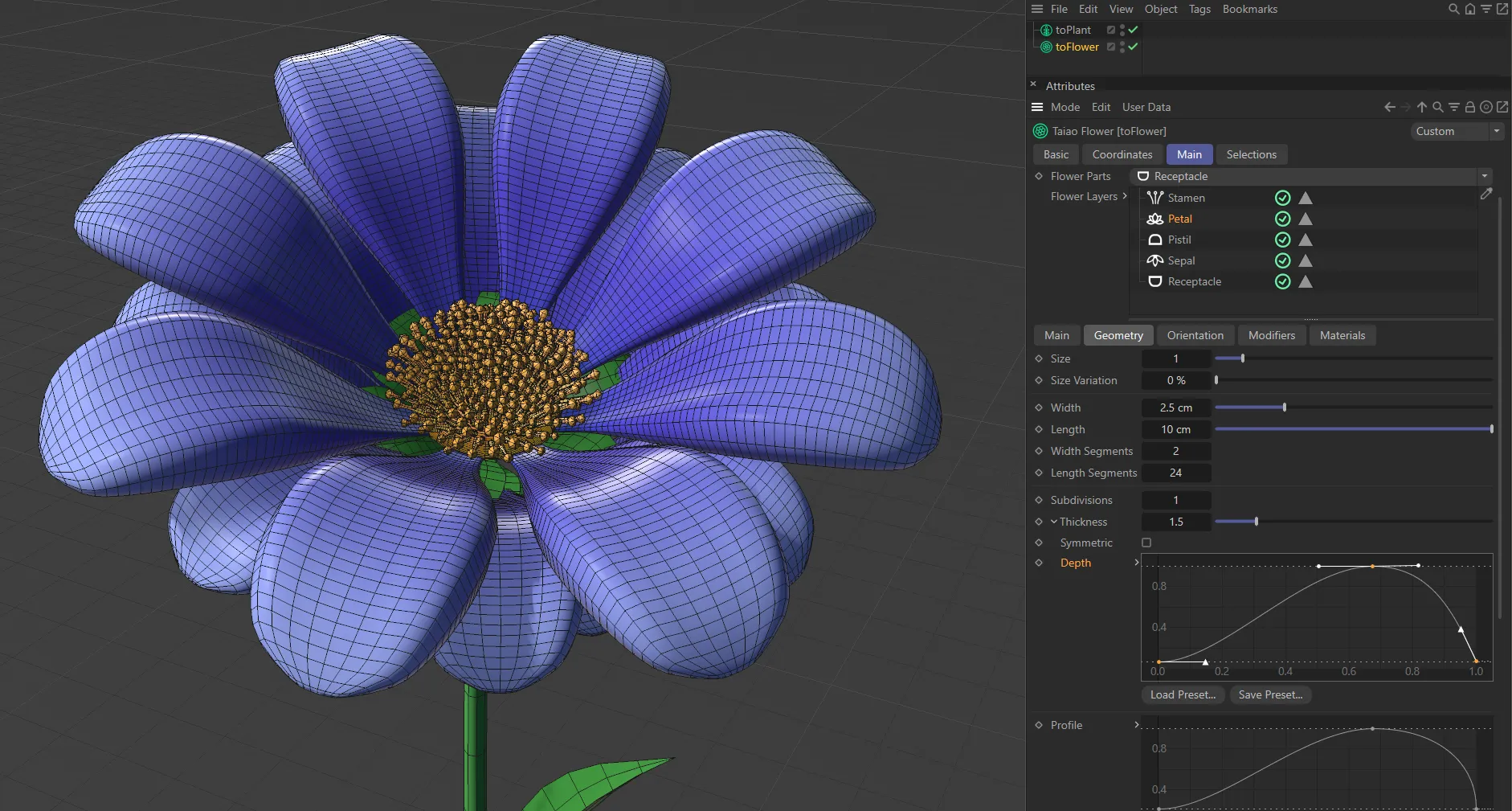
With the Depth spline shaped, as it is here, the thickness mimics the profile of the spline.
Profile
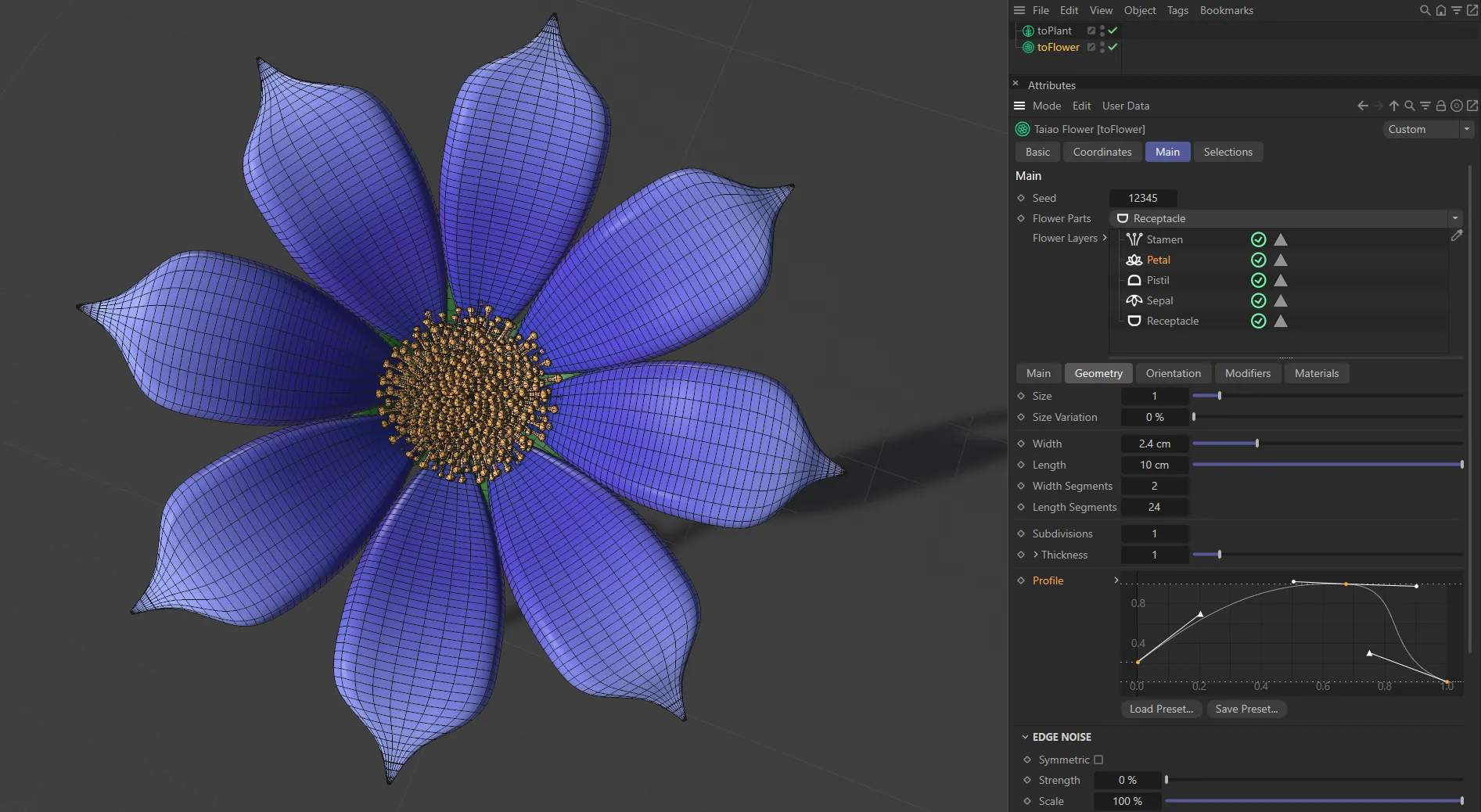
Section titled “Profile”The default setting can be adjusted to personalize your petals.
This profile can then be saved in Save Preset, or you can load a previously created design from Load Preset.
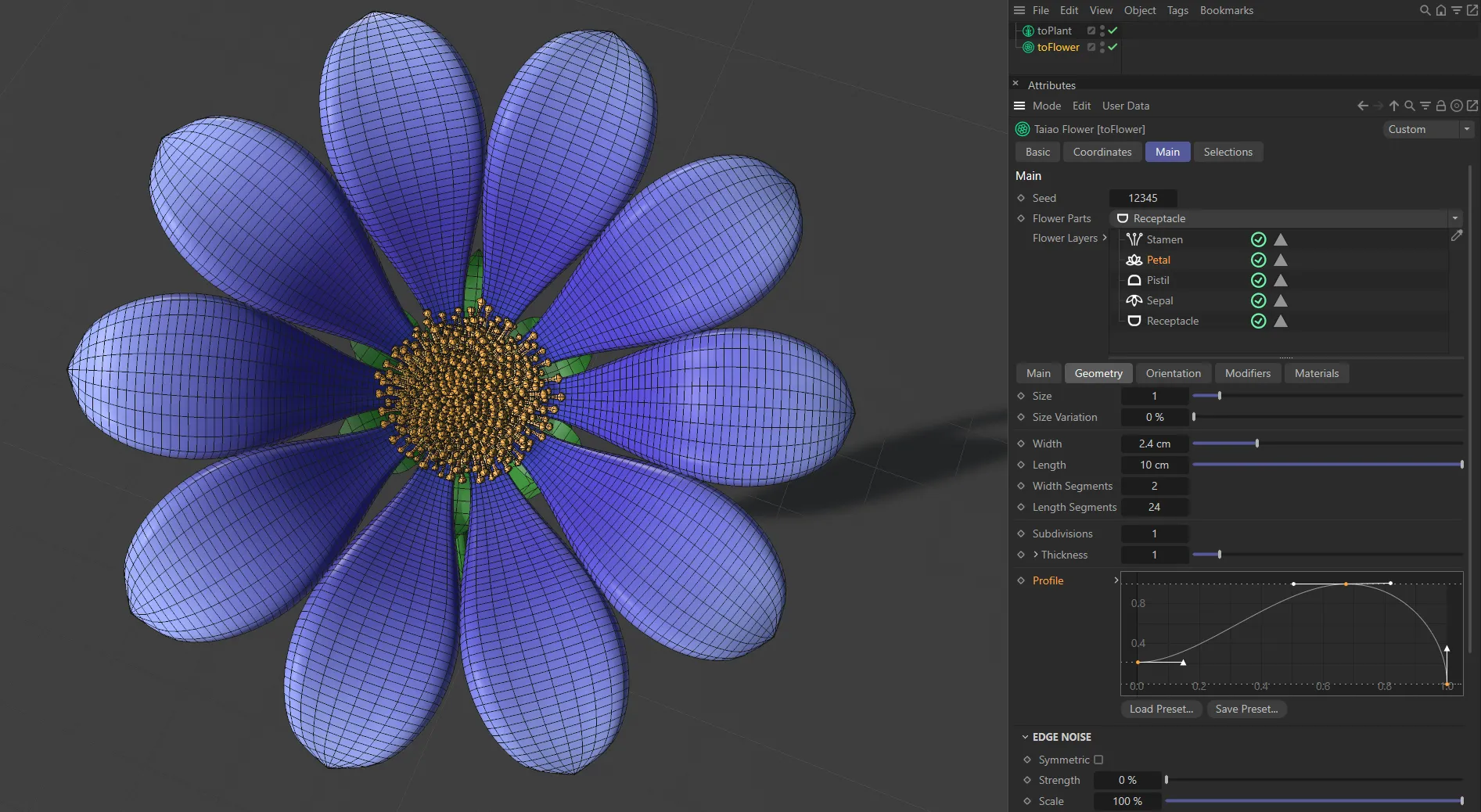
Two different Profile splines are shown here, in the two images (left and right) with the resulting petal shapes.
Edge Noise
Section titled “Edge Noise”Symmetric
Section titled “Symmetric”Enabling this parameter will apply symmetry to the edge noise across the Petal layer.
Strength
Section titled “Strength”Controls the amount of noise along the edges of the petals.
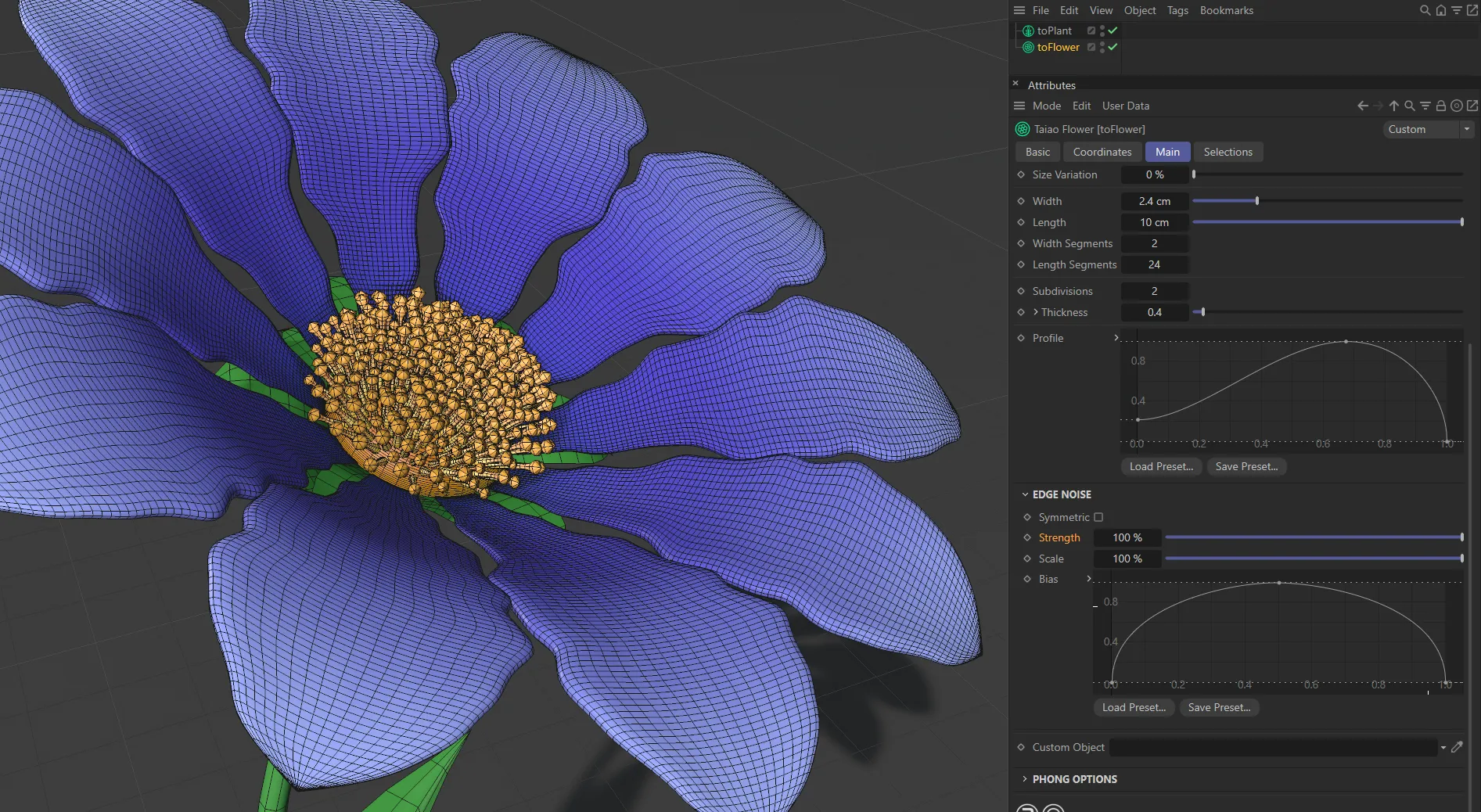
The Strength setting is at 100%, giving maximum noise along the edges of the petals.
Applies the usual scale control to the noise setting.
Allows you to further control where, on the petals, the noise is targeted.
Custom Object
Section titled “Custom Object”You can import custom objects by simply dragging them into the Custom Object link field and then alter the different settings, as desired.
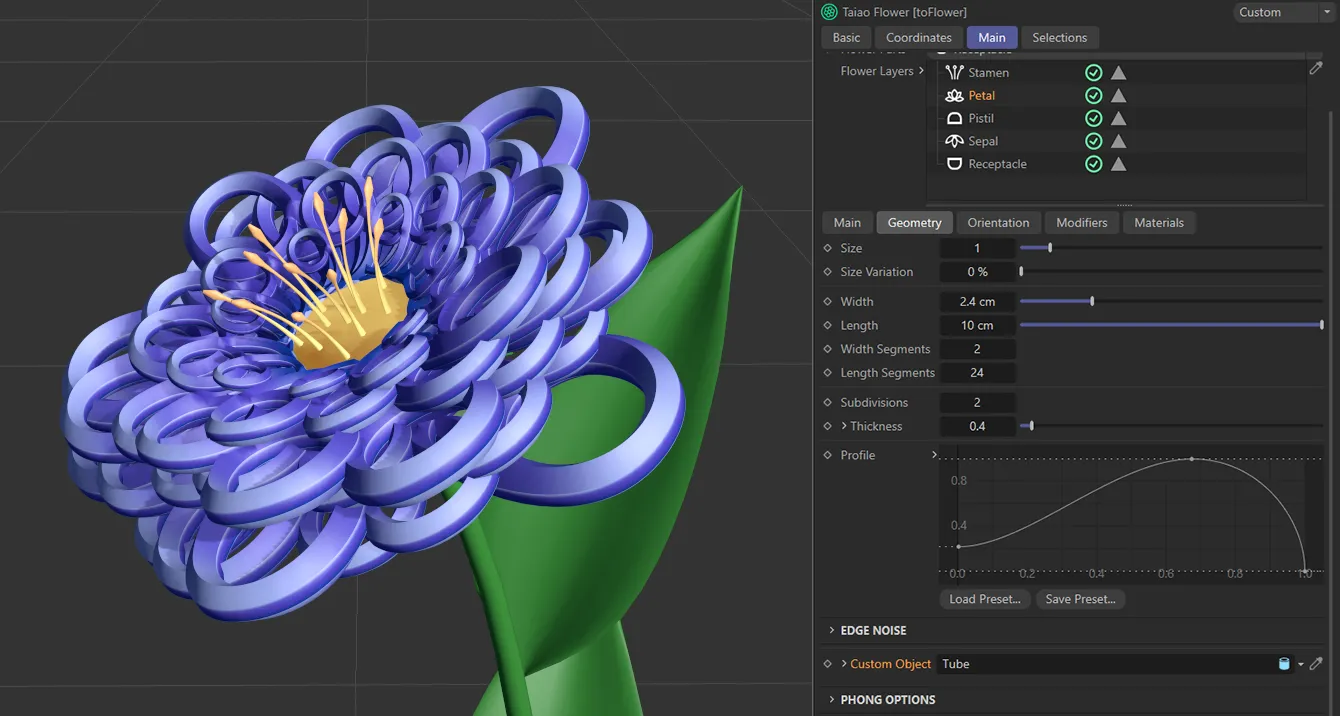
In this image, petals are being replaced by a 3D text (number 9) as a Custom Object.
Orientation tab
Section titled “Orientation tab”You can angle the petals up, or down, using this Angle slider.
Clicking on the drop-down arrow will reveal an Bias curve.
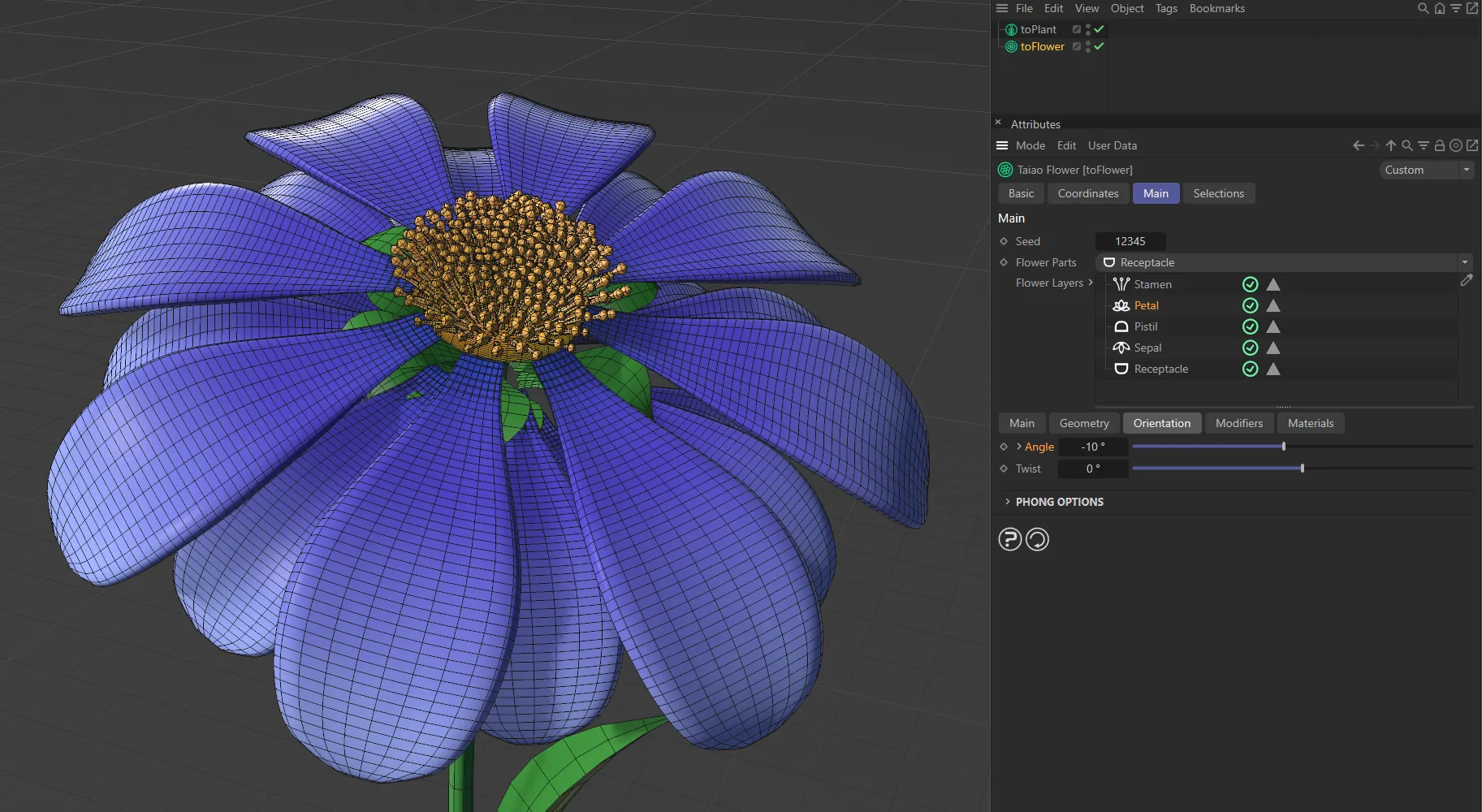
Angle of the petals is (negative) -10 degrees, folding the petals back.
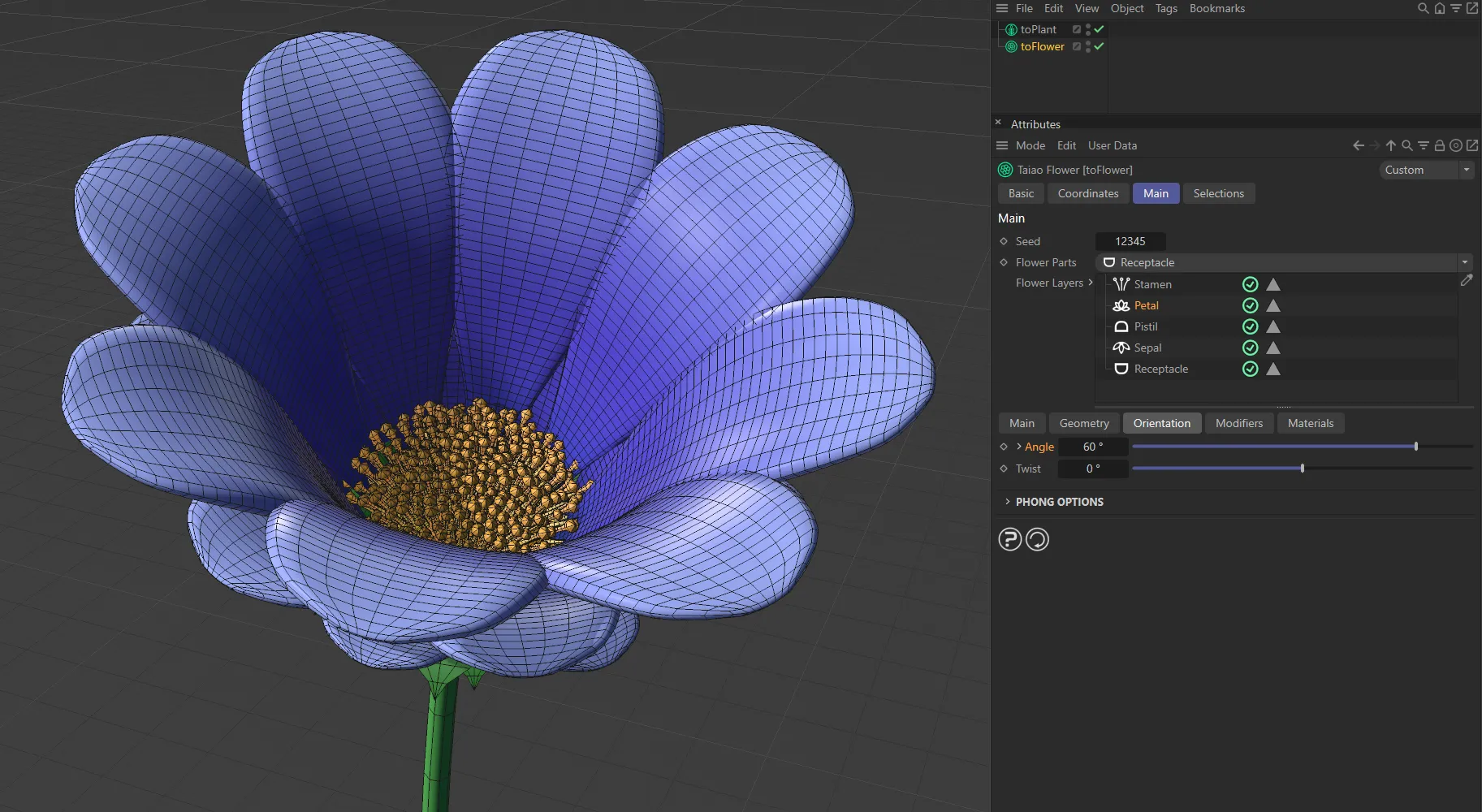
Angle at 60 degrees.
The X-axis represents the different layers and the Y-axis is the strength of the angles up to the degree set in the Angle parameter, above.
By manipulating this spline you can set different layers at different angles, to create a more natural, realistic look.
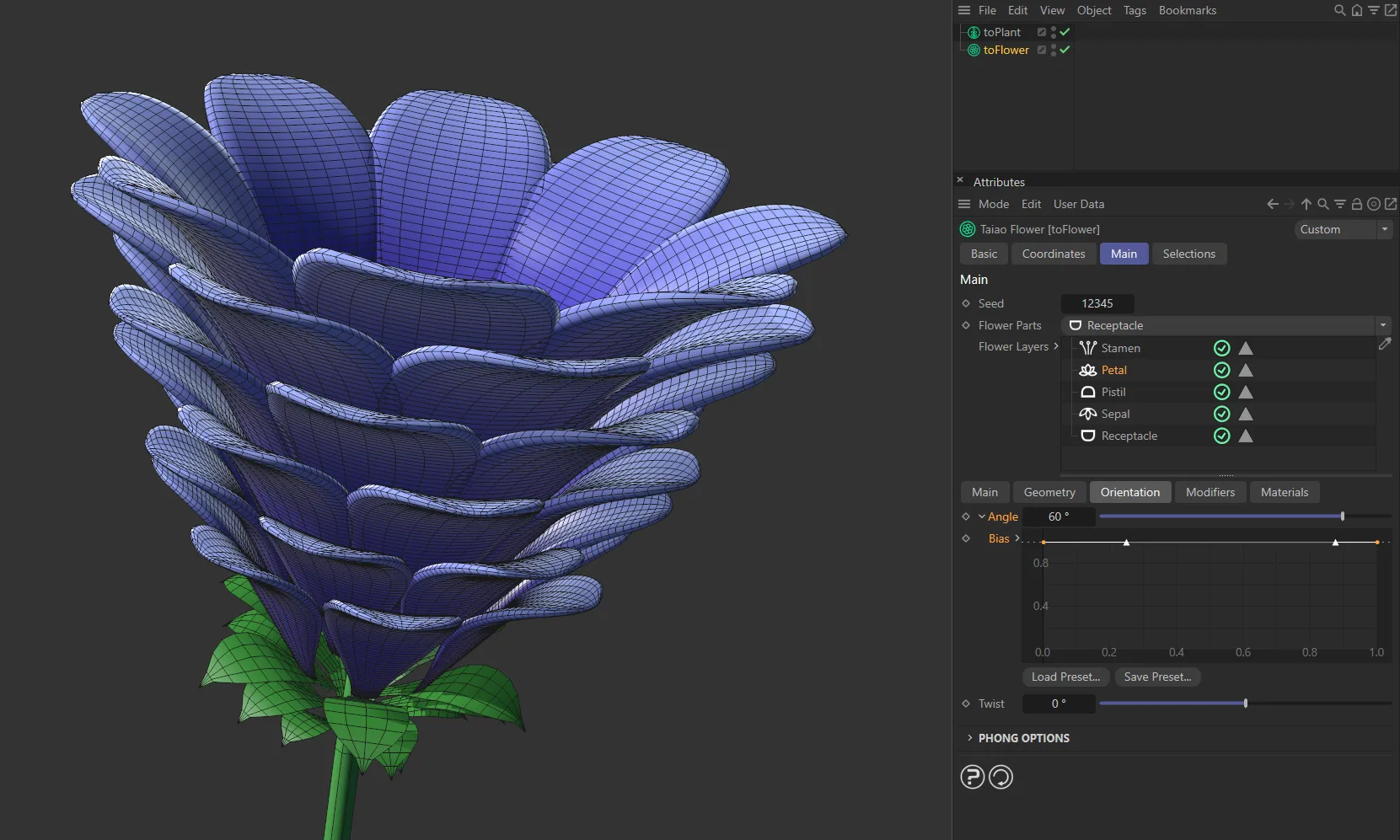
With the Bias curve at full strength, all petals have the same angle.
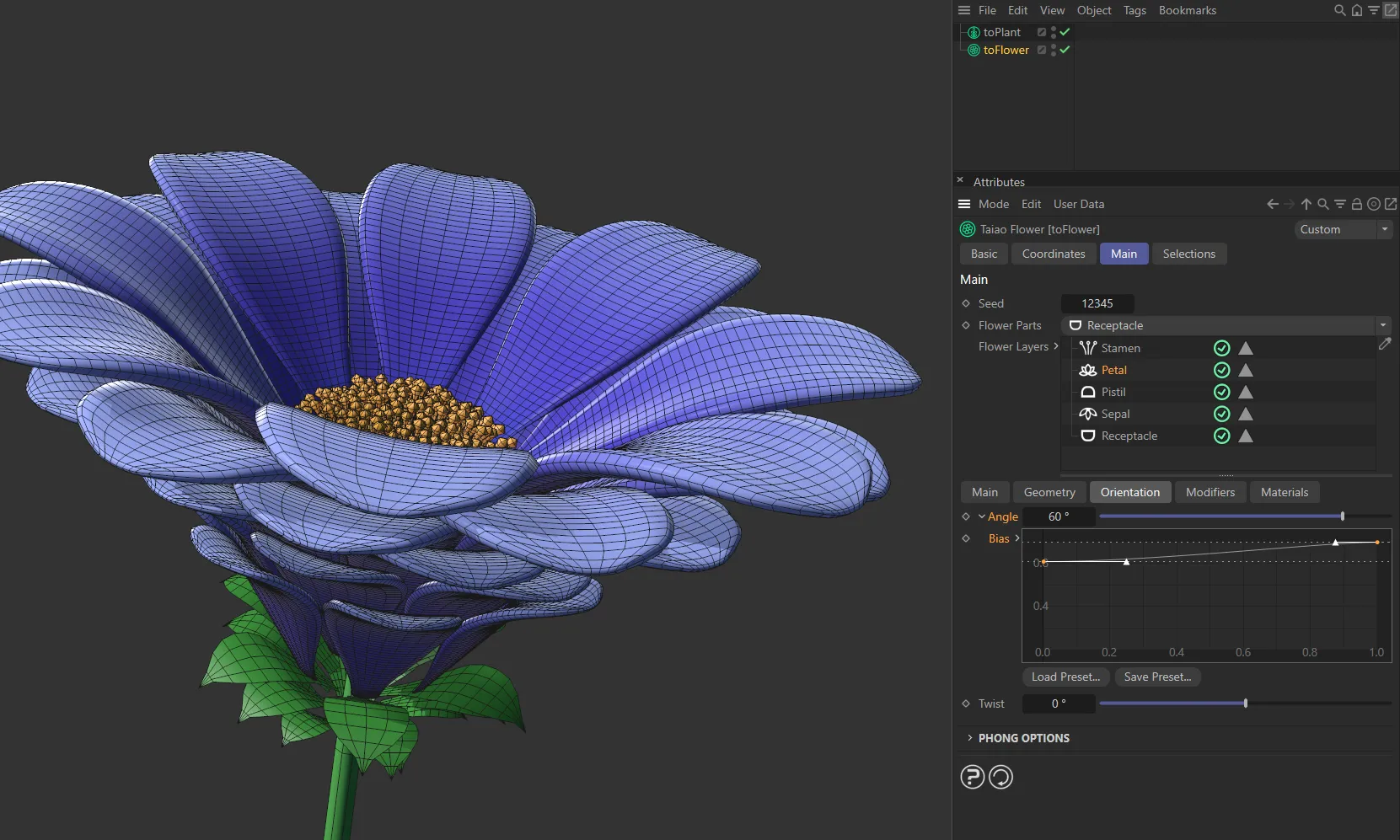
This Bias spline is shaped, resulting in less of an angle for the first layers.
This setting will twist the petals by a set degree.
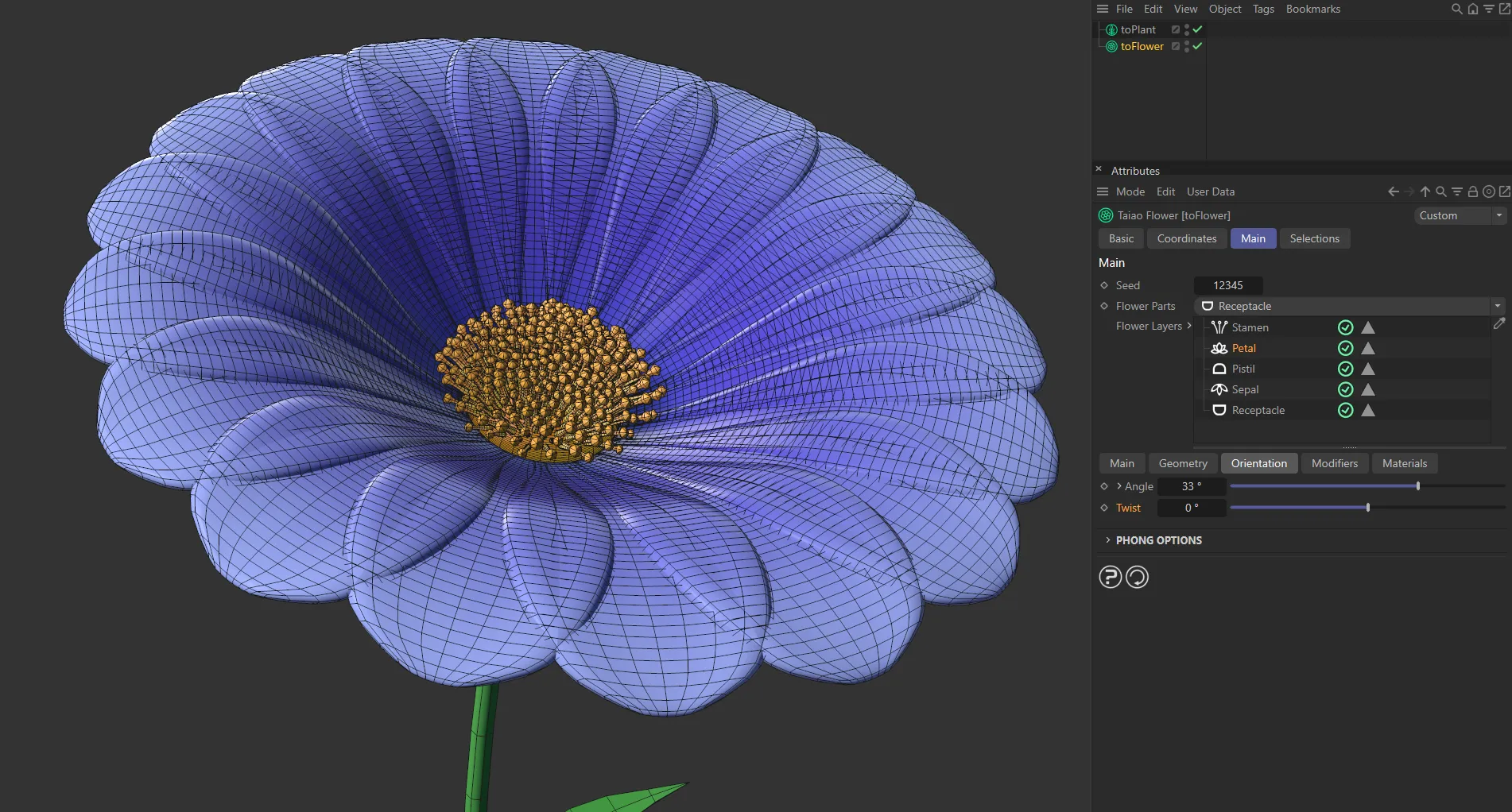
With the Twist setting at 0 (zero) degrees, the crowded petals are intersecting.
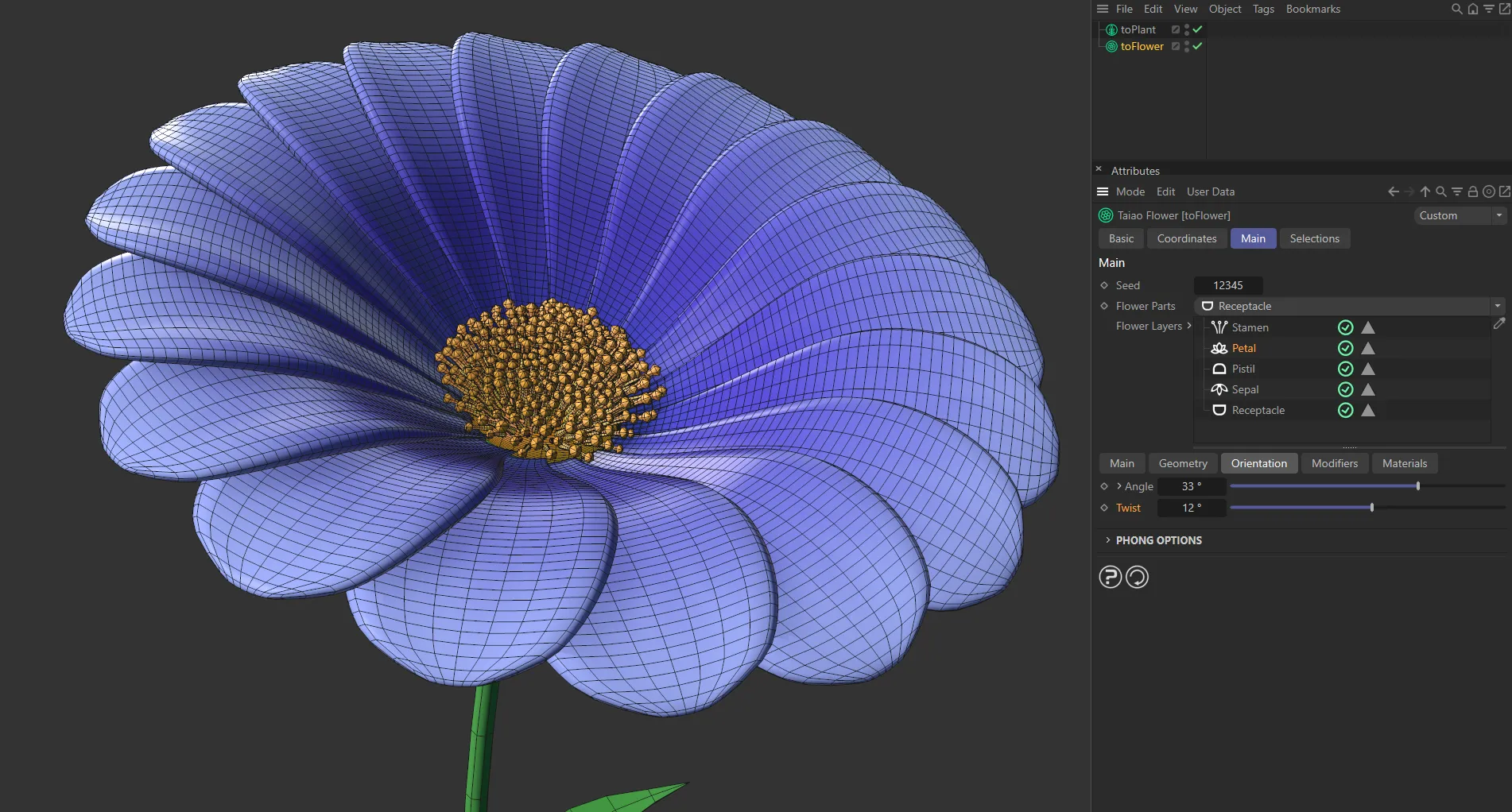
In this second image, 12 degrees of Twist, lifts the petals at one side, to overlap.
Modifiers tab
Section titled “Modifiers tab”These settings give you the ability to deform and twist your petals.
Modifier
Section titled “Modifier”The available Modifier types are: Fold, Furling, Turbulence, Deform and Displacer.
Each comes with its own parameter settings.
Modifier Stack
Section titled “Modifier Stack”The hierarchical list of modifiers affecting your plant layer.
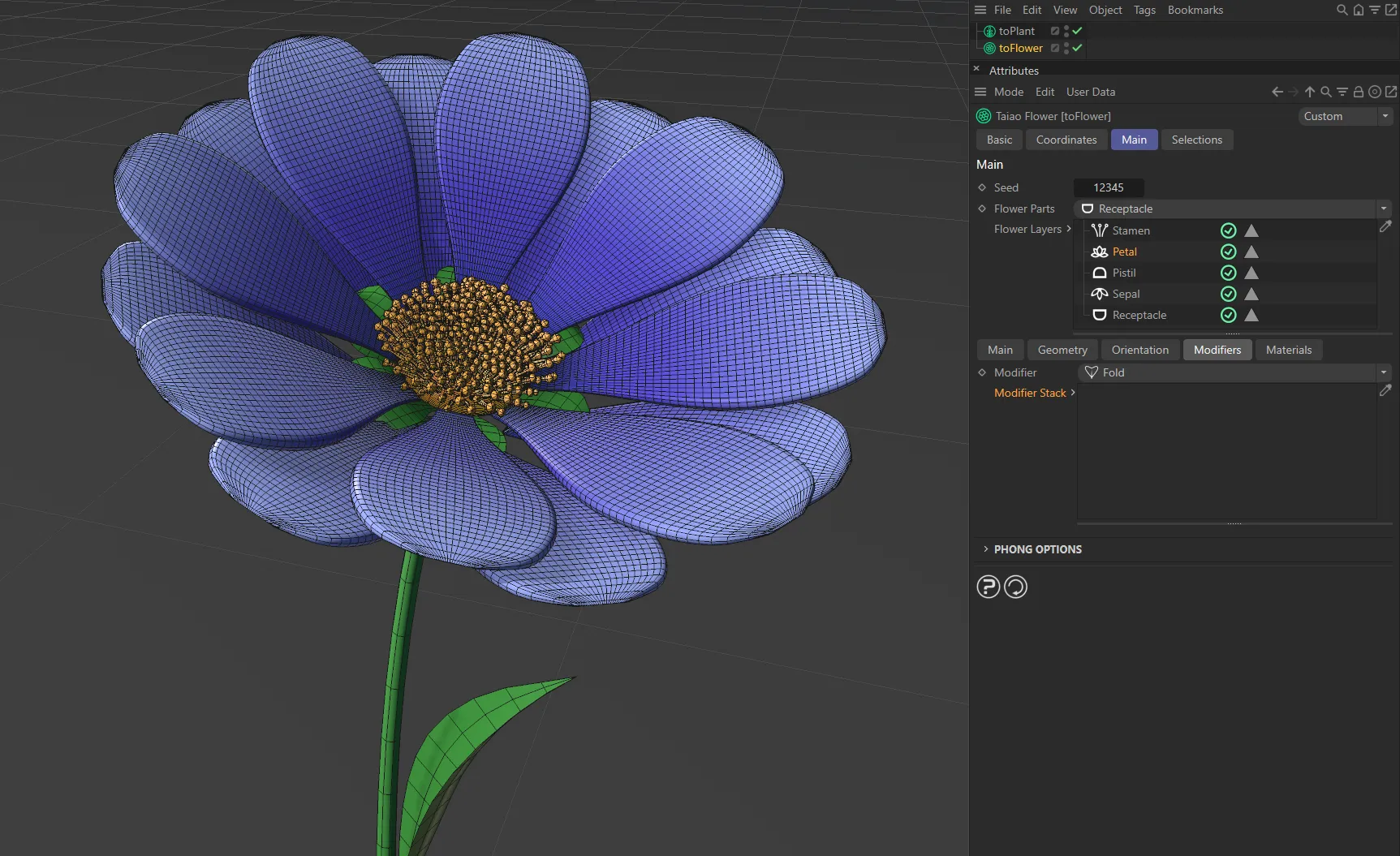
In this first image, there are no modifiers in the Modifier Stack, so none are active.
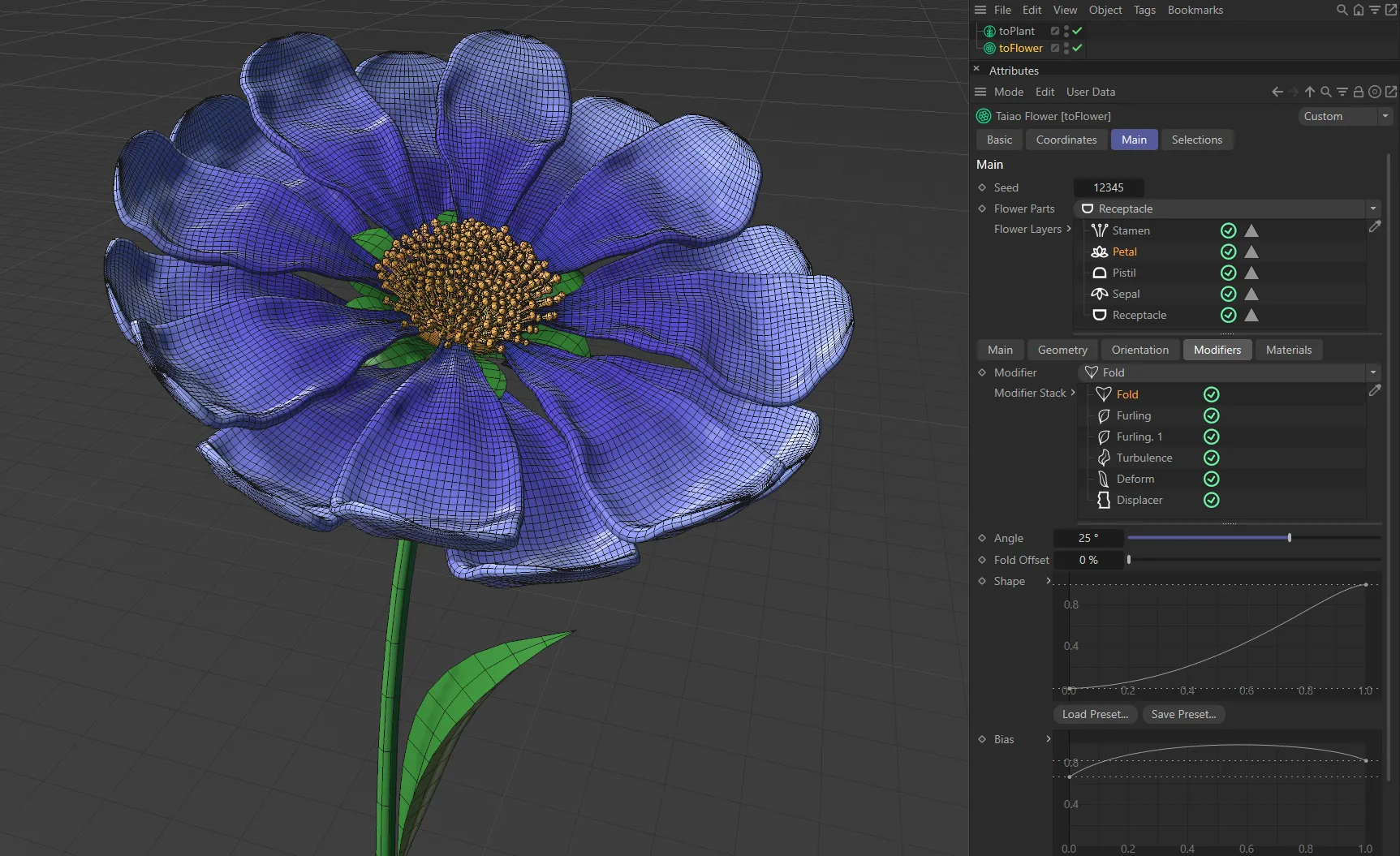
All five Modifier types are active in the Modifier Stack.
Fold modifier
Section titled “Fold modifier”Here, you can fold the petals upwards or downwards.
By default, this is set at 12 degrees but you can increase or decrease this.
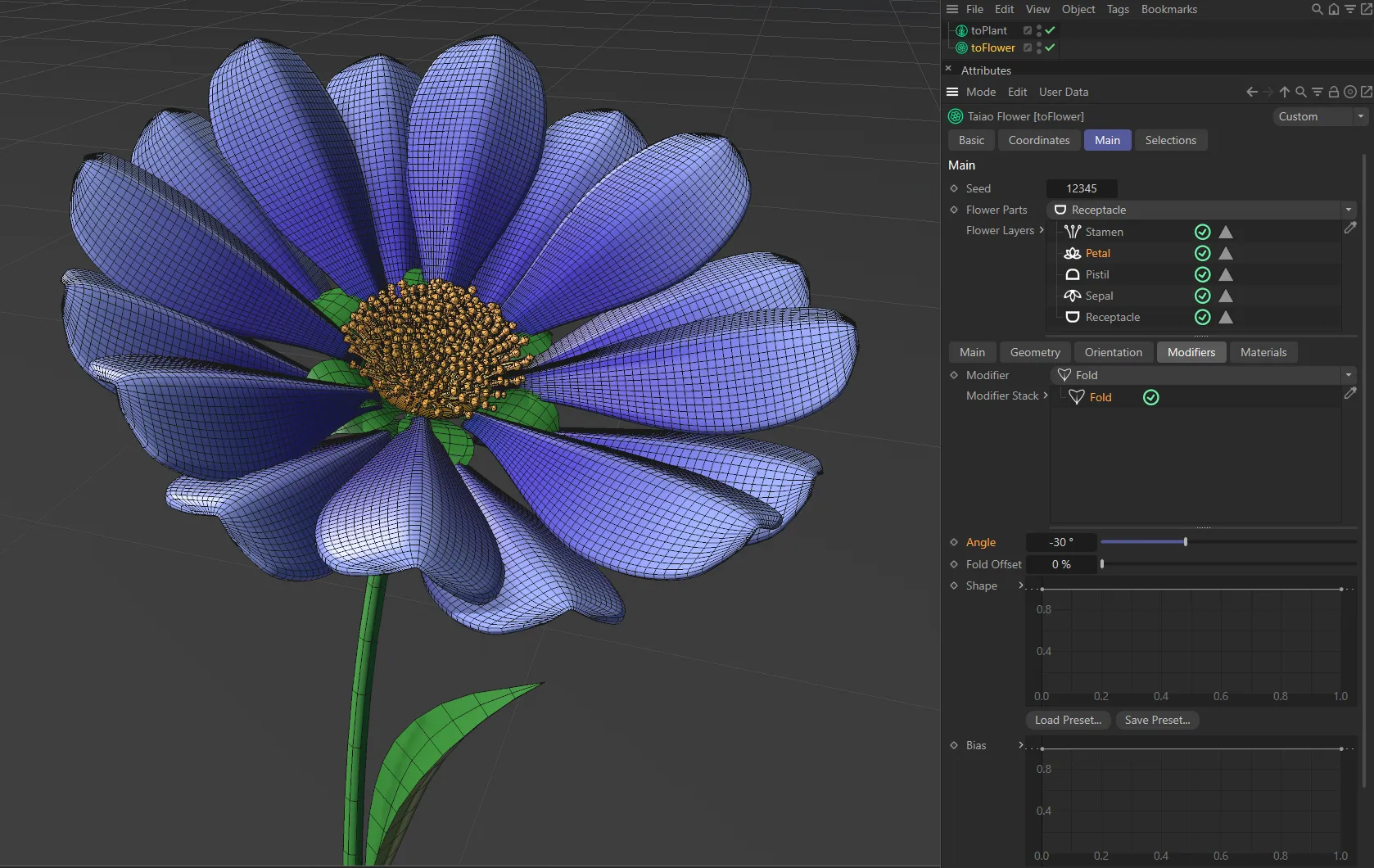
Here, the fold Angle is set at (negative) -30 degrees.
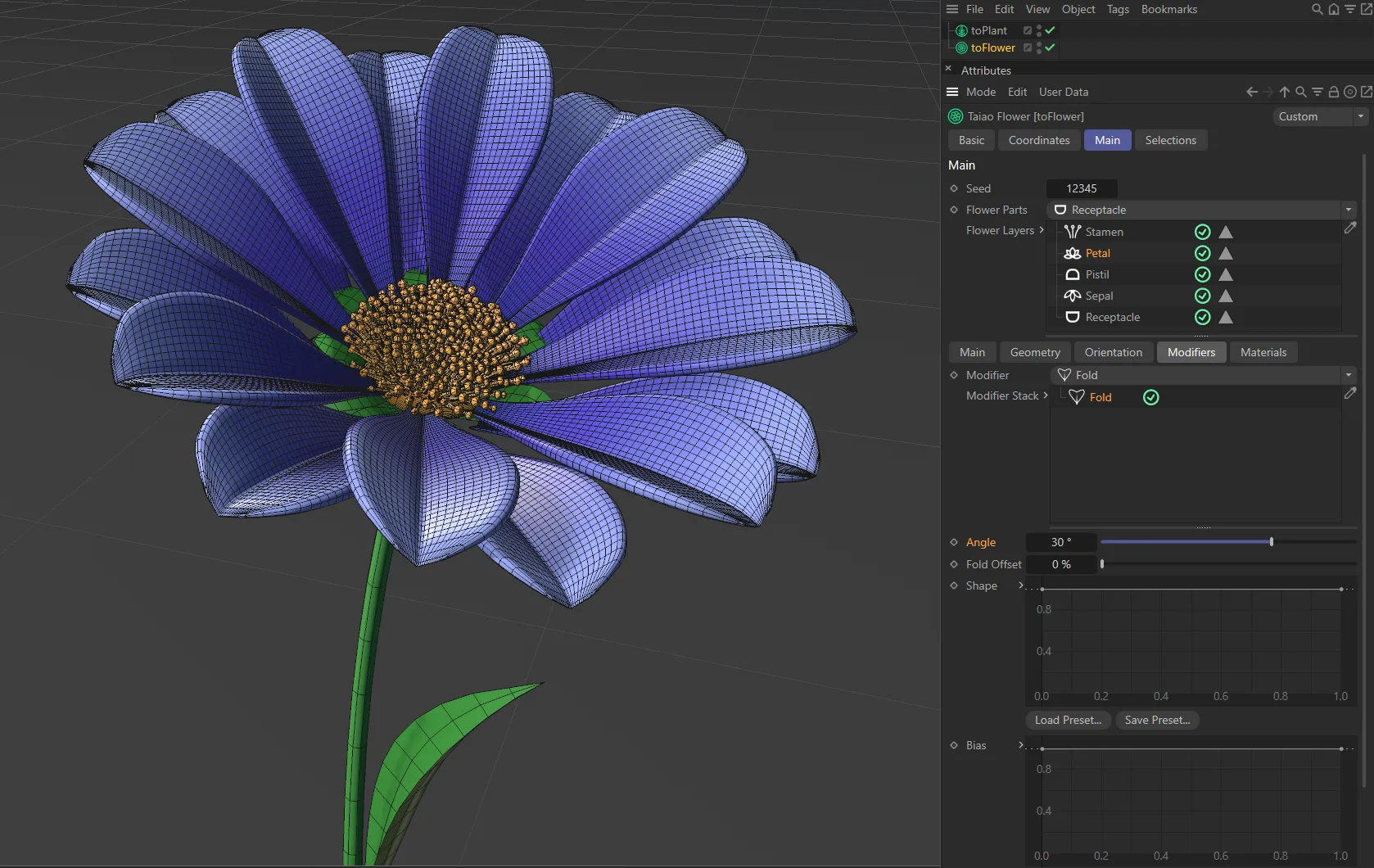
Angle at 30 degrees.
Fold Offset
Section titled “Fold Offset”Allows you to offset the fold by a percentage.
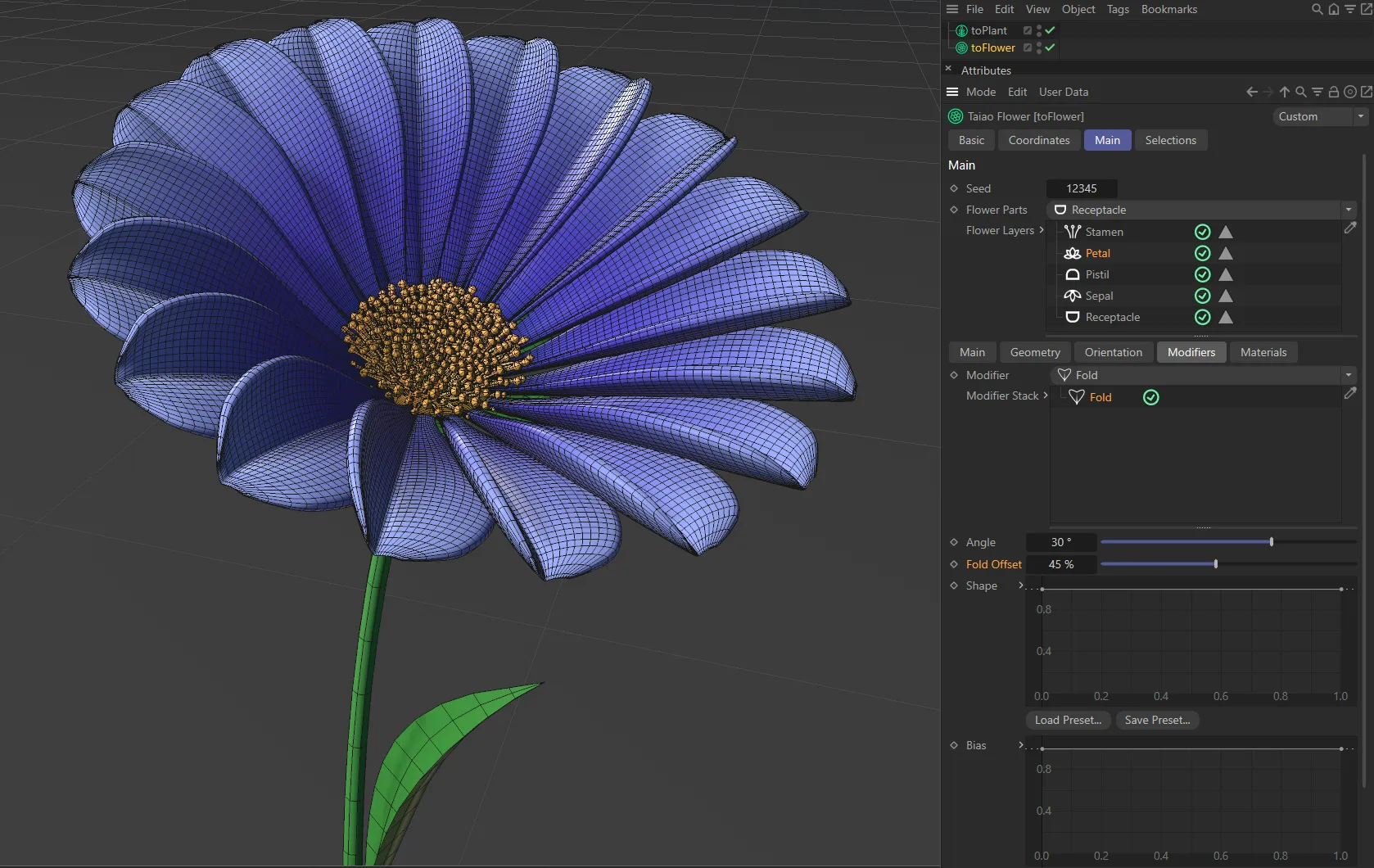
In this image, the Fold Offset is set at 45%.
This curve gives you extra control over where, on the petal, the folding is taking place.
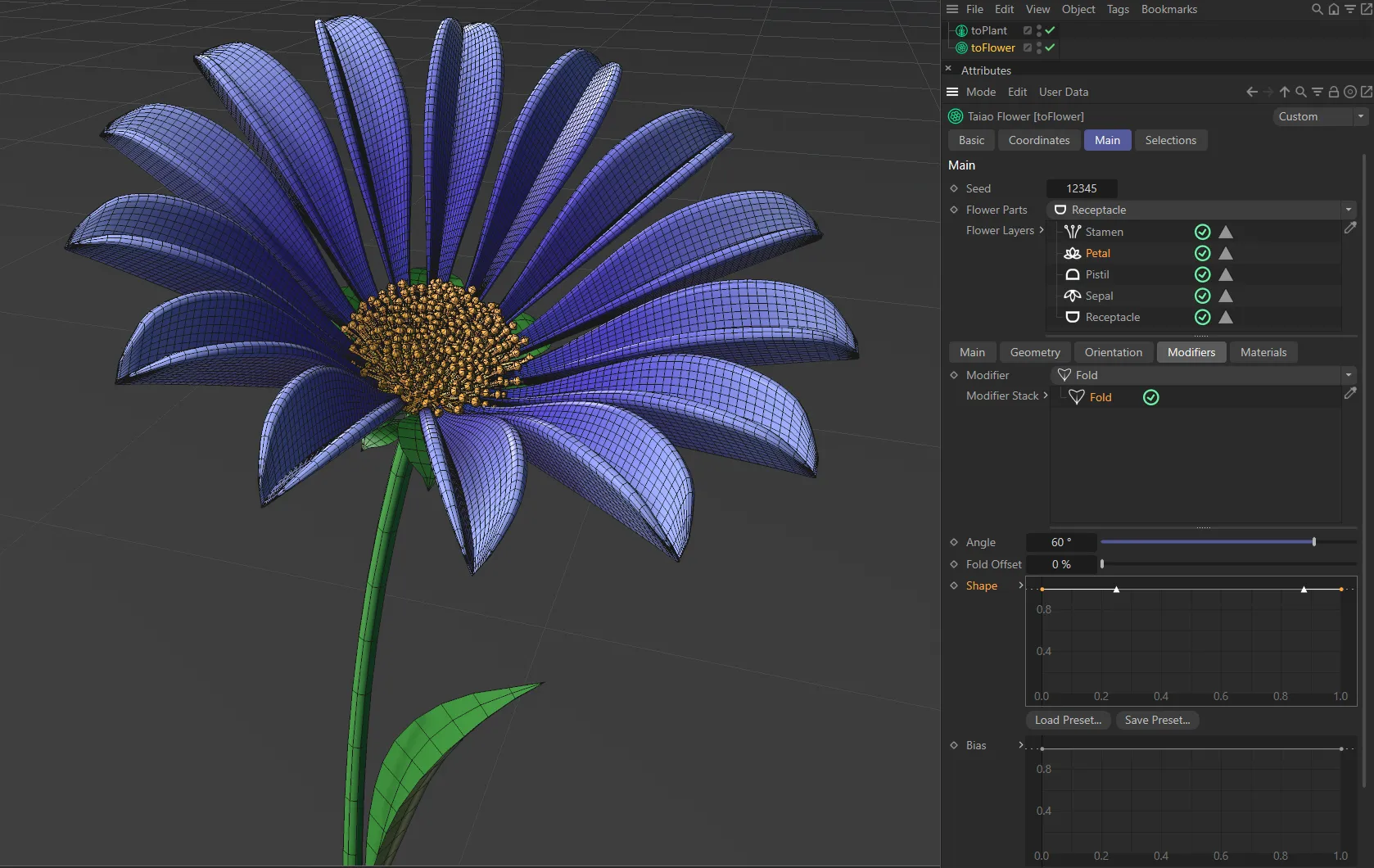
The fold Shape spline is at full strength, here, folding all petals to the full 60 degrees.
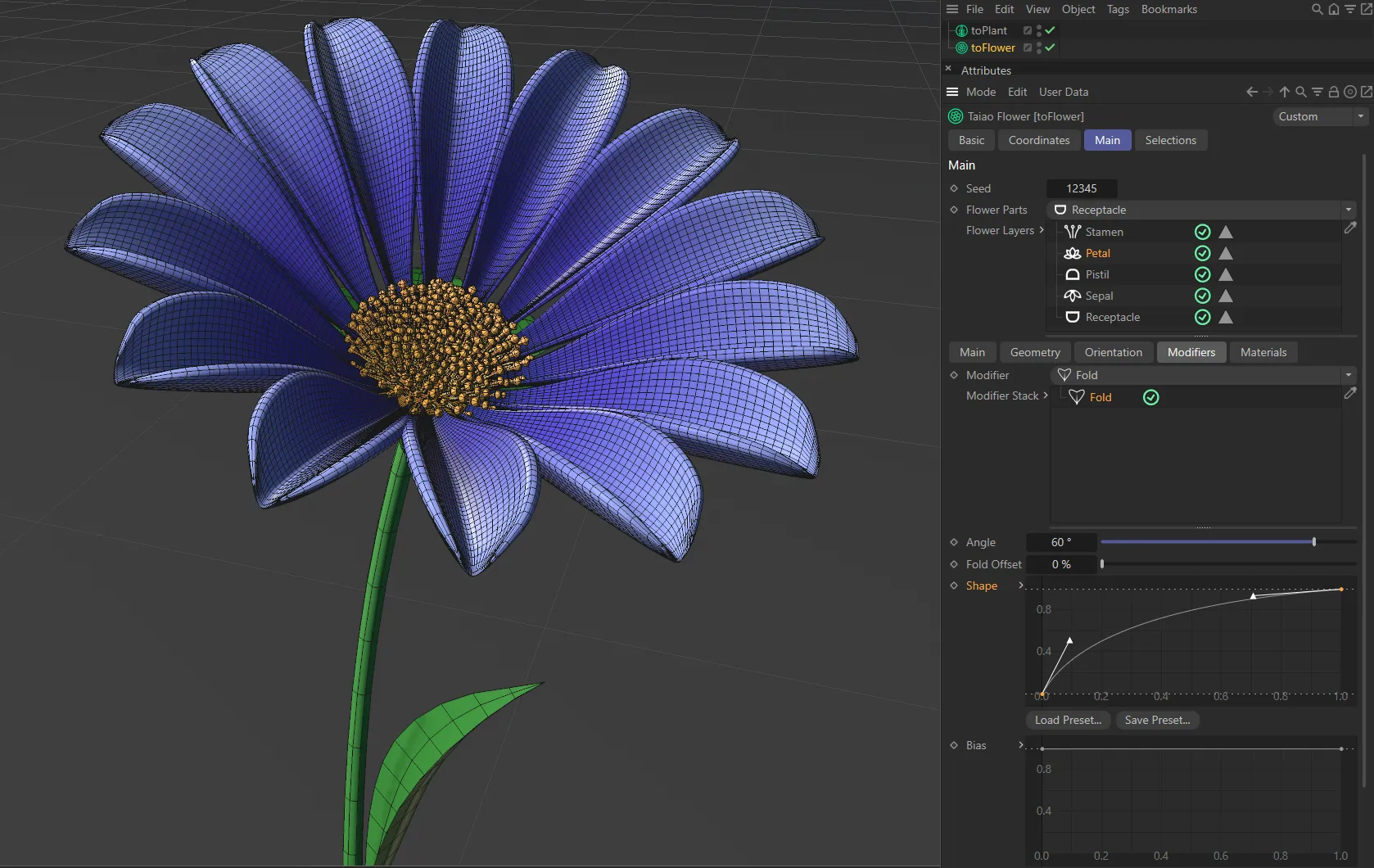
This rising linear spline Shape setting is the inverse of the final image.
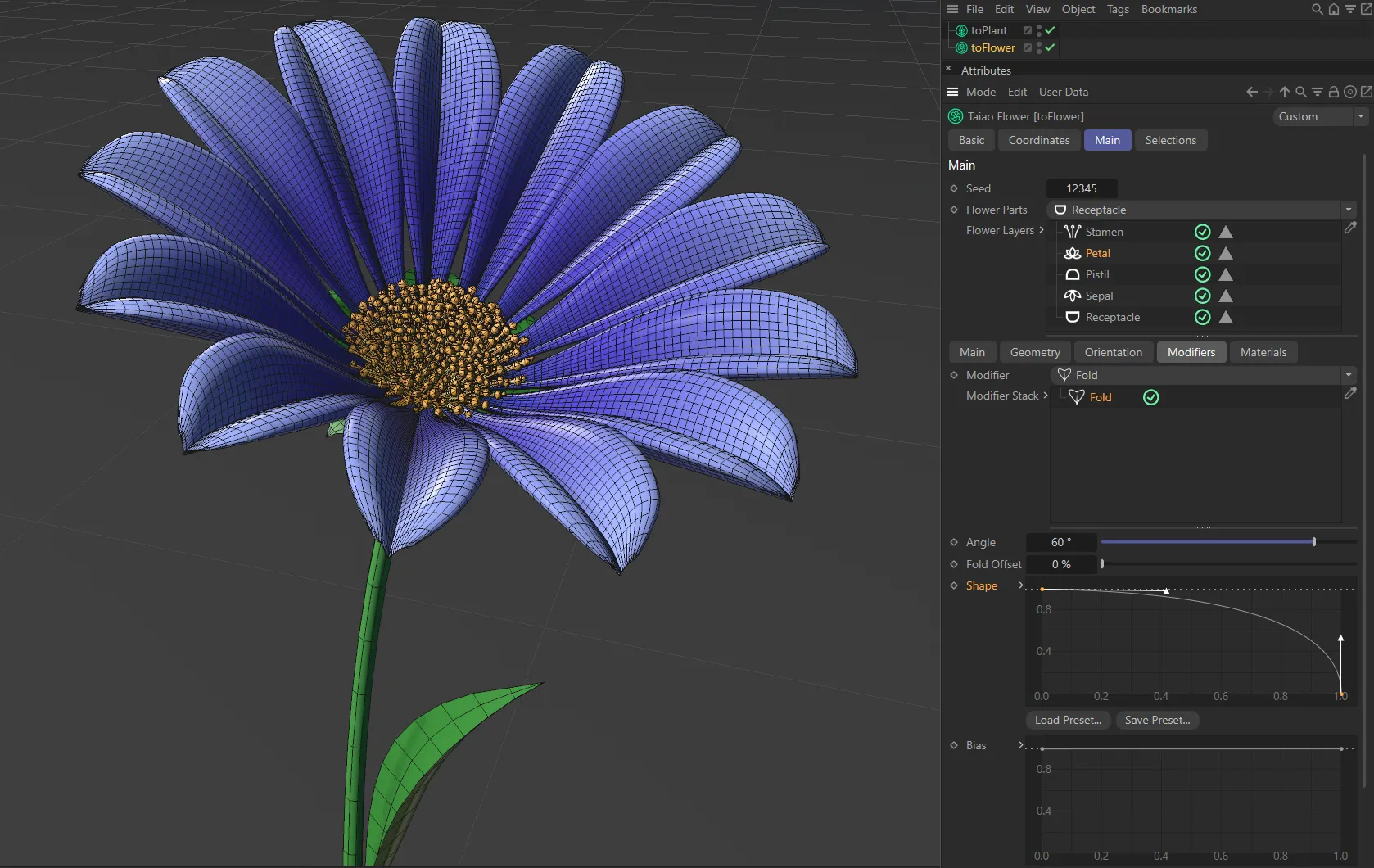
Falling linear spline Shape setting, driving the petal fold.
This controls the fold along the length of the petal.
At 50%, the folding will begin halfway along the petal.
Decreasing the percentage will start the folding from closer to the beginning of the petal and increasing it will move the folding towards the tips.
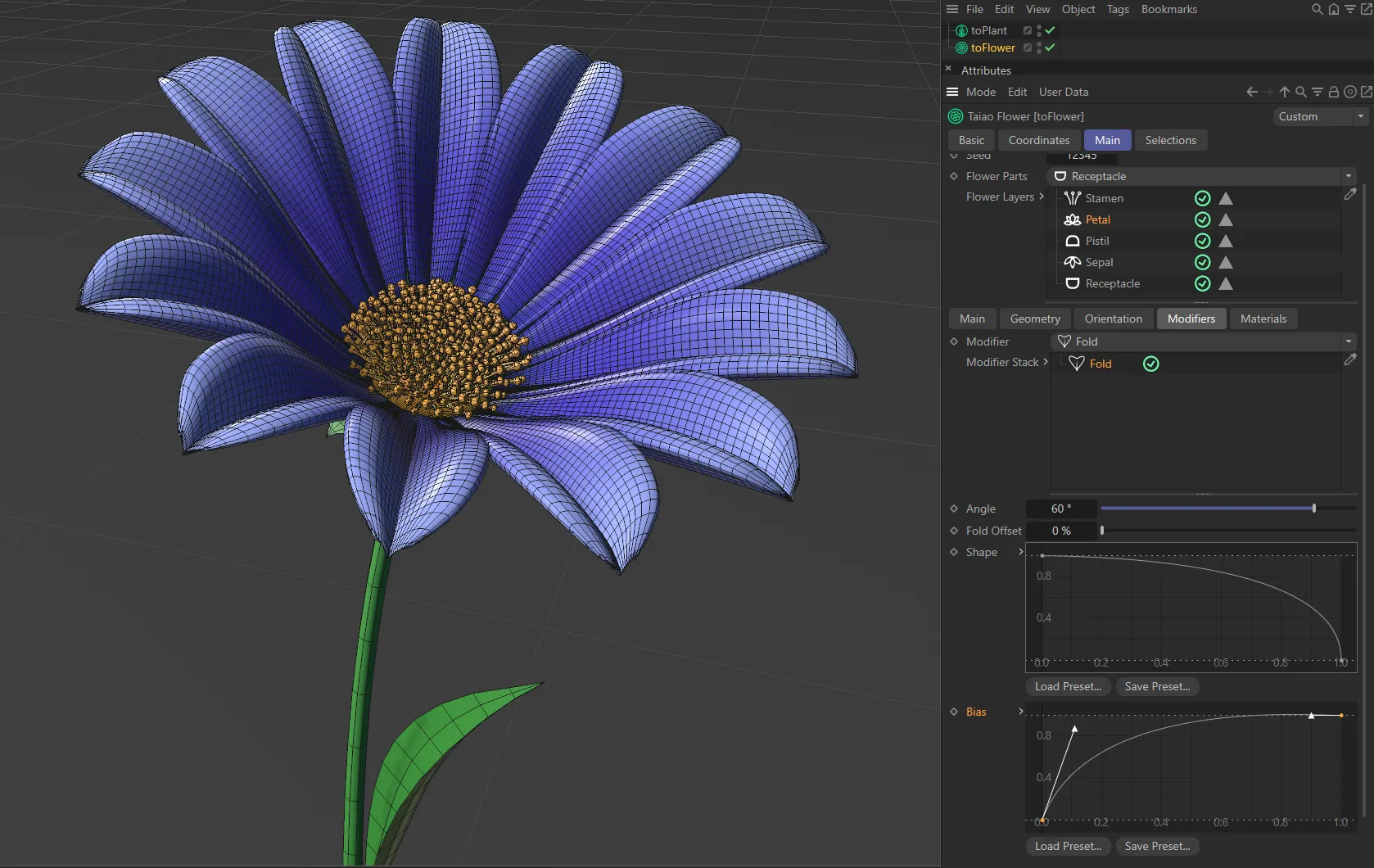
In this image, the rising Bias spline controls the furling angle of the petals, with more fold strength towards the edge.
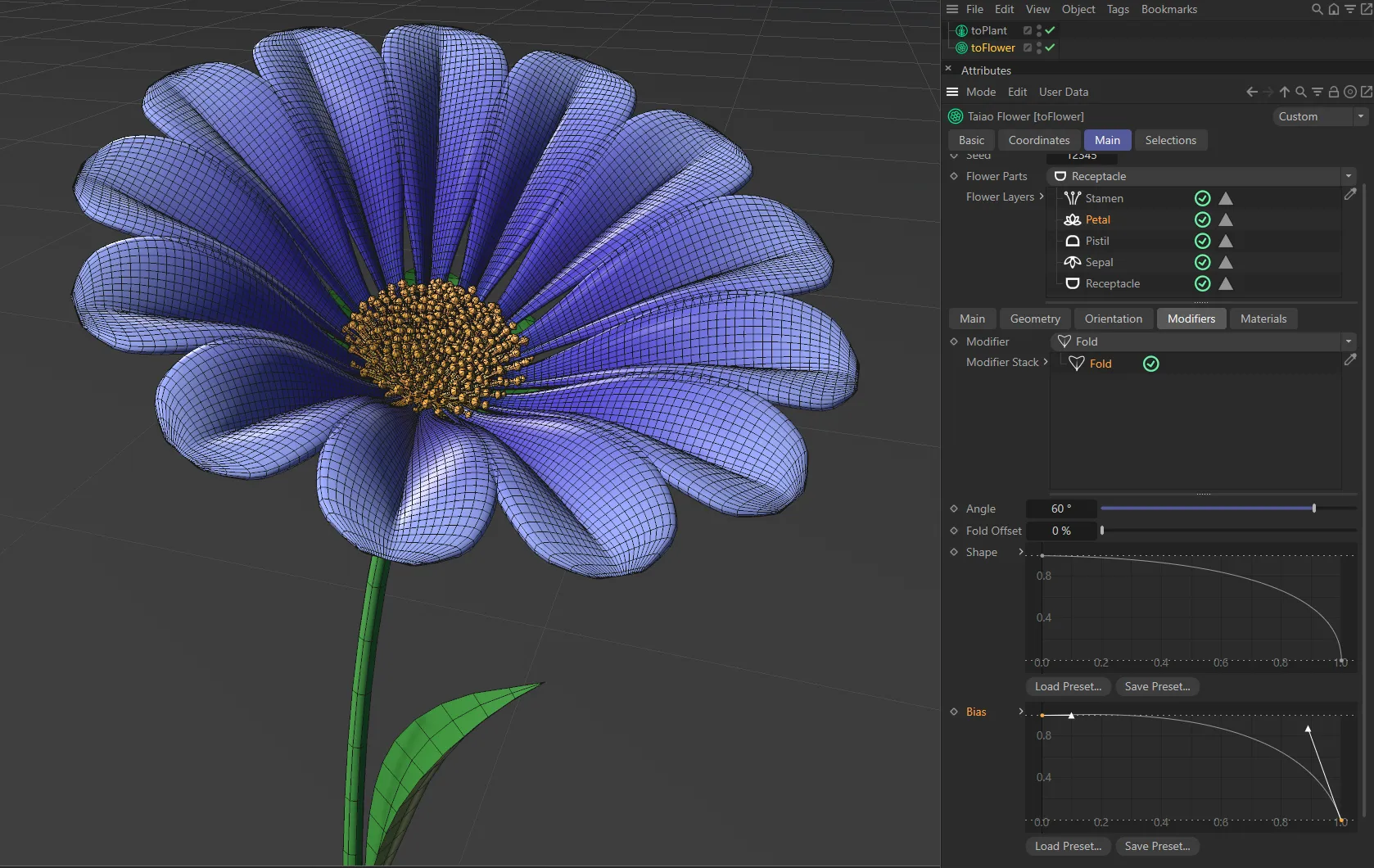
This is opposite, with a falling Bias spline curve, giving less fold strength towards the edge.
Furling modifier
Section titled “Furling modifier”The Furling settings mimic the natural curling that can occur in plants as they grow.
Increasing this slider will apply an angle in one direction and decreasing it will curl in the other.
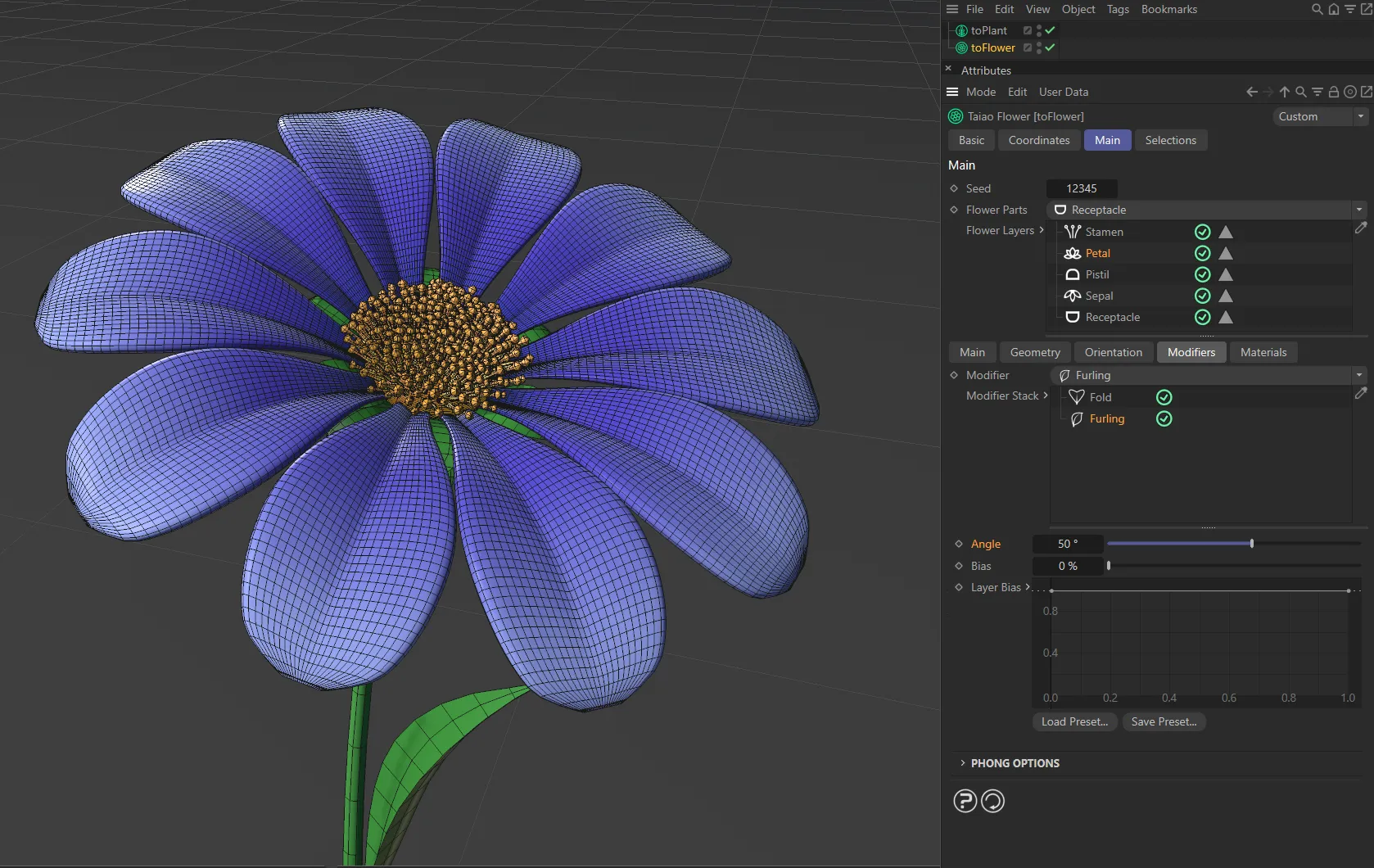
A (negative) -50 degree Angle, folding the petals backwards.
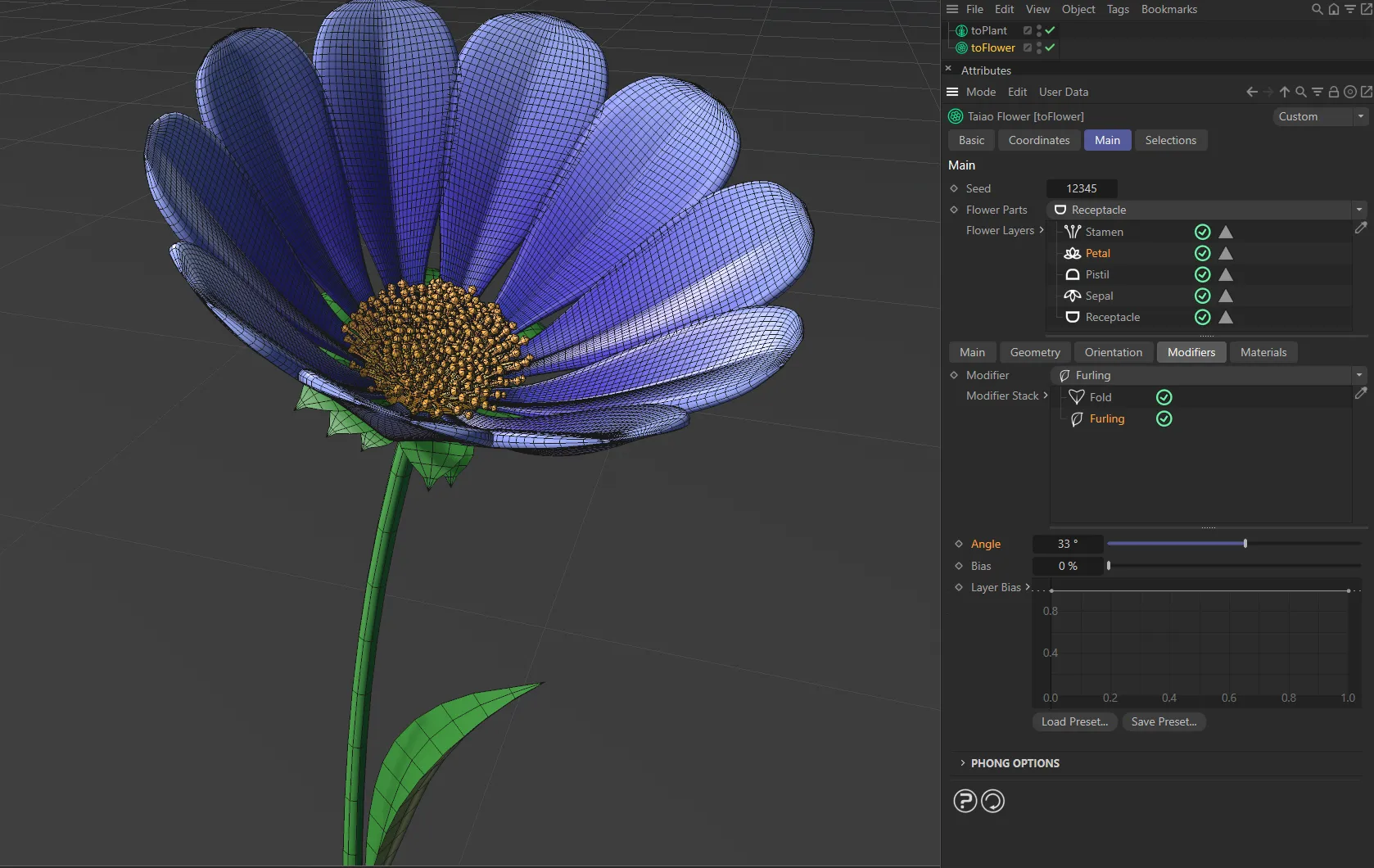
The Angle here is 33 degrees.
This dictates where, on the petals, the furling takes place.
At the default setting of 50%, furling occurs from the middle of the petal, towards the end.
Lowering the setting sets the furling beginning nearer the start of the petal and raising it has the opposite effect.
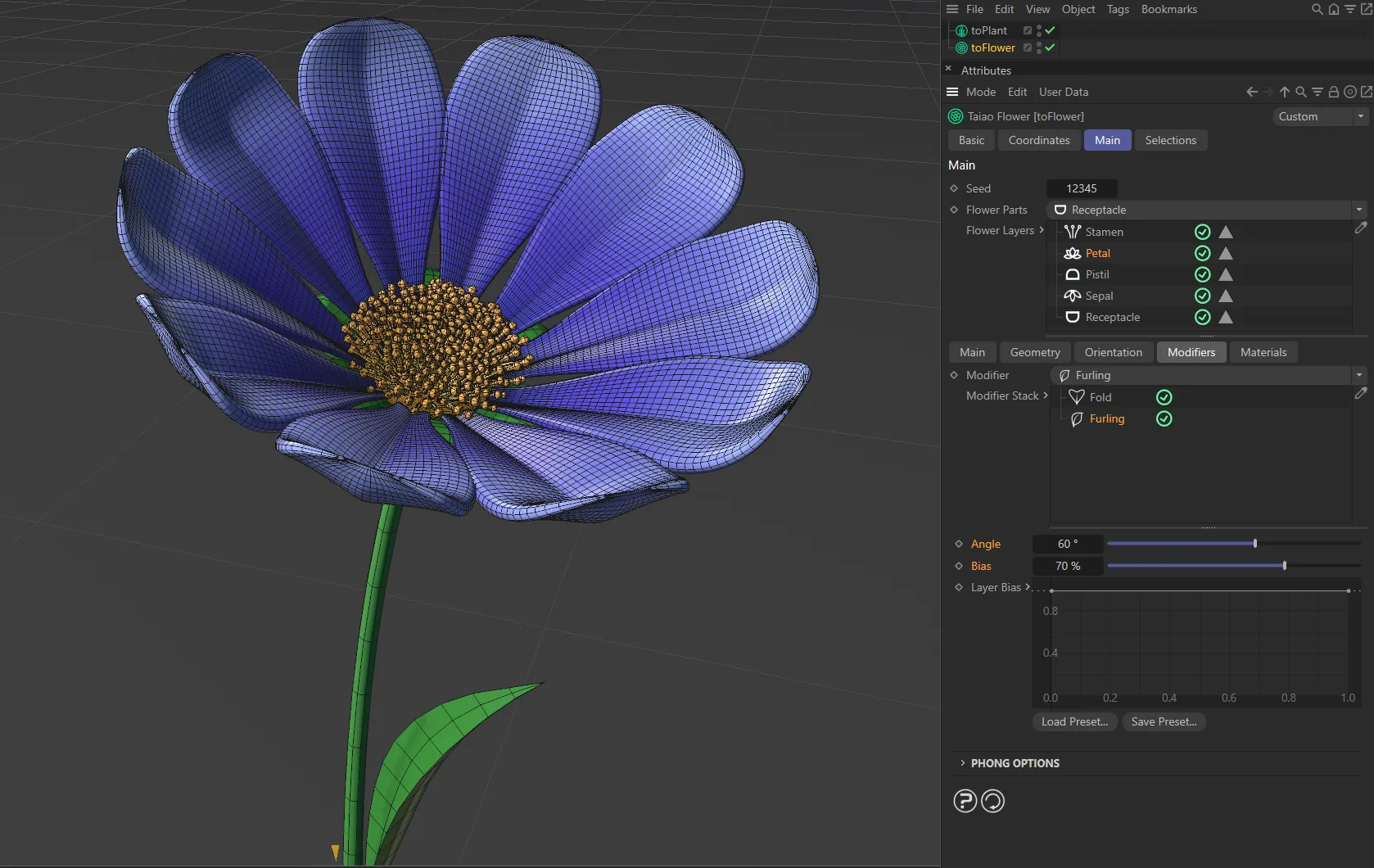
In this image, with a Furling of 60 degrees and a Bias of 70%, the furling is more directed towards the tips of the petals.
Angle Bias
Section titled “Angle Bias”This setting (added with update 2024.2) simply acts as a multiplier to the existing bend angle along the length of the Petal layer.
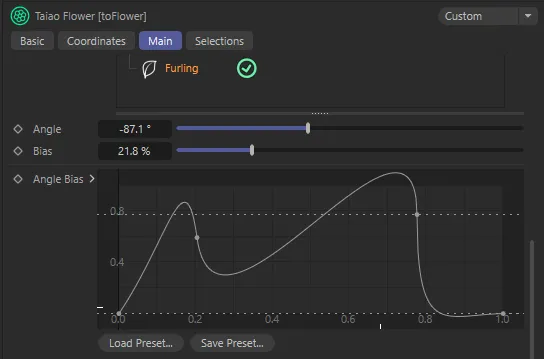
The Angle Bias spline (added with update 2024.2) can be manipulated to shape and customize your petal.
Layer Bias
Section titled “Layer Bias”This allows control over how much furling angle there is on a per-layer basis.
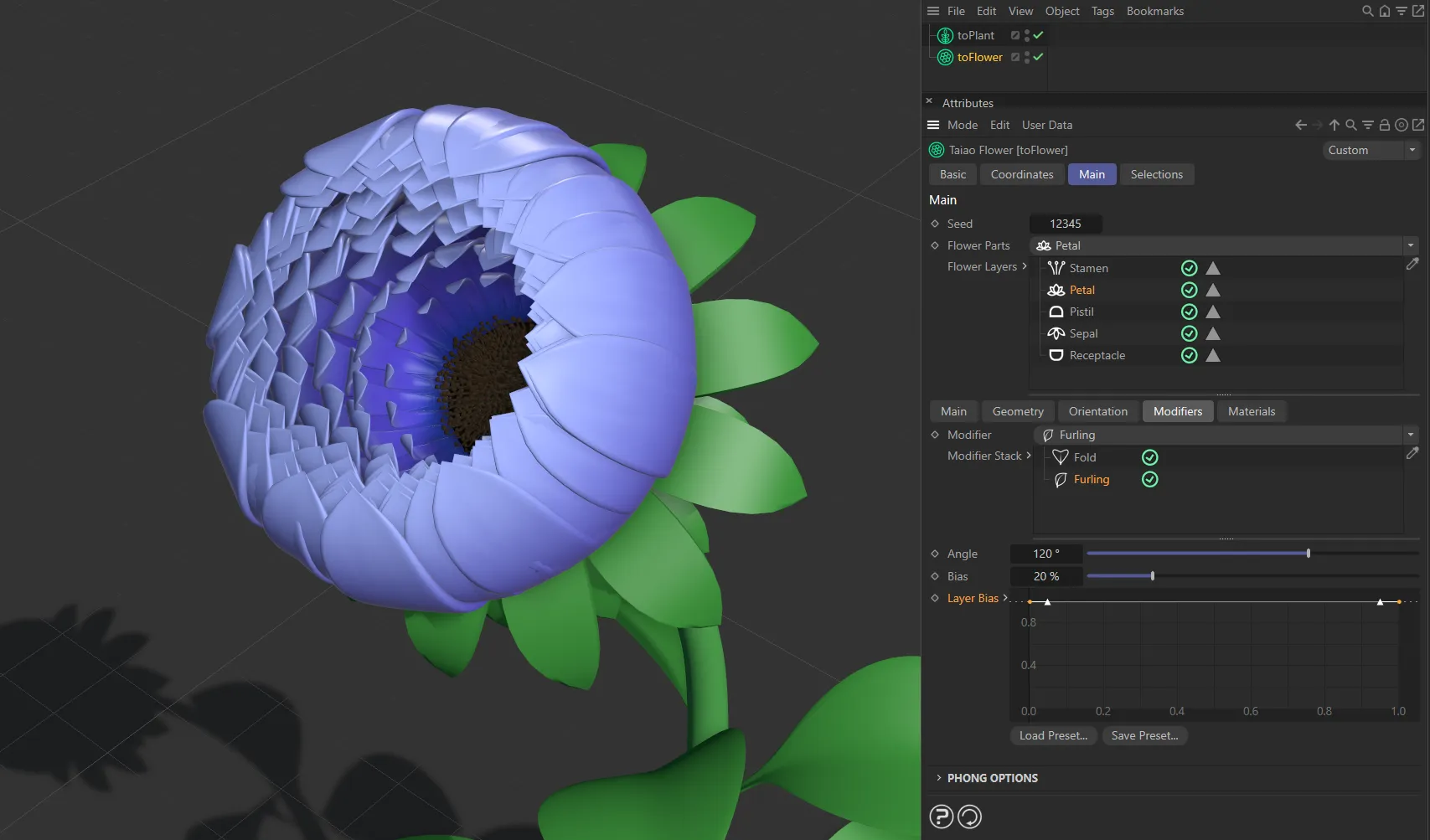
Layer Bias at full strength, giving the same amount of furling for each Petal layer.
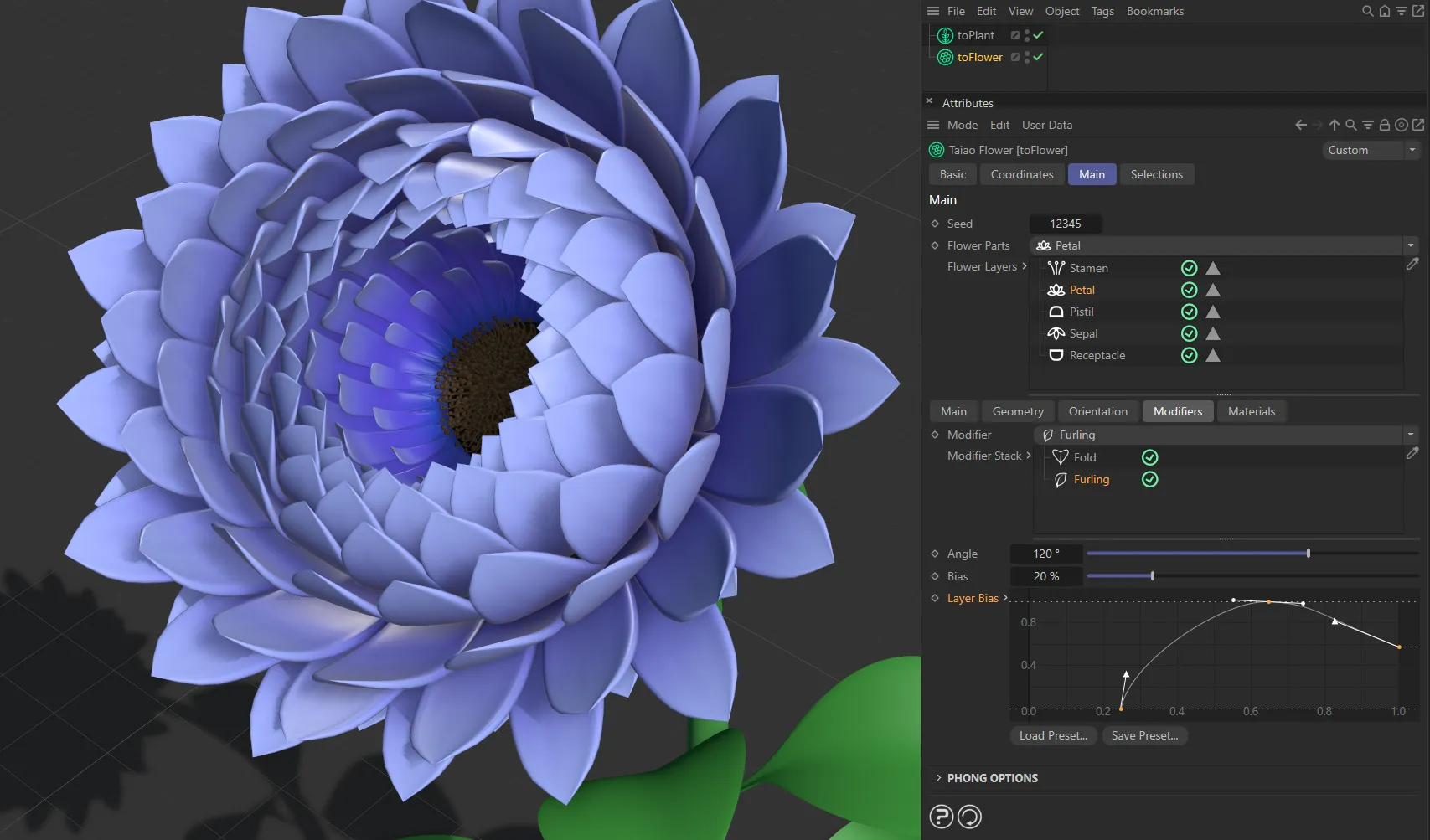
With this Layer Bias custom user spline, there is no furling on the inner layers, then up to full furling strength before going down again.
Turbulence modifier
Section titled “Turbulence modifier”Changing this value will give a different, random look, based on the values set.
Vary Seed
Section titled “Vary Seed”Enabling this will give a different seed number per petal.
Strength
Section titled “Strength”You can increase this, to your taste, either by using the slider to 100% or manually inputting a higher value to further increase the deformation.
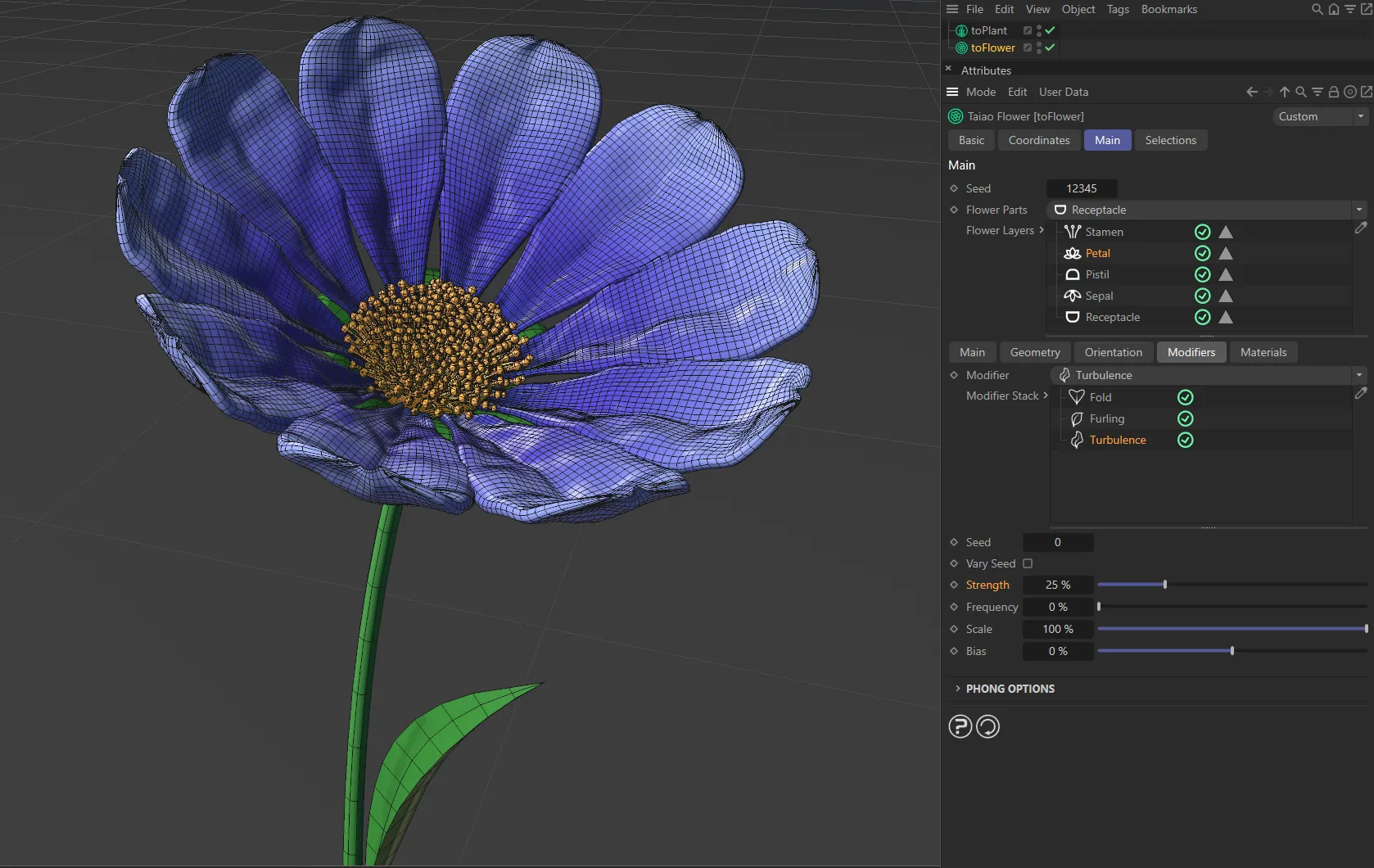
Turbulence Strength set at 25%
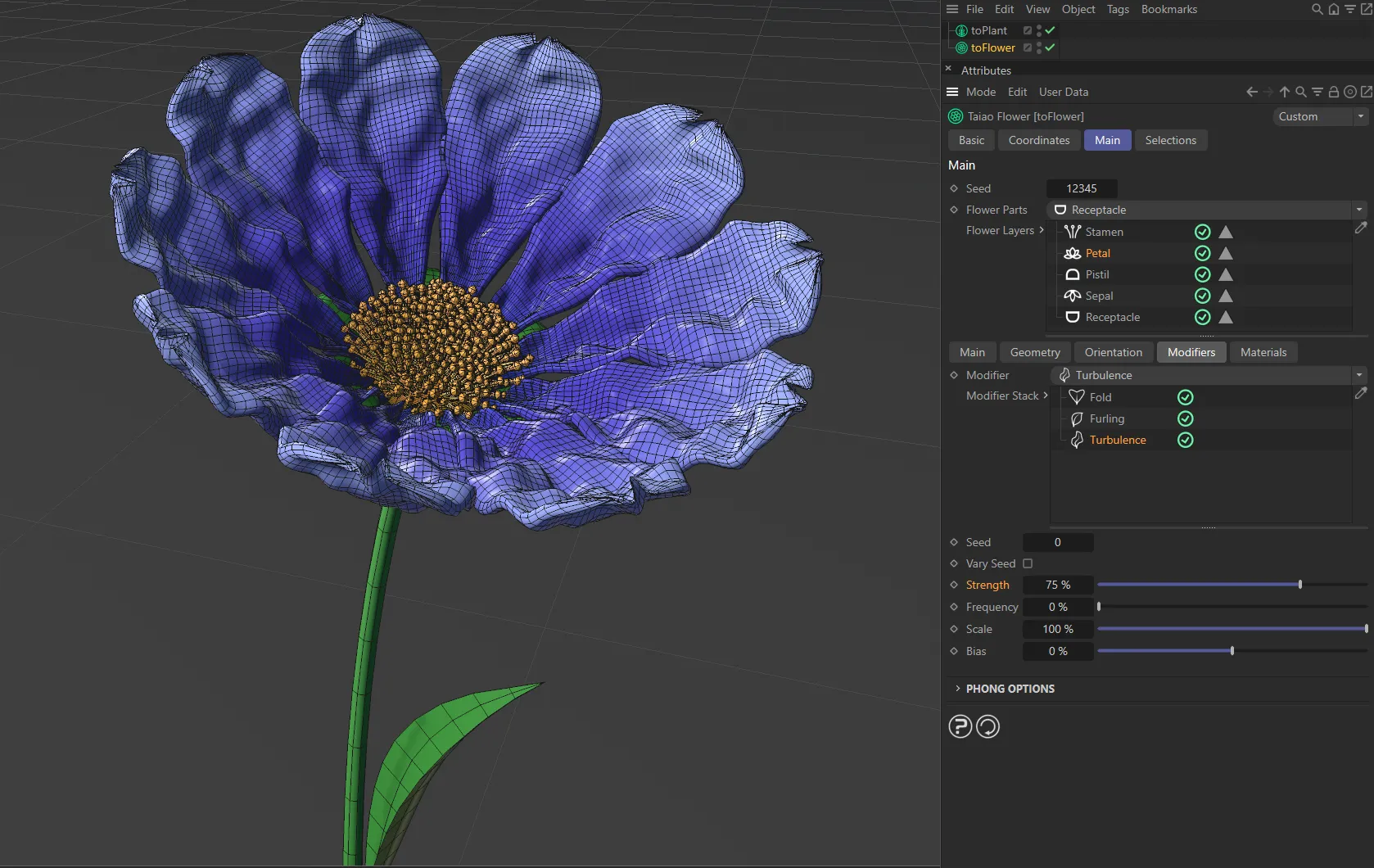
In this second image, the Strength is raised to 75%.
Frequency
Section titled “Frequency”Sets the rate at which the turbulence animates.
This slider increases or decreases the scale of turbulence that you have set, with much more detailed noise deformation at lower value settings.
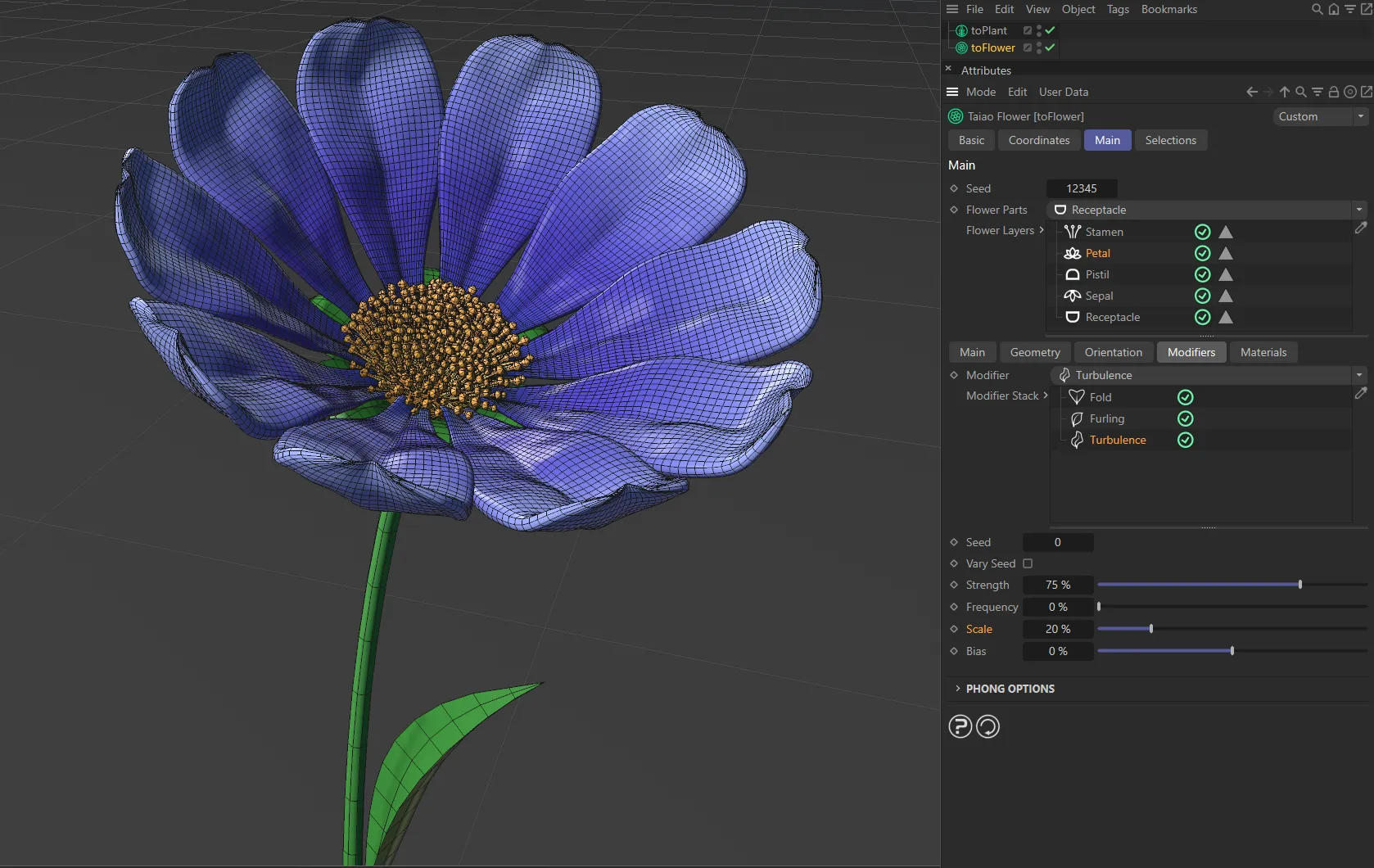
With the Scale decreased to 20%, there is a larger detail of turbulence in the petals.
The Bias slider setting dictates where, along the petals, the deformation begins.
At the default setting of 0 (zero) %, the entire layer is affected by the turbulence and at 100% there is no turbulence at all.
A negative bias value will isolate the deformation to affect the base of the layer, whereas a positive bias value will isolate the deformation to affect the tip(s) of the layer.
Deform modifier
Section titled “Deform modifier”You can also deform the petals, along their length in conjunction with the Strength slider.
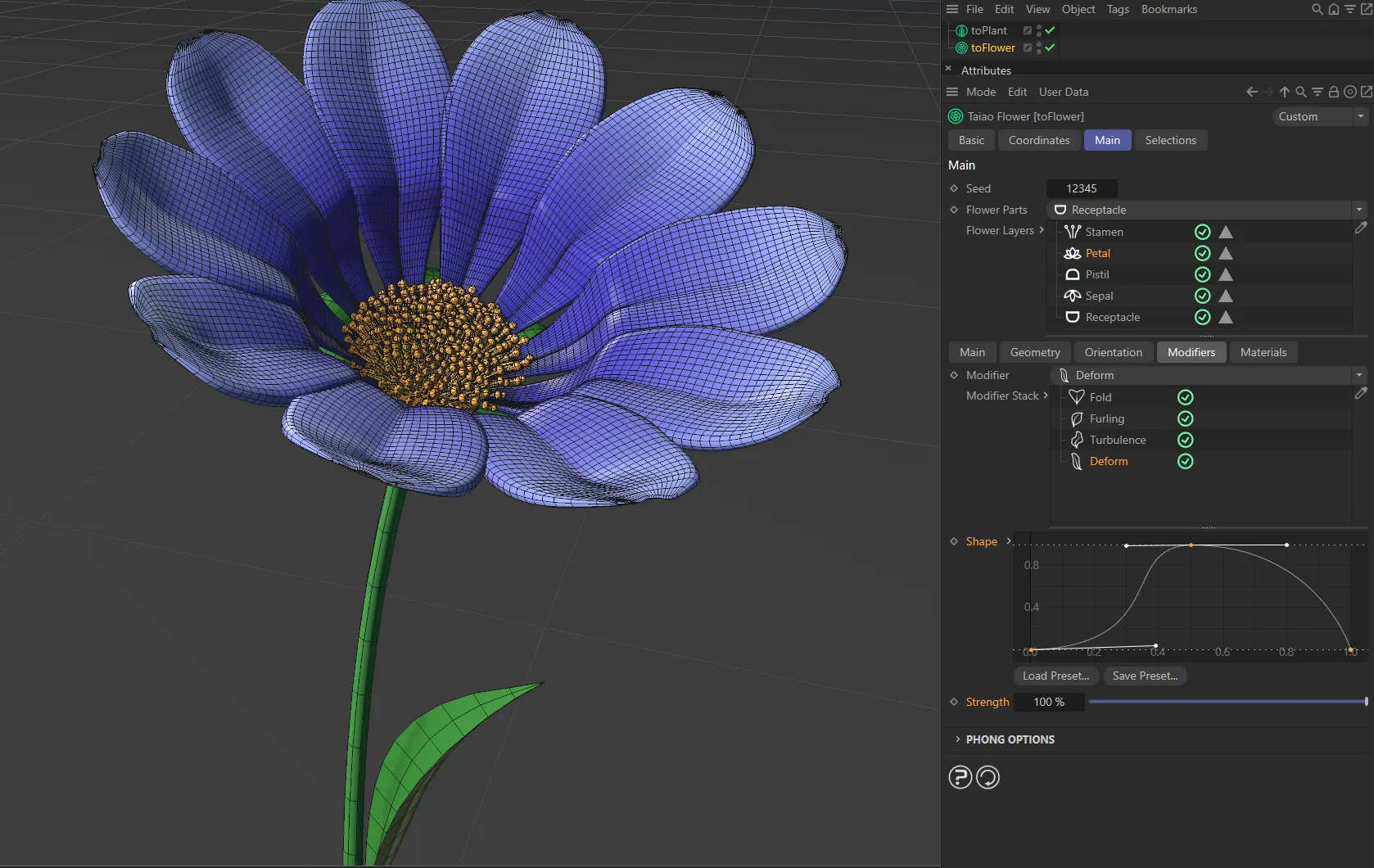
With the Strength at 100%, the petals are deforming to mimic the spline Shape setting.
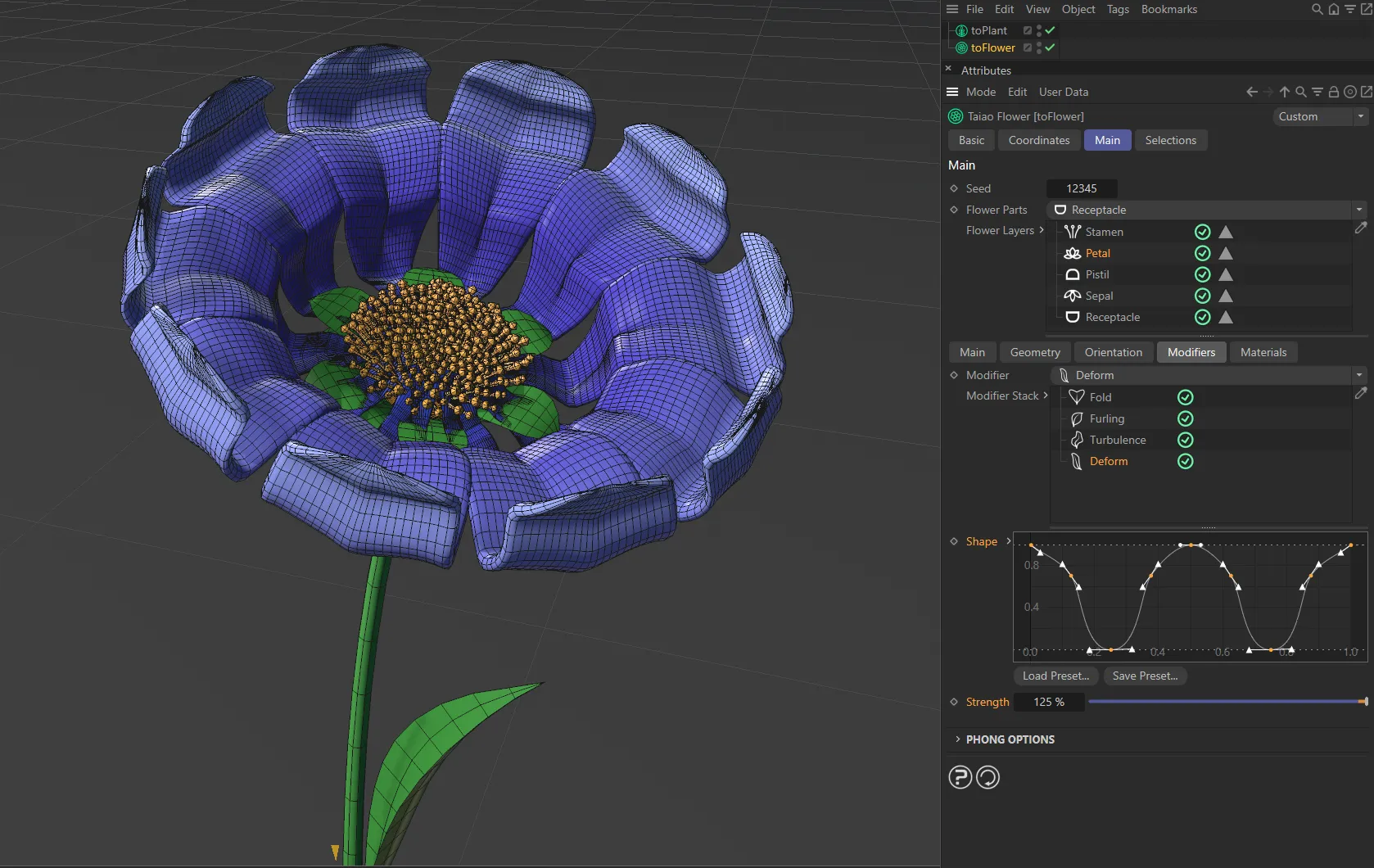
This artistic Shape spline curve is creating an interesting deformity of the petals, in conjunction with an increased Strength of 125%.
Strength
Section titled “Strength”This slider controls the amount of deformity in the petals.
Displacer modifier
Section titled “Displacer modifier”This modifier lets you bring in a Shader or a Texture to shape the petals.
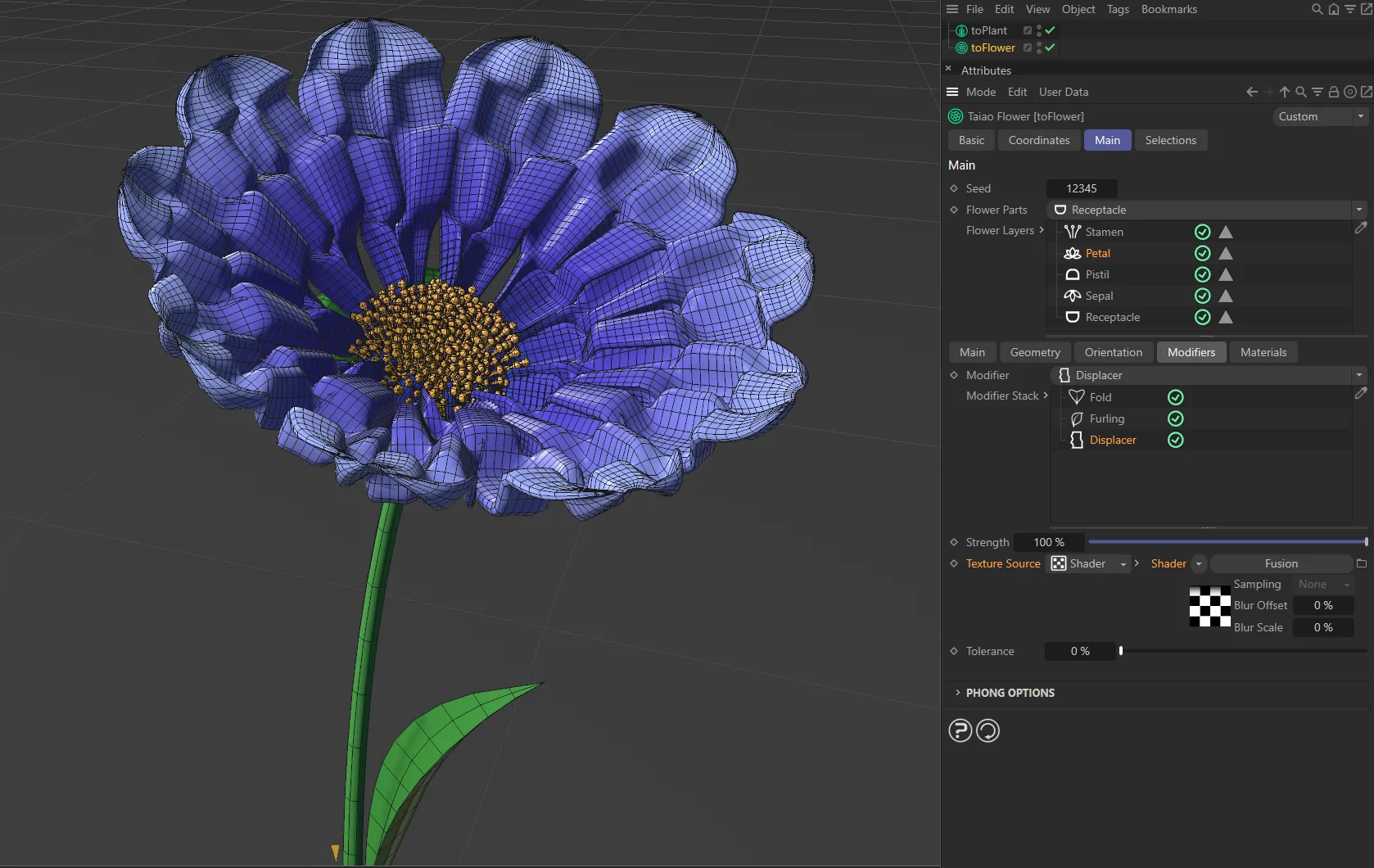
In the Texture Source mode of Shader, with a Fusion shader loaded in, which has a Checkerboard shader being masked at the tips of the petals. This results in a checkerboard displacement with a reduction of the effect towards the tips.
Selecting this modifier will give you the usual additional options (explained more fully in the Stamen layer page) to be able to import your Shader or Texture into the scene, including parameters for Channel and Tolerance settings.
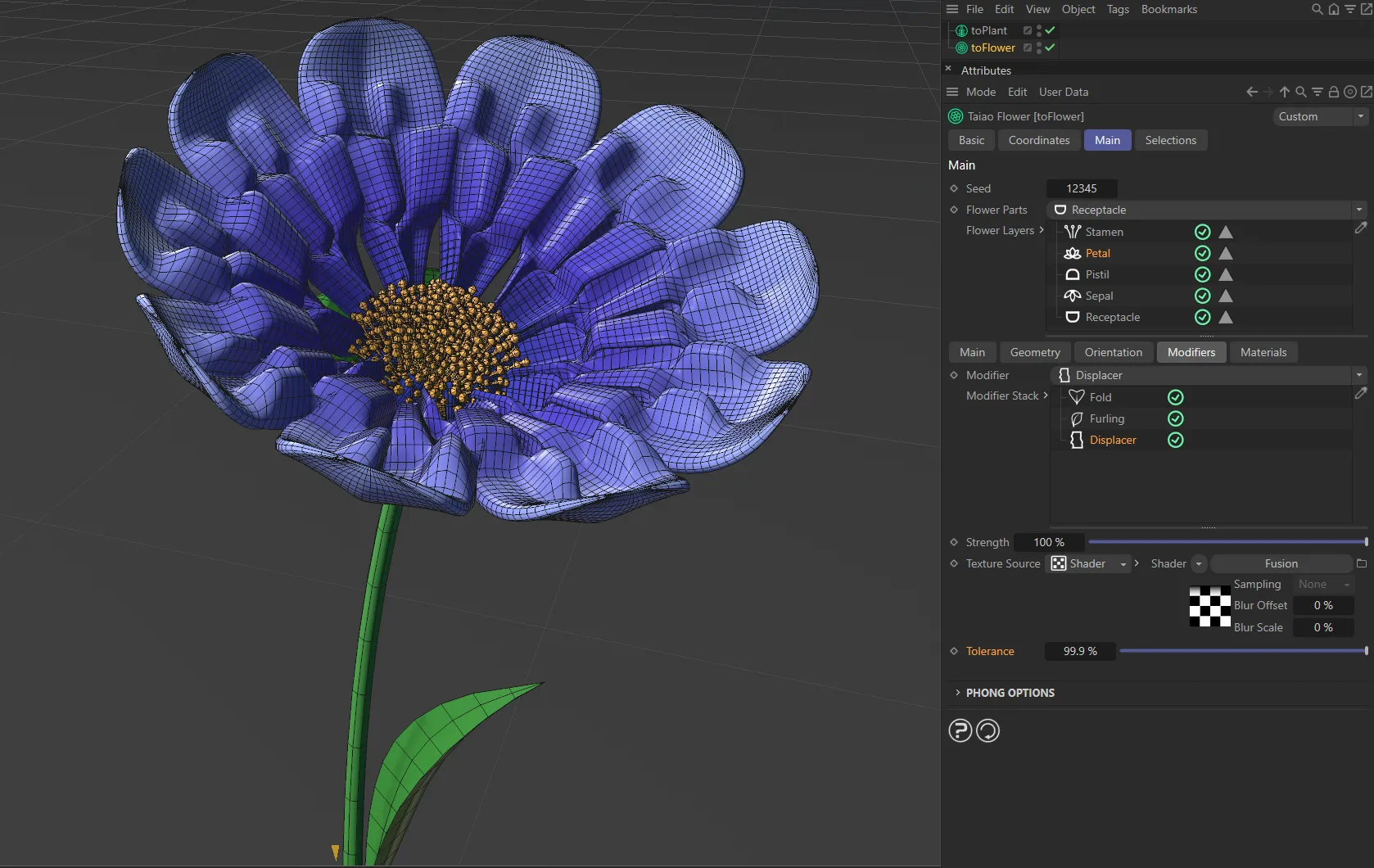
Increasing the Tolerance to a high value means that only the brightest areas of the shader will displace. In this example it smoothes off the falloff caused by the gradient shader at the tips.
Main tab - Cone petal settings
Section titled “Main tab - Cone petal settings”Position
Section titled “Position”The position of the cone can be raised or lowered.
Rotate
Section titled “Rotate”Rotates the cone around by degrees.
You can increase or decrease the cone size.
Size Variation
Section titled “Size Variation”In order to make things look more organic, you can add variation here.
Radius
Section titled “Radius”This will change the radius of your cone.
Length
Section titled “Length”Similarly, changes the length of your cone.
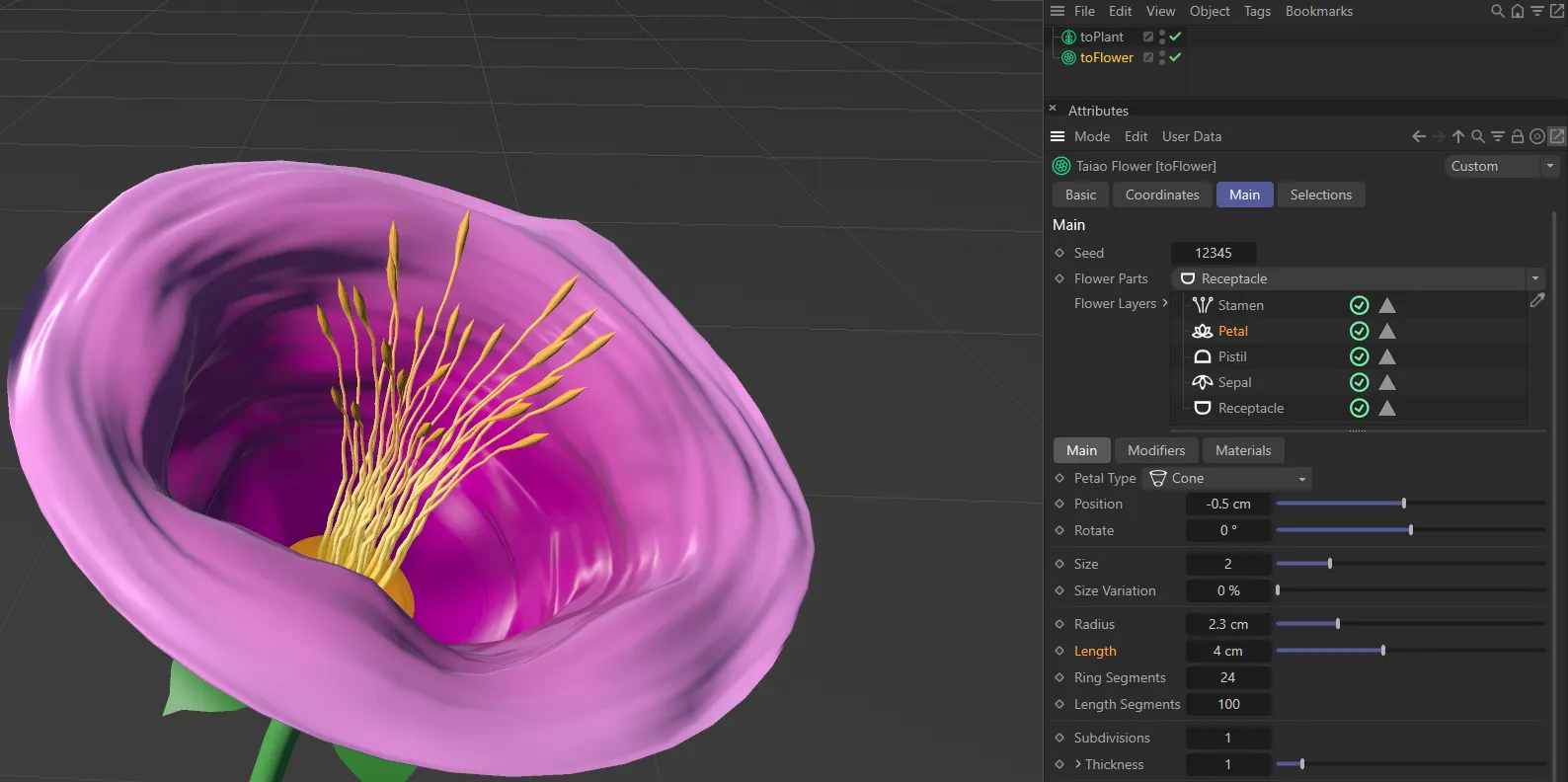
Cone Length set at 4cm.
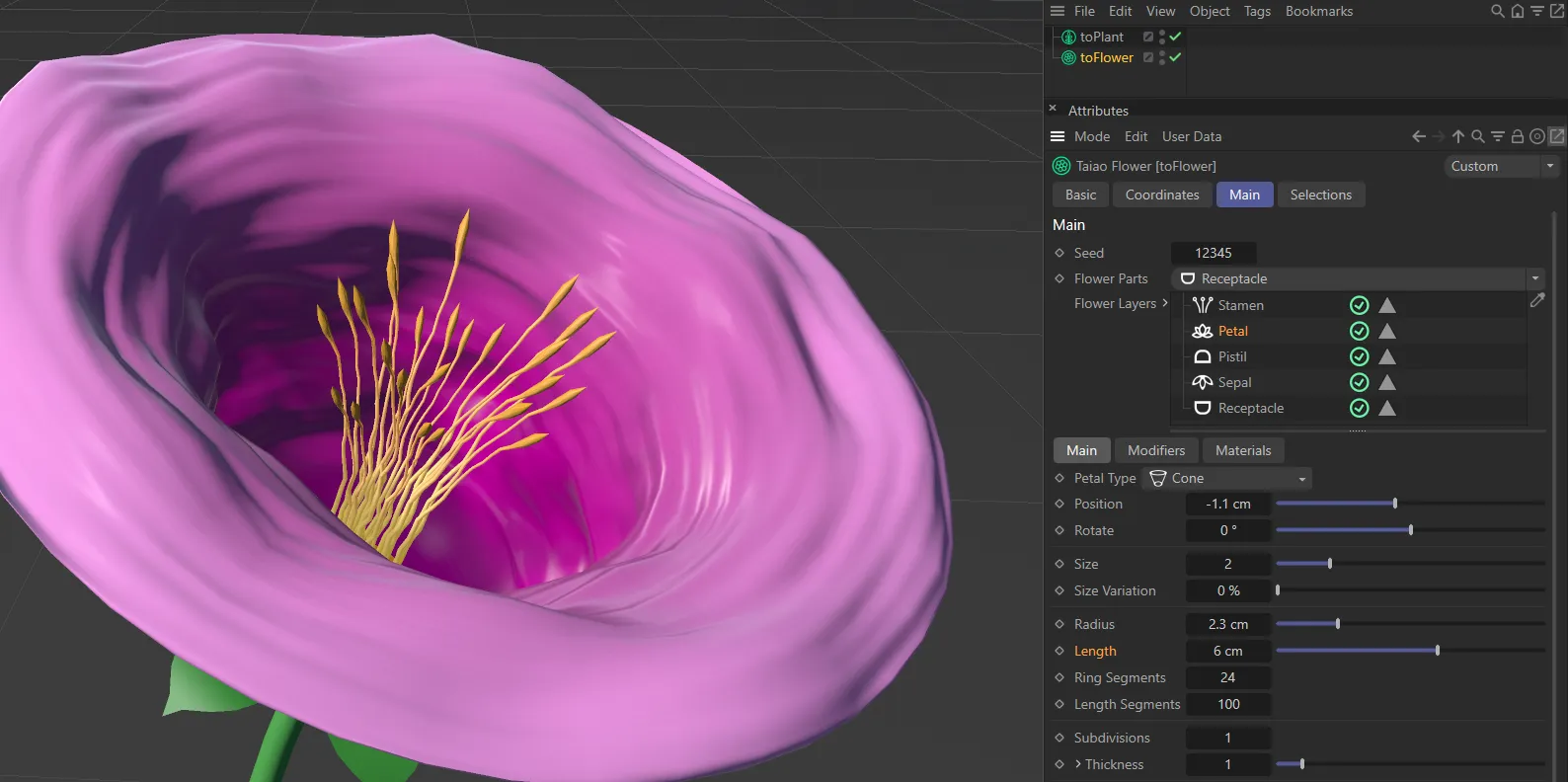
Length increased to 6cm.
Ring Segments
Section titled “Ring Segments”In order to alter the geometry, you can add ring segments.
Length Segments
Section titled “Length Segments”Similarly, you can add length segments to the cone.
Subdivisions
Section titled “Subdivisions”To smoothen out your cone, you can add subdivisions to give more geometry.
Thickness
Section titled “Thickness”Adding thickness will give your cone some depth.
Unfolding the drop-down arrow will reveal a Depth spline curve.
You can shape the Depth profile to meet your needs and, similarly, you can use Load Preset to call up earlier saved designs and Save Preset to save any new creations.
Profile
Section titled “Profile”Exactly the same as with the Standard setting, the default can be adjusted to personalize your cone shape.
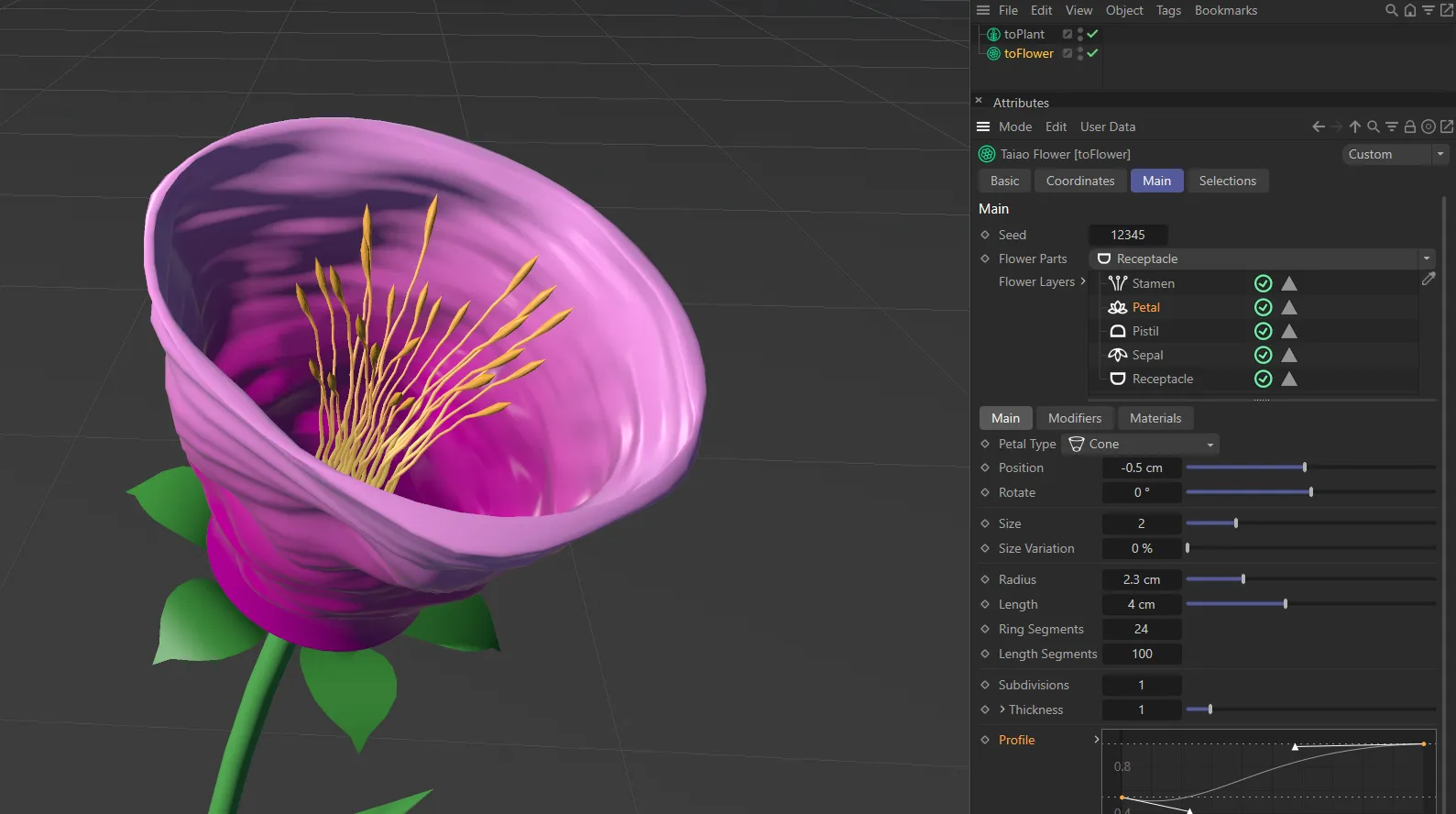
This rising spline Profile is shaping the cone outwards.
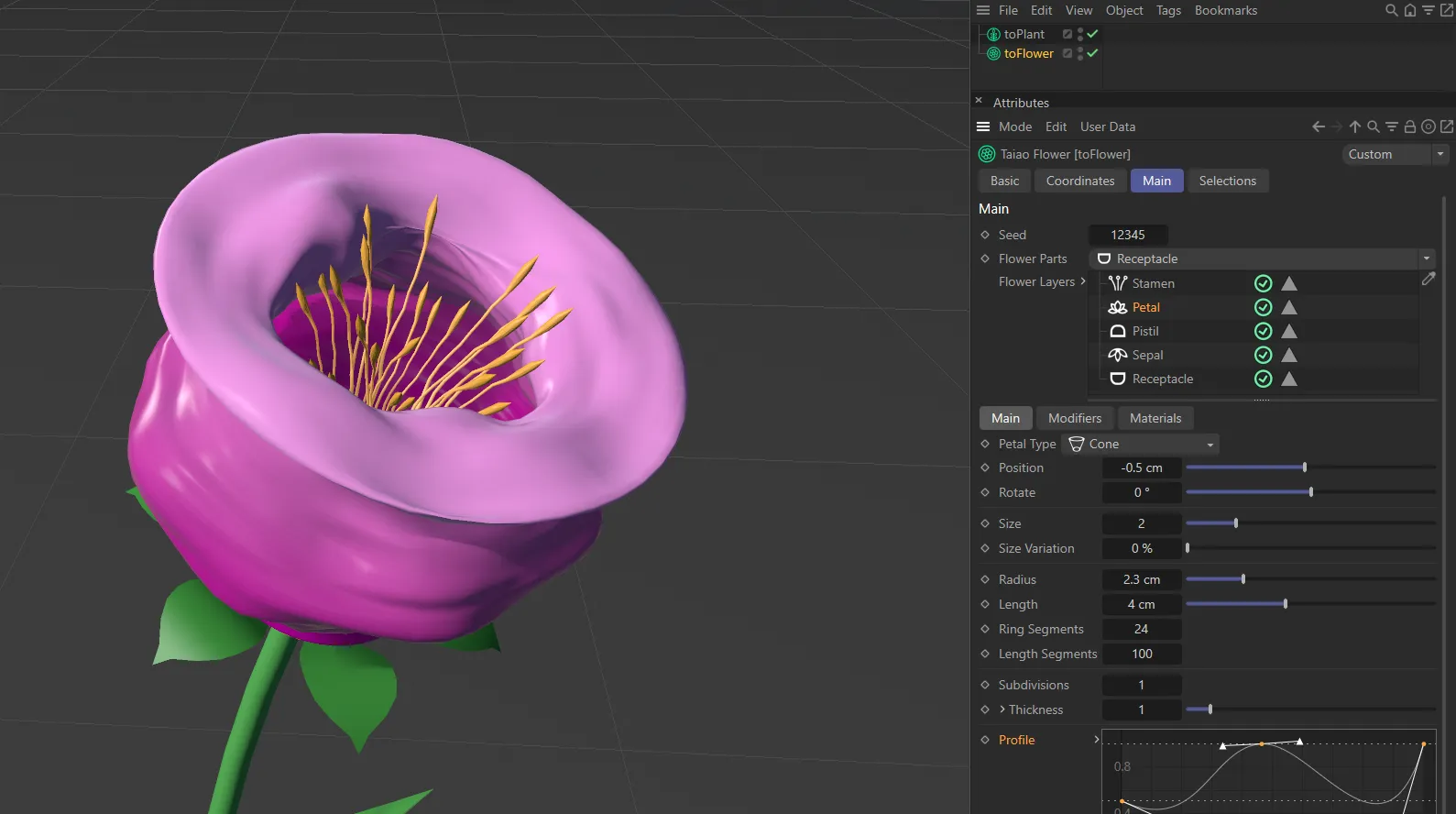
Altering the Profile shape gives this interesting cone.
Edge Noise
Section titled “Edge Noise”Strength
Section titled “Strength”Controls the amount of noise along the edges of the petals.
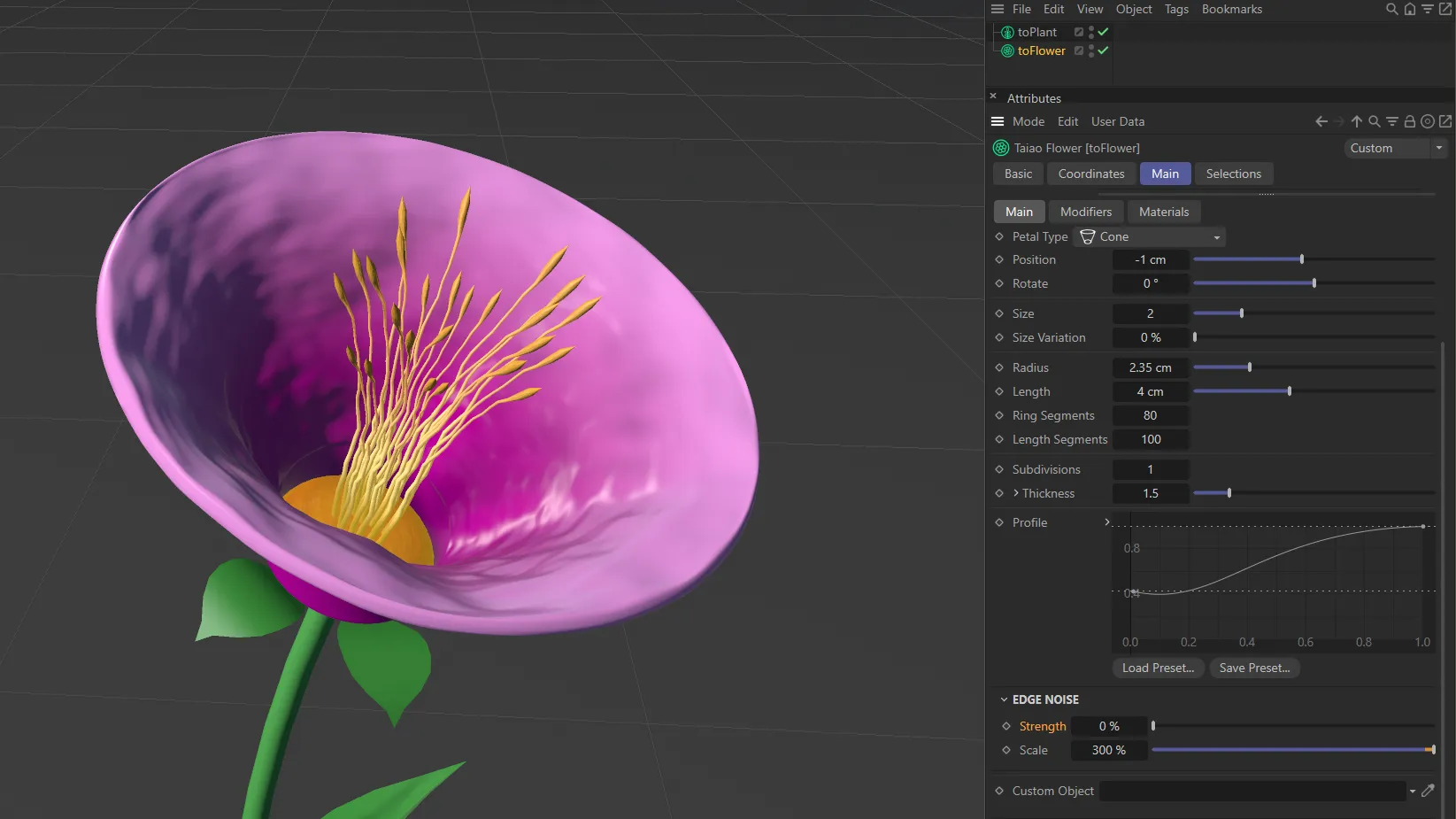
0 (zero) % Strength set, giving no edge noise.
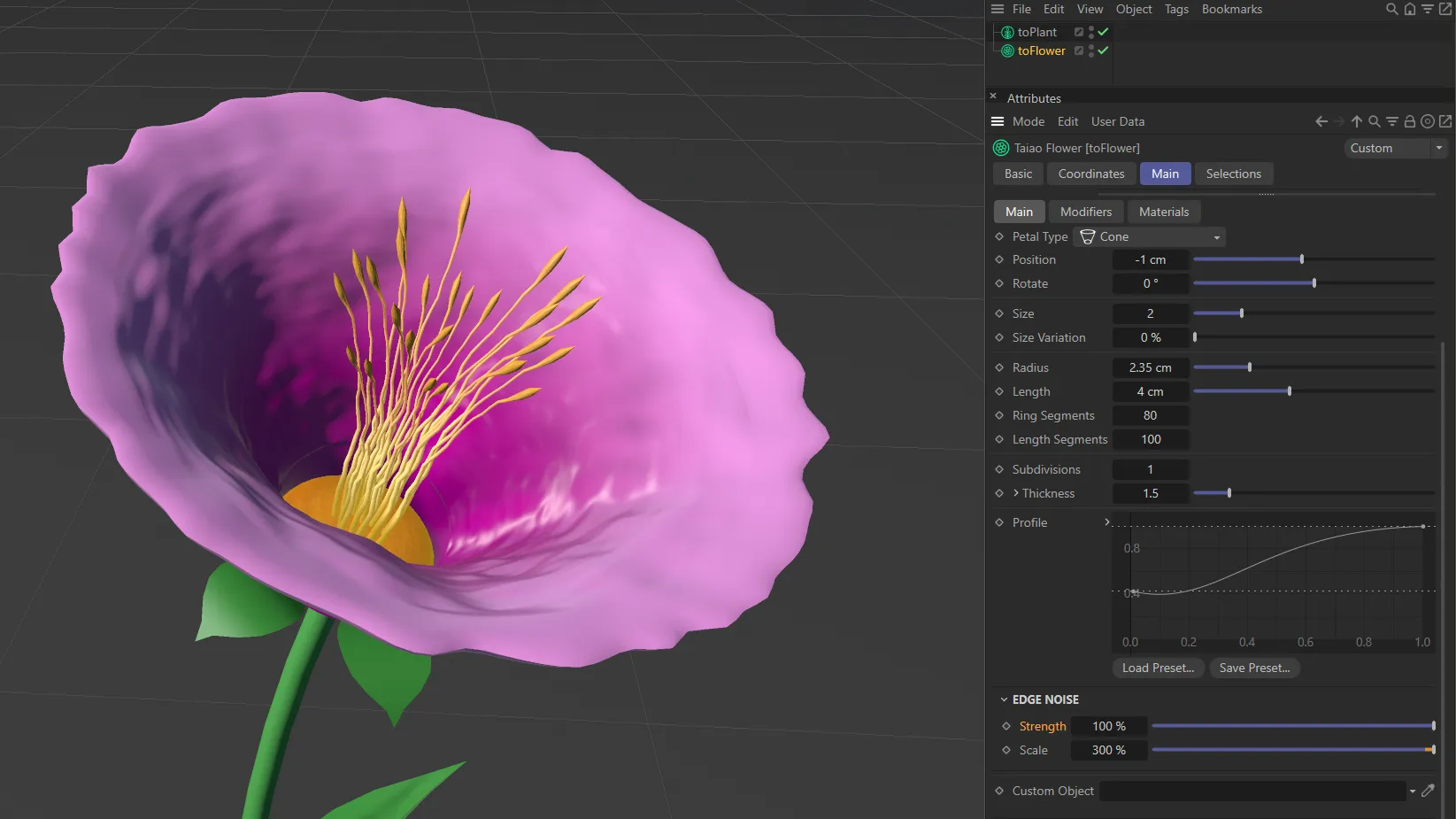
With 100% Strength, there is noise all around the edges of the cone.
Applies the usual scale control to the noise setting.
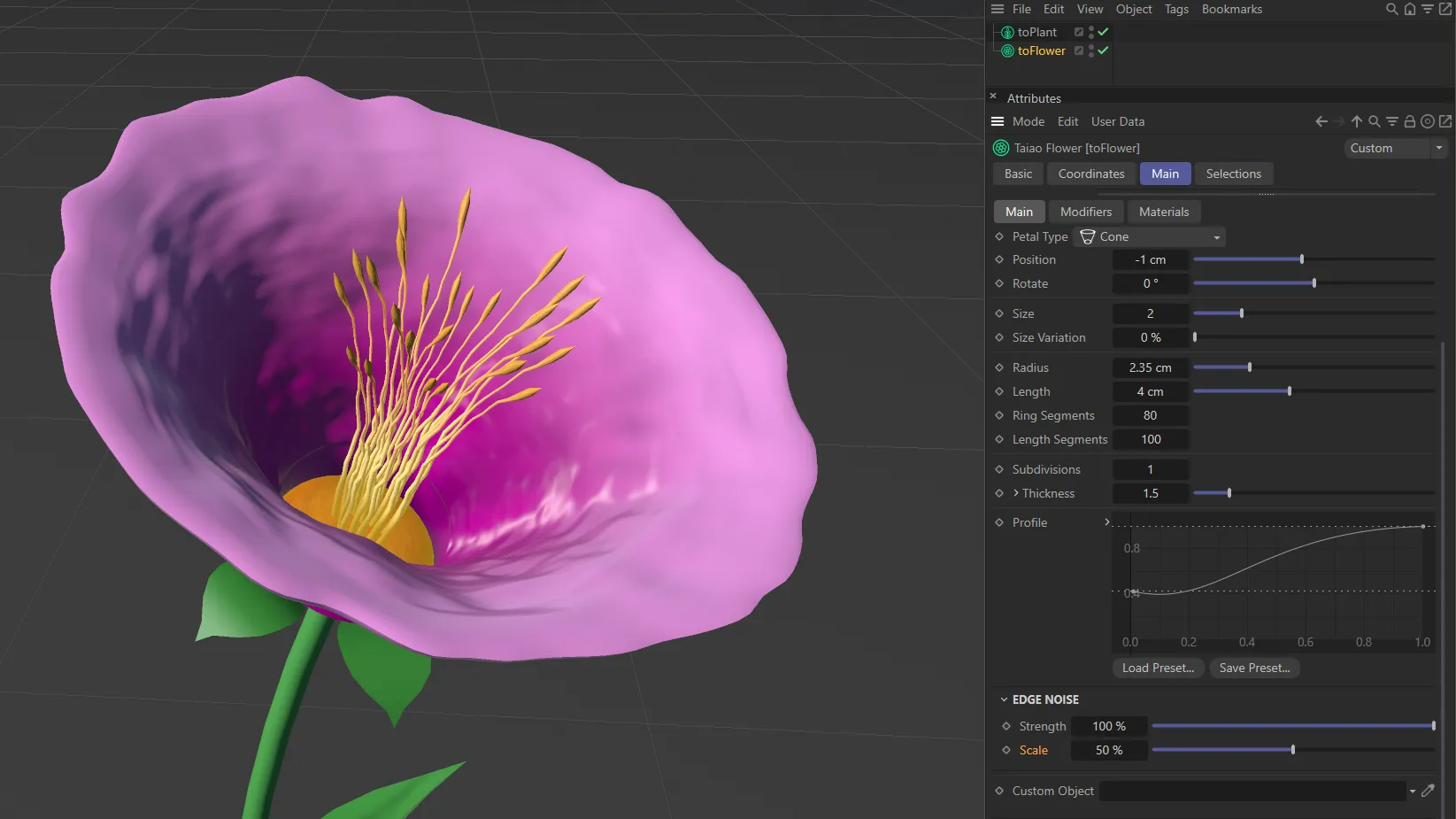
With a 50% Scale setting, there is a larger noise pattern.
Custom Object
Section titled “Custom Object”You can import custom objects by simply dragging them into the Custom Object link field and then alter the different settings, as desired.
Modifiers tab
Section titled “Modifiers tab”Modifier
Section titled “Modifier”The available Modifier types for the Cone setting are: Curl, Turbulence and Displacer.
Turbulence and Displacer have been explained, above.
Curl modifier
Section titled “Curl modifier”You can angle the cone in or out, using this Angle slider.
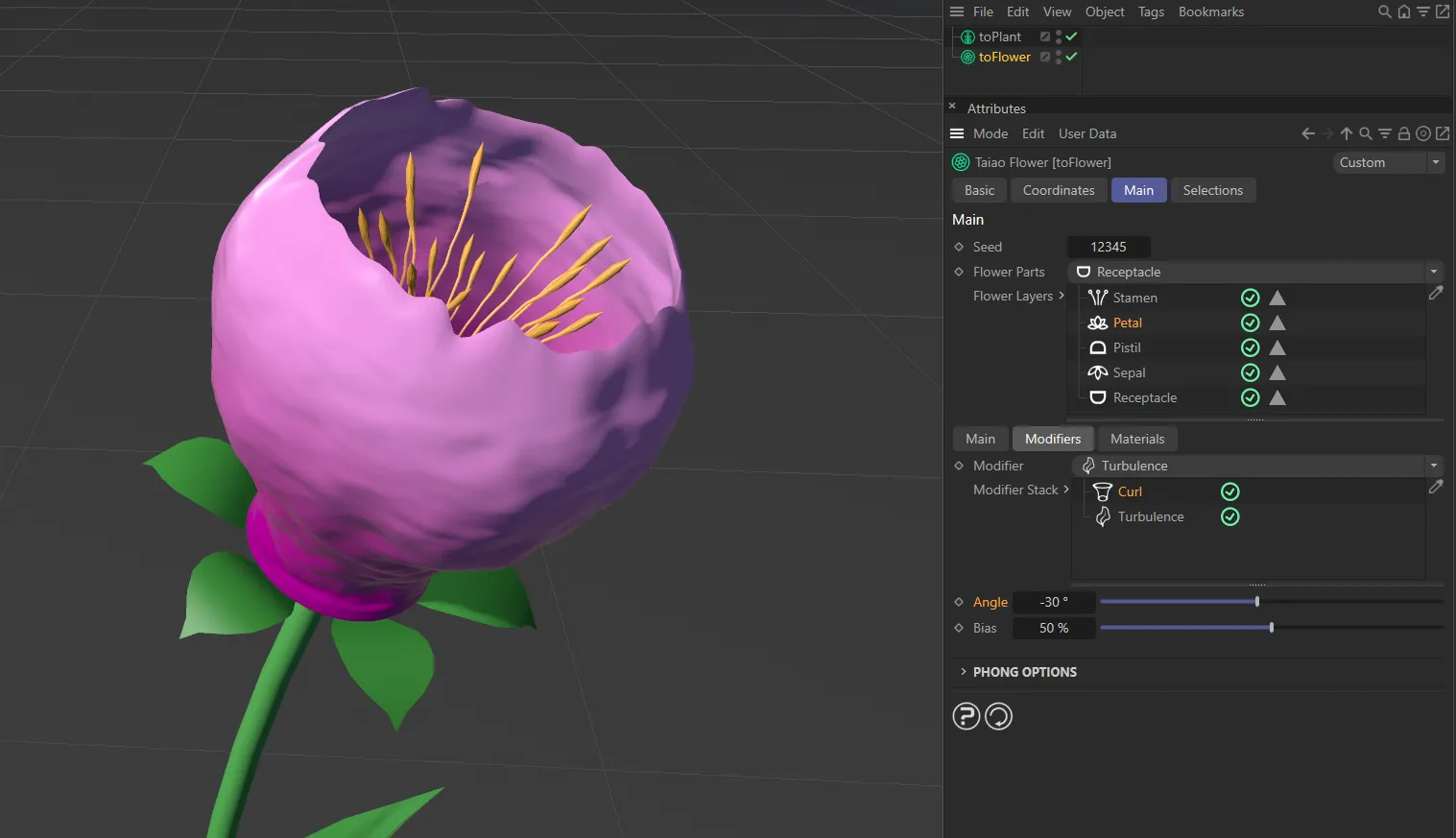
With the Curl modifier and a (negative) -30 degree Angle setting.
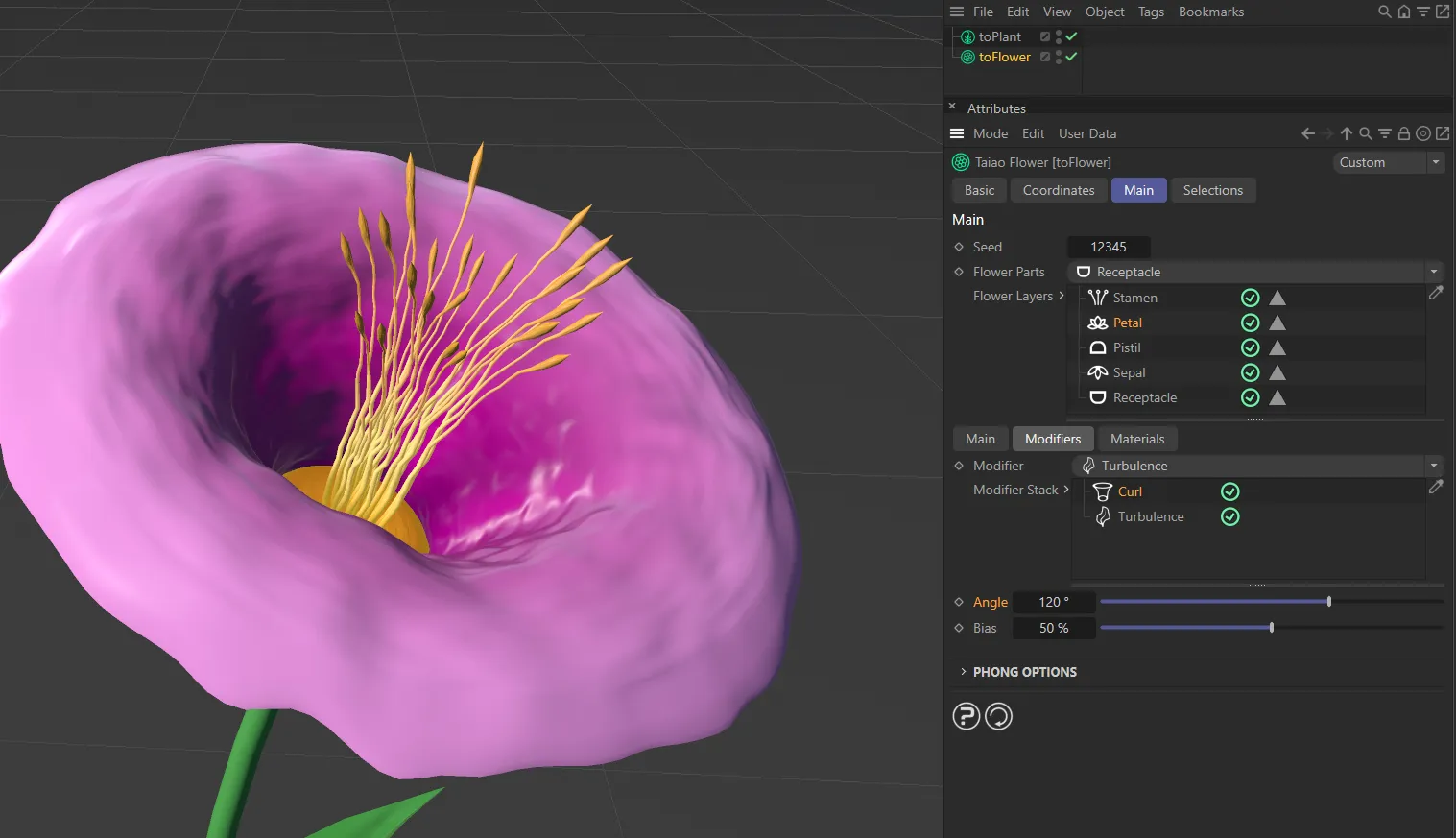
Angle raised to 120 degrees.
Use this setting to choose where, on the cone, the curling takes place.
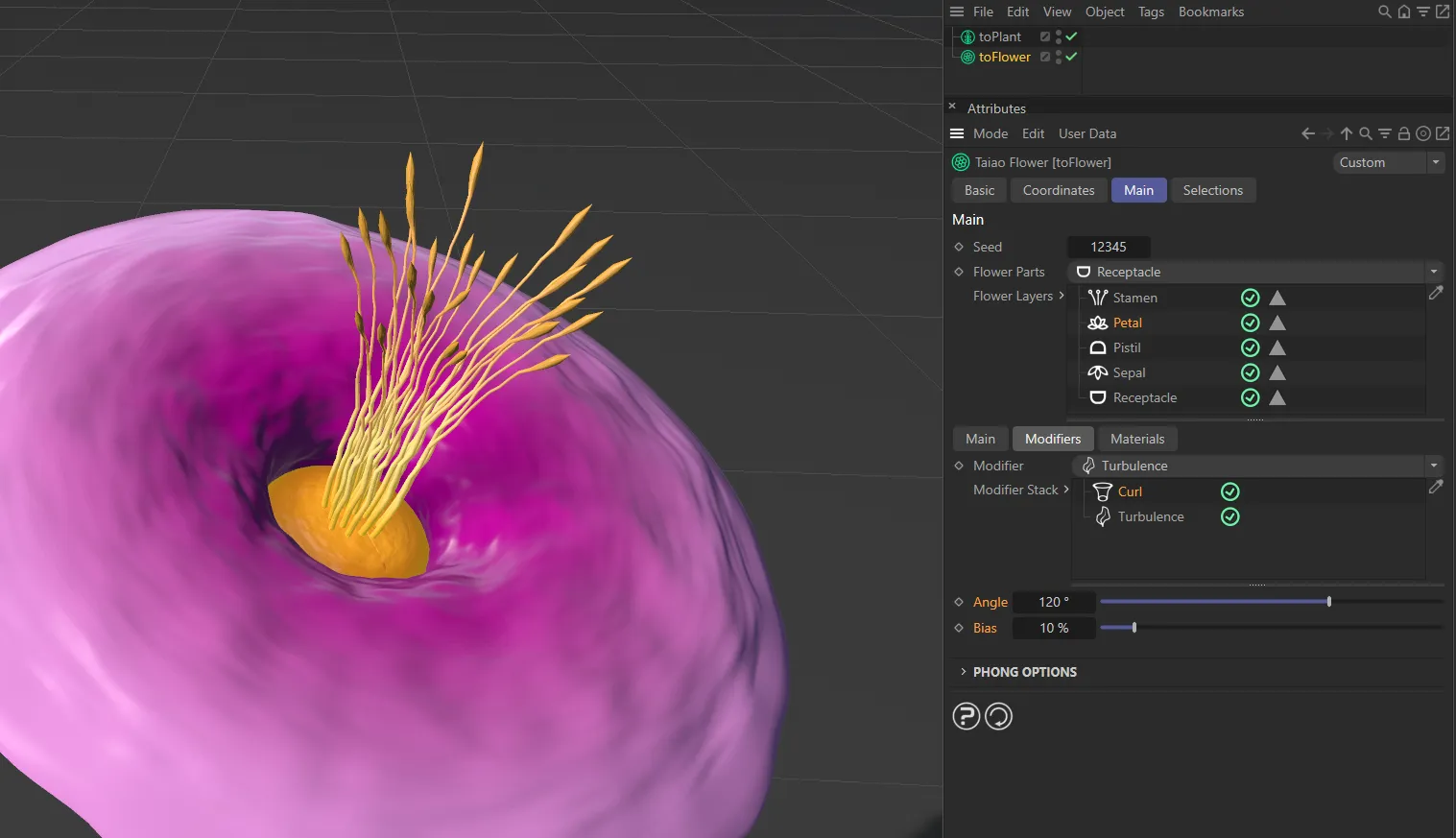
Here, a Bias of 10% is starting the curling near the base of the cone.
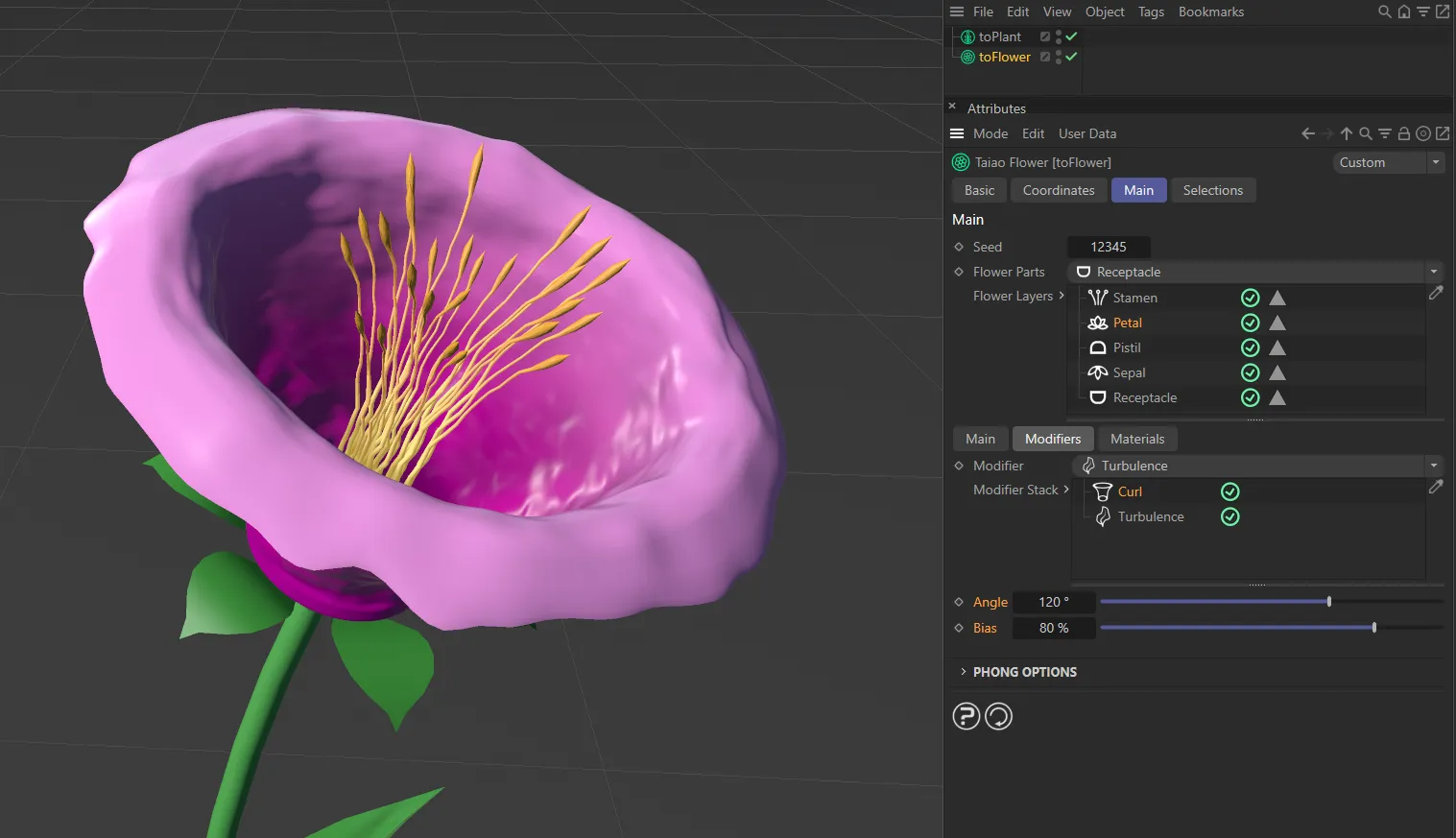
Conversely, a Bias value of 80% starts the curling towards the top of the cone.
Turbulence modifier
Section titled “Turbulence modifier”Explained above.
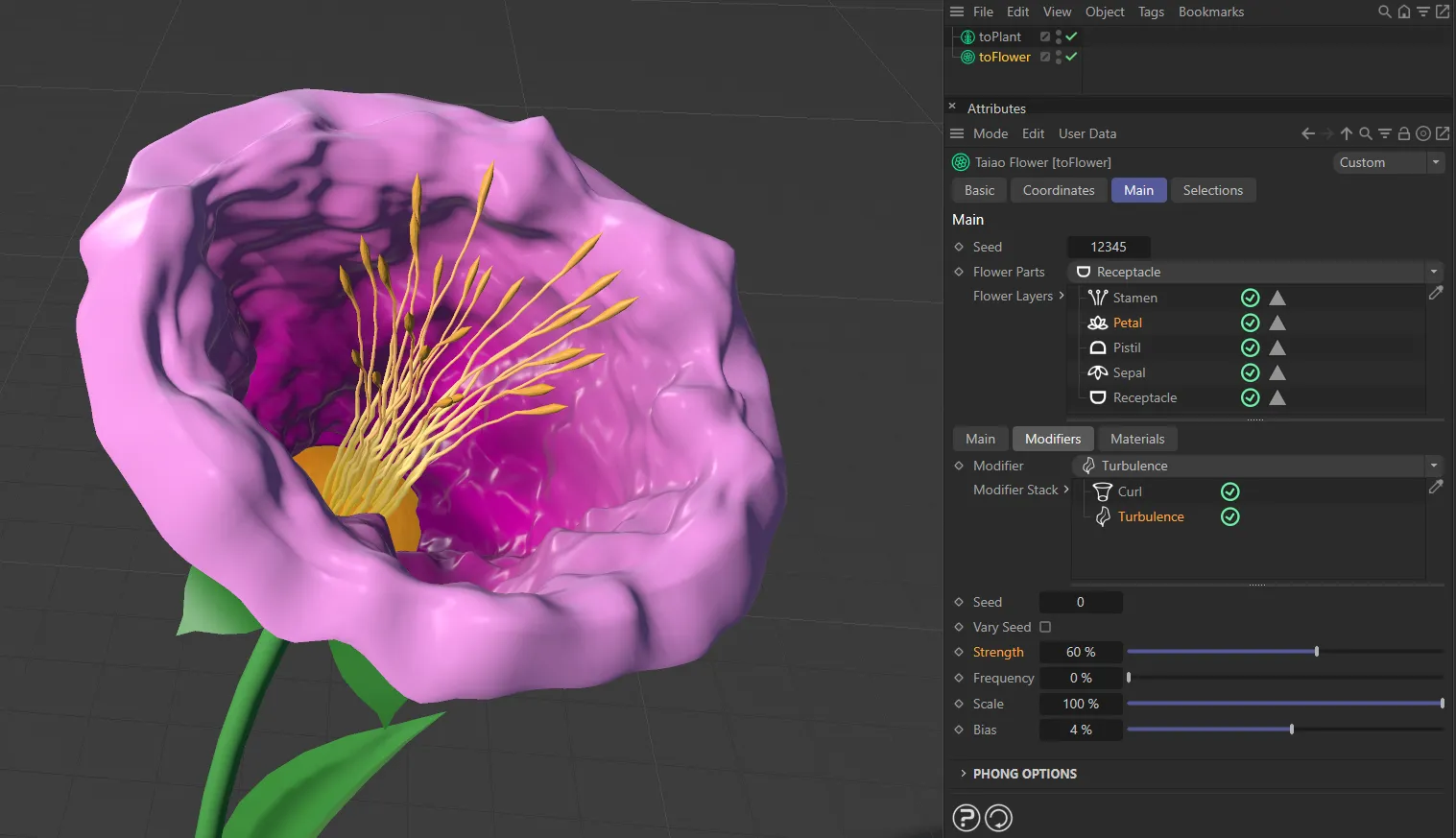
With a 60% Strength setting, giving more turbulence.
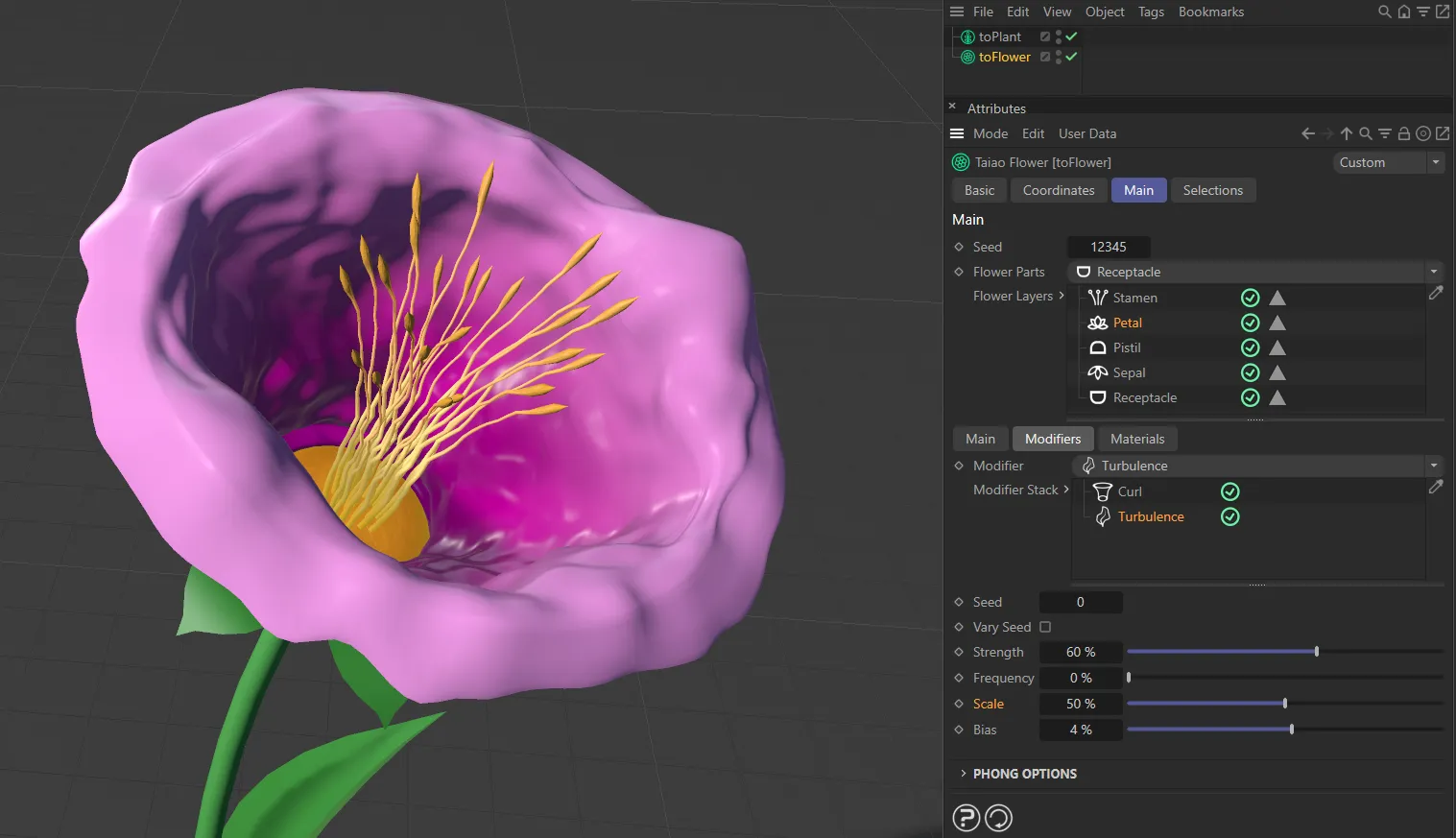
The same Strength setting as above, but with a 50% Scale value, for a larger turbulence pattern.
Displacer modifier
Section titled “Displacer modifier”Explained above.
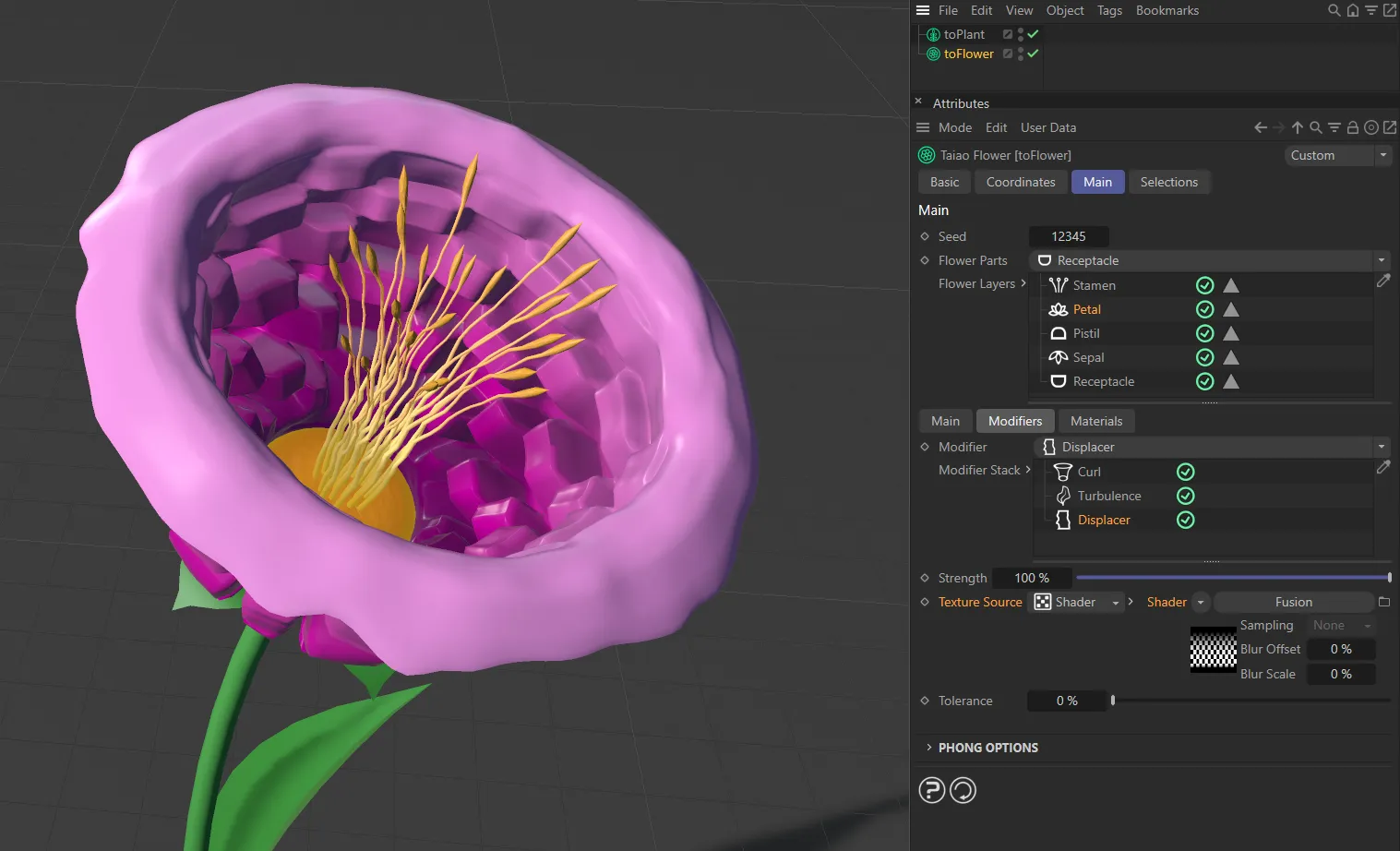
In the Texture Source mode of Shader, with a Fusion shader loaded in, which has a Fusion shader with a gradient to feather it off towards the tips.
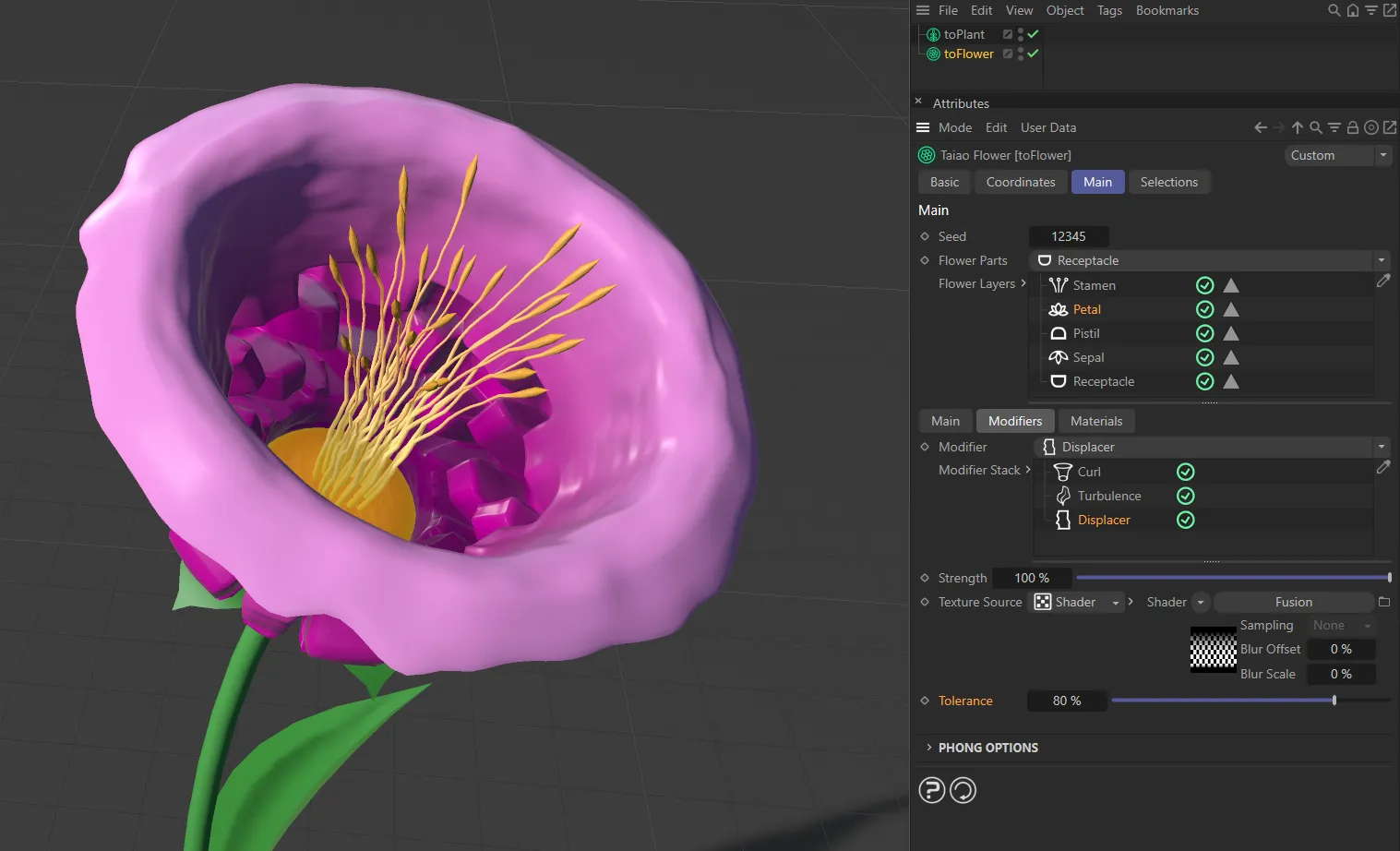
Increasing the Tolerance to a high value means that only the brightest areas of the shader will displace, reducing the effect.
Copyright © 2026 INSYDIUM LTD. All rights reserved.