
jdGeoFlow
A procedural tool, offering flowing animation path options, using geometry or scene objects.
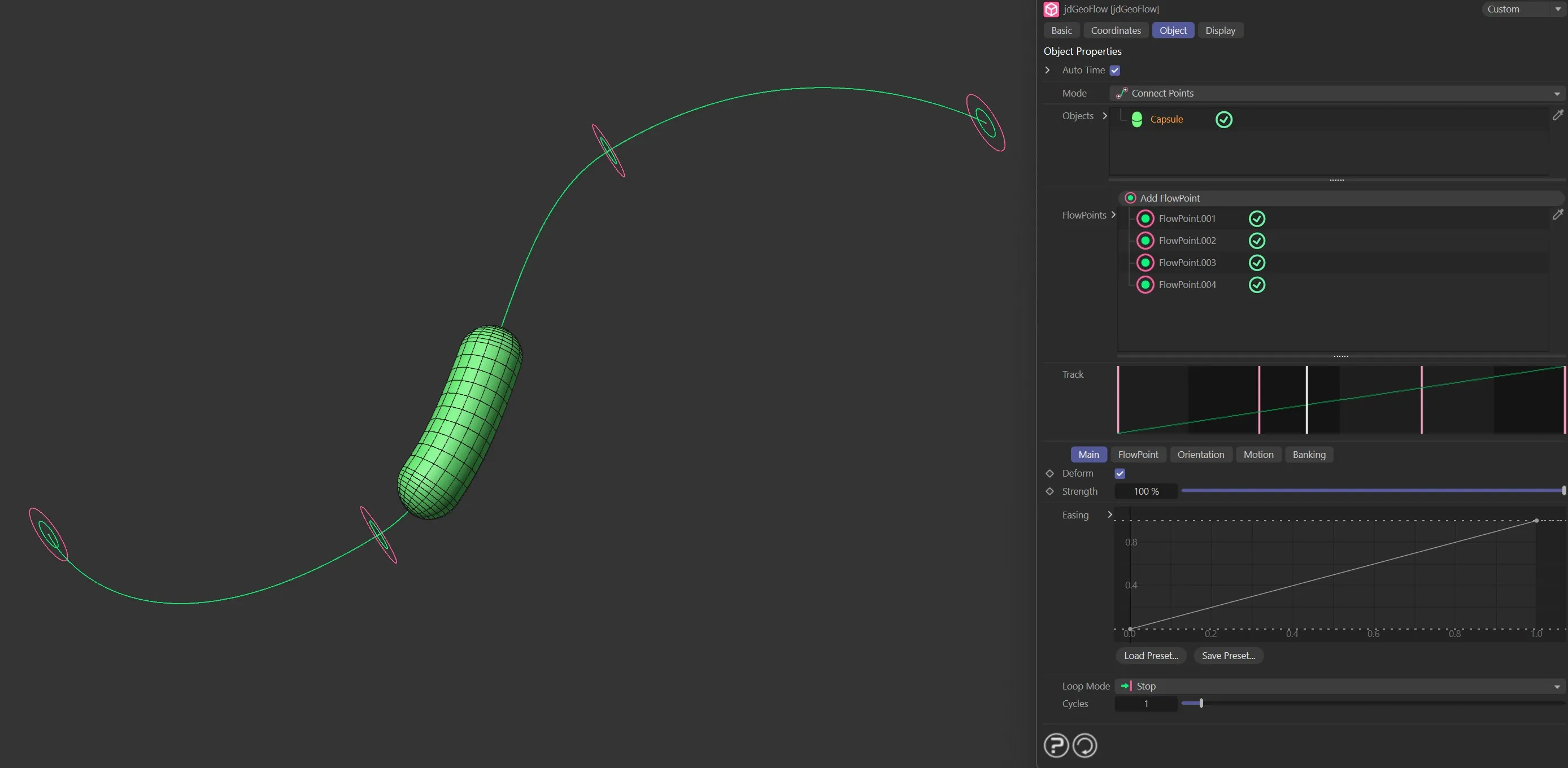
jdGeoFlow.
Object tab
Section titled “Object tab”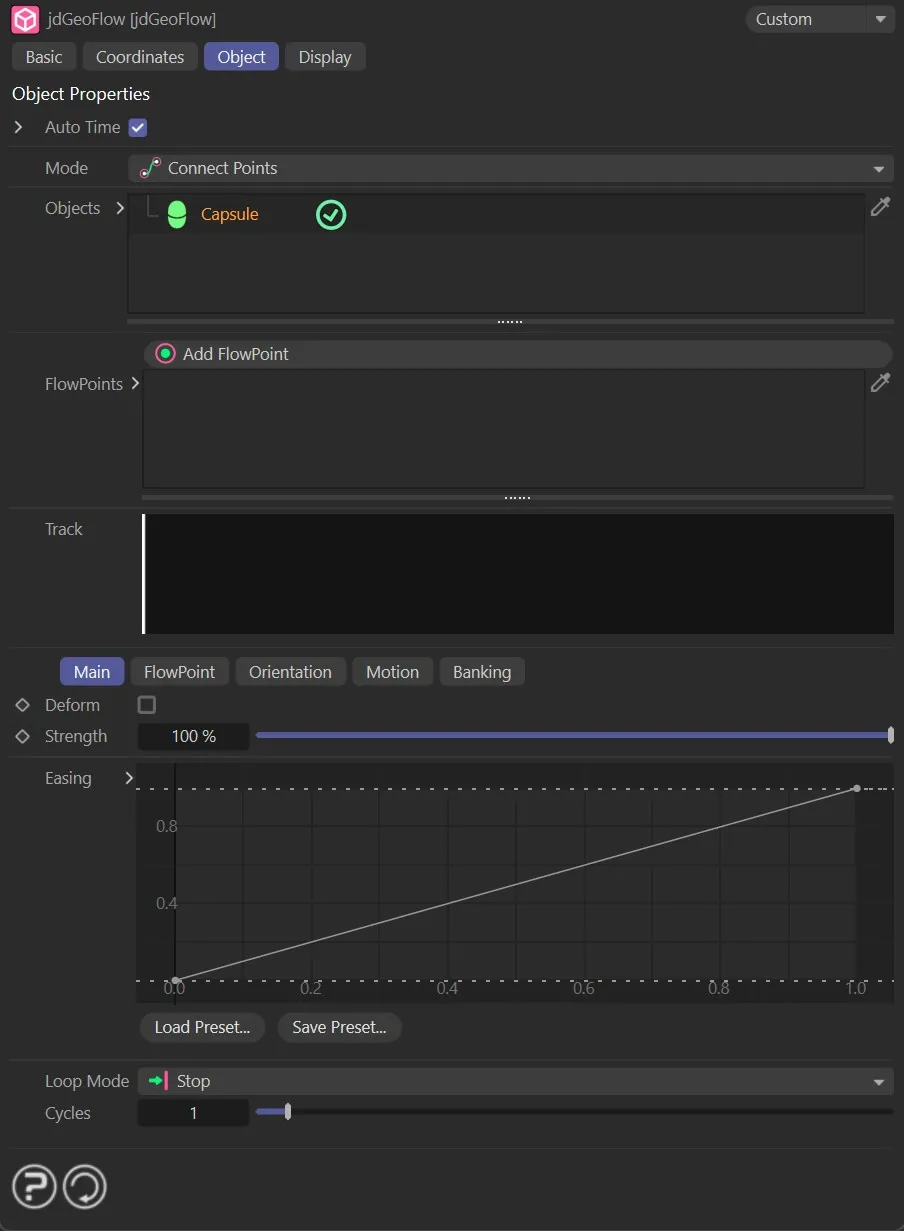
jdGeoFlow Object tab.
Auto Time
Section titled “Auto Time”Allows you to choose whether to automatically discern the start and end time from the project timeline.
When disabled, you can enter the times manually in the Start Time and End Time parameters, accessed via the drop-down arrow.
Start Time, End Time
Section titled “Start Time, End Time”Specifies a start and end time for the motion.
Set to Connect Points, by default, which uses the FlowPoints to define the motion.
The alternative setting is Path, which uses a preset spline for the motion.
When Path is selected, a Path tab becomes available, with options to define how the path is used (described below).

jdGeoFlow Modes.
Objects
Section titled “Objects”Drag and drop objects into this field for jdGeoFlow to use.
Add FlowPoint
Section titled “Add FlowPoint”Click to add FlowPoints to your scene.
FlowPoints
Section titled “FlowPoints”Here, the FlowPoints in the list can be seen and selected to change their values.
The green check mark next to each FlowPoint can be disabled to remove it from the Track interface.
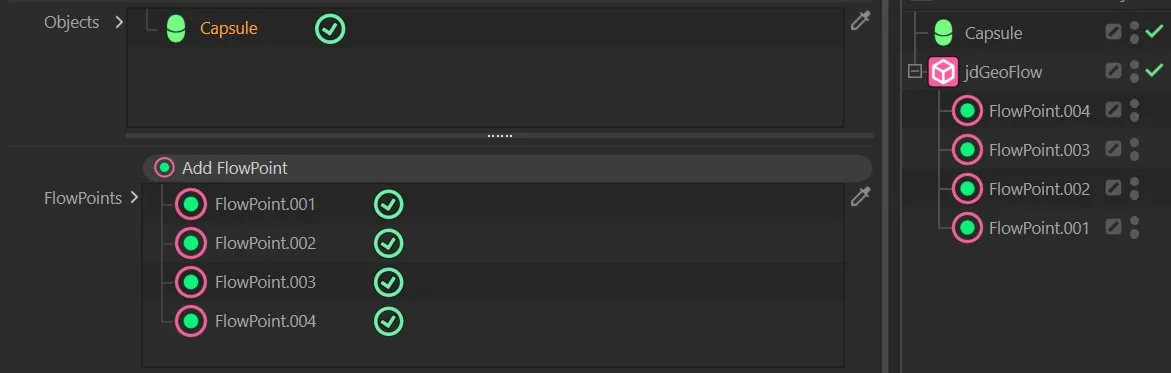
jdGeoFlow FlowPoints list and Object Manager.
The Track interface lets the user slide FlowPoints back and forth along the timeline by adjusting the weights of the surrounding FlowPoints.
Pink lines – unselected FlowPoints White line – current frame marker Green line – selected FlowPoint.
Blue shaded area – Hold Time around a CamPoint.

jdGeoFlow Track View.
Main tab
Section titled “Main tab”The main settings that affect the overall behavior of the camera.
Deform
Section titled “Deform”Enable this, to allow the scene object to deform to the path set.
Strength
Section titled “Strength”Sets the strength of the deformation.
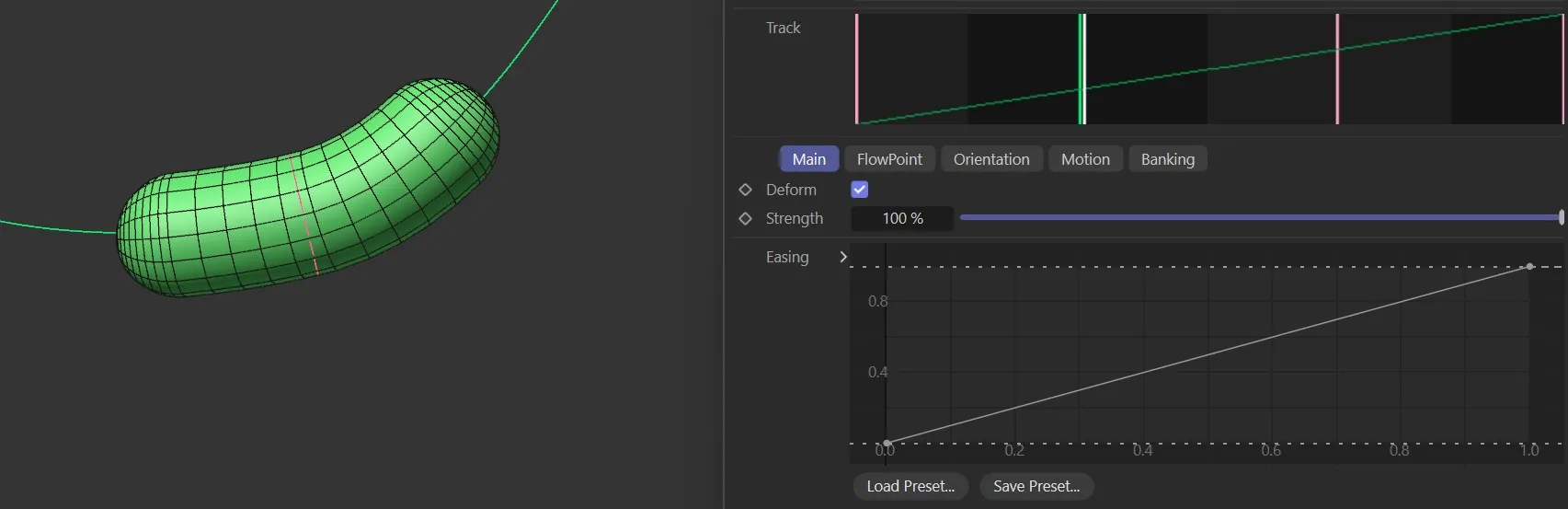
jdGeoFlow Deform option enabled.
Easing
Section titled “Easing”Manipulate this spline curve to set how the object’s speed will change throughout the whole path.
Loop Mode
Section titled “Loop Mode”Loop Mode options for what happens at the end of the path: Stop, Loop, Ping-Pong and Continue.
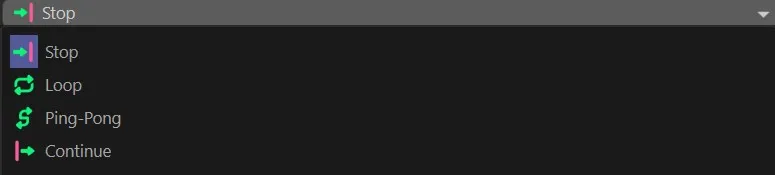
jdGeoFlow Loop Modes.
Animations of the Loop Modes.
Cycles
Section titled “Cycles”Sets how many times the selected mode will run.
FlowPoint tab
Section titled “FlowPoint tab”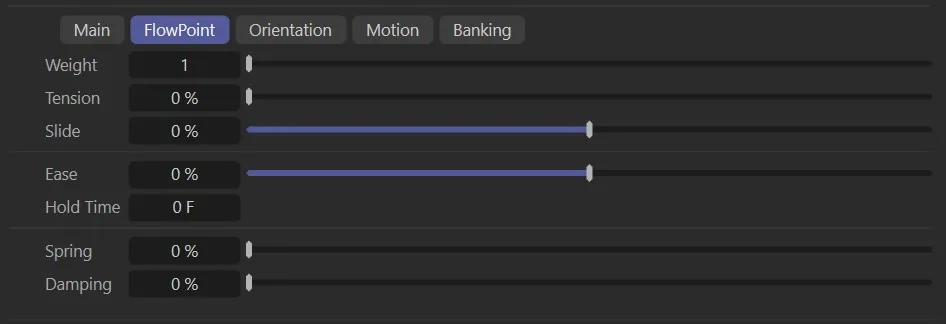
FlowPoint tab menu settings.
Weight
Section titled “Weight”Sets how much weight the selected FlowPoint should have.
More weight will give it more time on the track and other FlowPoints will be re-timed to accommodate.
Tension
Section titled “Tension”Sets how sharply the path will bend around this point.
100% means the path will take a very sharp corner at the given point.
A second way to adjust the position on the track, without changing any weights.
Sets how the speed will change as it nears the FlowPoint.
At 0 (zero), there will be no change of speed as it passes through.
At 100%, the speed will slow down as it reaches the FlowPoint, then speed up again afterwards.
Hold Time
Section titled “Hold Time”Sets how long the pause will be at the given FlowPoint.
Spring
Section titled “Spring”Sets how much ‘springiness’ there should be as it reaches this FlowPoint.
Damping
Section titled “Damping”Increase this to reduce the number of oscillations after springing.
Orientation tab
Section titled “Orientation tab”
Orientation tab menu settings.
Up Vector
Section titled “Up Vector”Sets the up vector used in spline normal calculations.
Set as +Y (World), by default, this can usually be left alone but the usual options are available.
Axis Align
Section titled “Axis Align”Allows for aligning the axis to the usual options.
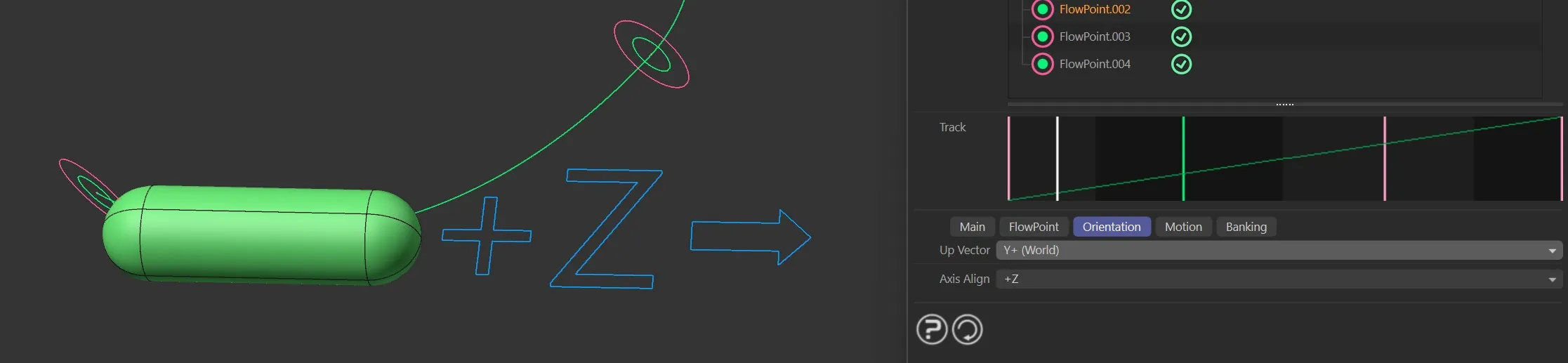
Axis Align set to +Z .
Motion tab
Section titled “Motion tab”Enable Motion
Section titled “Enable Motion”Enables a sine-based motion throughout the camera’s path.
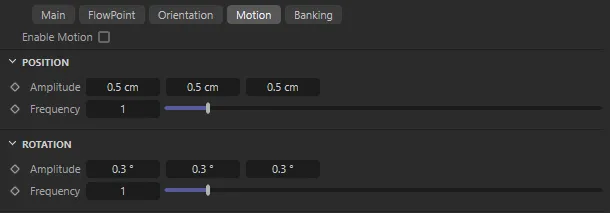
Motion tab settings.
Position
Section titled “Position”Amplitude
Section titled “Amplitude”The maximum distance at which the camera should oscillate around its ideal position.
Frequency
Section titled “Frequency”The frequency of the sine wave (Hz).
Rotation
Section titled “Rotation”Amplitude
Section titled “Amplitude”The maximum angles at which the camera should oscillate around its ideal rotation.
Frequency
Section titled “Frequency”The frequency of the sine wave (Hz).
Banking tab
Section titled “Banking tab”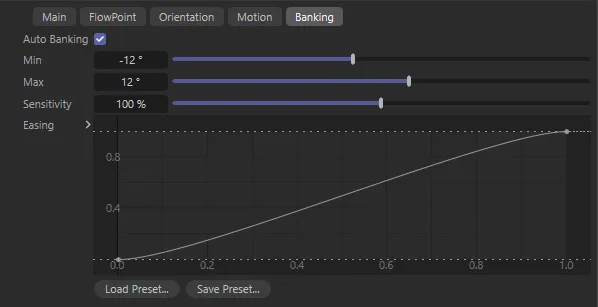
Banking tab settings menu.
Auto Banking
Section titled “Auto Banking”Enable auto banking.
This will roll the camera left or right based on its horizontal rotation speed.
Min, Max
Section titled “Min, Max”The angle limits for the banking roll.
Sensitivity
Section titled “Sensitivity”Sets how much the camera’s horizontal rotation speed will affect the roll angle.
Easing
Section titled “Easing”Defines how much the angle changes as speed increases.
Copyright © 2026 INSYDIUM LTD. All rights reserved.