

nxFalloff
nxFalloff is a spatial falloff object that limits where another NeXus modifier acts.
On its own nxFalloff does nothing. You add it to the Falloff tab of a modifier such as nxGravity so that modifier only affects particles inside the falloff region. A single falloff shape can drive several modifiers at once, and you can stack more than one falloff in the same list and blend them together.
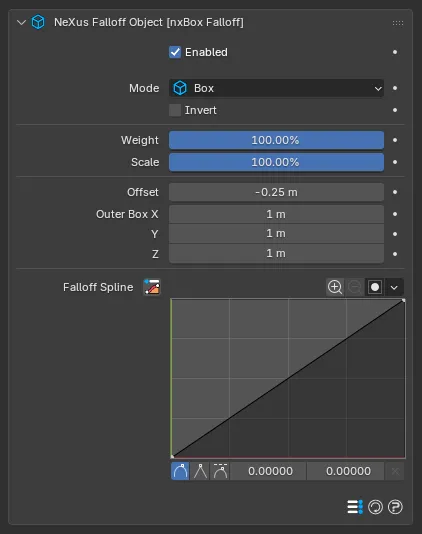
The nxFalloff panel in Properties ▸ Physics, in Box mode.
Adding a falloff
Section titled “Adding a falloff”Unlike most NeXus objects, nxFalloff is not in the Add ▸ INSYDIUM NeXus menu. You create it from the modifier you want to limit.
Open that modifier in Properties ▸ Physics and switch to its Falloff tab. Use the add button on the Falloffs list to create a new nxFalloff and add it to the list in one step. The new object appears in the scene with a gizmo showing its region, and its full settings are drawn inline beneath the list entry.
Position and rotate the nxFalloff object in the viewport to place the region, then shape it with the settings below.
Object Properties
Section titled “Object Properties”nxFalloff has a single panel. The available controls change with the Mode you pick.
Enabled
Section titled “Enabled”Turns the nxFalloff on or off. Disable it to switch off its region without deleting the object.
Selects the shape of the falloff region. Set as Box, by default. The other options are Linear, Sphere and Noise.
Changing the mode renames the object (nxBox Falloff, nxLinear Falloff, nxSpherical Falloff or nxNoise Falloff) and swaps the shape controls and the viewport gizmo.
Invert
Section titled “Invert”Flips the falloff, so the region that was at full strength drops to zero and the area outside becomes active. Use it to cut a hole in an effect instead of defining a volume for it. Off by default.
Weight
Section titled “Weight”The overall output strength of the falloff. Set as 100%, by default. Lower it to scale the whole falloff down so the modifier it feeds never reaches full strength inside the region.
Uniformly scales the falloff shape. Set as 100%, by default. This resizes the whole region at once, on top of the shape’s own size settings.
Box mode
Section titled “Box mode”
A rectangular falloff region. The outer box is the full extent, and an inner box marks the core that stays at full strength, with a smooth transition between the two.
Offset
Section titled “Offset”Sets the soft transition band inside the box. Set as -0.25m, by default. At 0 the falloff is hard at the box surface. Negative values pull the full-strength inner core inward, so the gap between the inner core and the outer box becomes the smooth falloff band. It is clamped so it cannot pull the core past the box center.
Outer Box
Section titled “Outer Box”Sets the full X, Y and Z extent of the box. Defaults to 1m on each axis. You can also drag the box handles in the viewport.
Linear mode
Section titled “Linear mode”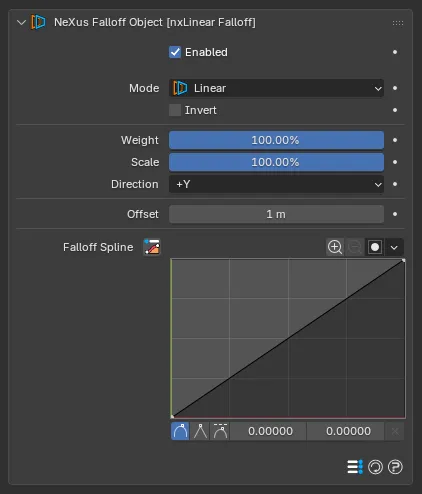
A directional falloff that fades along a single axis.
Direction
Section titled “Direction”Selects the axis the falloff fades along. Set as +Y, by default. The other options are +X, -X, -Y, +Z and -Z.
Offset
Section titled “Offset”Sets the distance the falloff reaches from the object origin out to its far edge. Defaults to 1m. The gradient runs from full strength at the origin down to zero at this distance.
Sphere mode
Section titled “Sphere mode”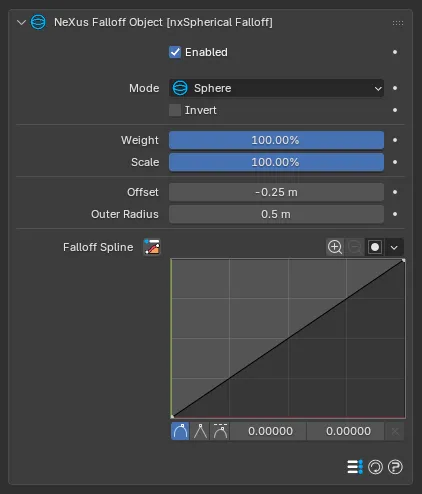
A radial falloff that fades outward from the object center.
Offset
Section titled “Offset”Sets the soft transition band inside the sphere. Set as -0.25m, by default. At 0 the edge is hard. Negative values pull the full-strength inner core inward, so the shell between the inner core and the outer radius becomes the smooth falloff. It is clamped so it cannot pull the core past the sphere center.
Outer Radius
Section titled “Outer Radius”Sets the full radius of the sphere. Defaults to 0.5m.
Noise mode
Section titled “Noise mode”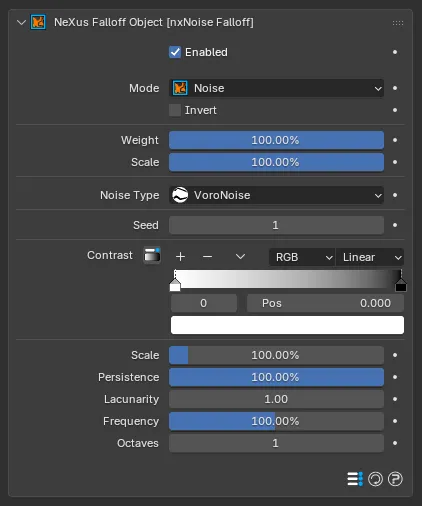
A procedural 3D noise field used as the falloff shape, for a broken-up or organic region rather than a clean solid volume.
Noise Type
Section titled “Noise Type”Sets the kind of noise. Set as VoroNoise, by default. The other options are Simplex, Curl, Turbulence, Wavy Turbulence, FBM and Cubic.
Randomizes the noise pattern while keeping all other settings the same. Defaults to 1. Change it for a different pattern from the same values.
Contrast
Section titled “Contrast”A gradient that remaps the noise values. Defaults to a white-to-black ramp. Push it toward a harder split for a crisp on/off region, or soften it for a gentle blend.
The size of the noise features. Set as 100%, by default. This is the noise feature size, separate from the object Scale above.
Persistence
Section titled “Persistence”How much each successive octave contributes, which controls how the strength changes across octaves. Set as 100%, by default.
Lacunarity
Section titled “Lacunarity”How the frequency changes from one octave to the next. Defaults to 1.
Frequency
Section titled “Frequency”The base frequency of the noise. Set as 100%, by default. Raise it for finer, more rapid variation across the field.
Octaves
Section titled “Octaves”The number of noise layers combined. Defaults to 1. More octaves add finer detail on top of the base pattern.
Falloff Spline
Section titled “Falloff Spline”
A curve that remaps the falloff profile. It runs as a straight ramp from 0 to 1 by default. Reshape it to make hard edges, ease-in and ease-out transitions or custom profiles.
The Falloff Spline is shown in Box, Linear and Sphere modes. Noise mode uses the Contrast gradient instead.
Blending falloffs
Section titled “Blending falloffs”You can add more than one nxFalloff to a modifier’s Falloffs list. Each entry in the list has its own Enabled toggle plus two blend controls that decide how it combines with the falloffs above it.
How this falloff combines with the ones above it in the list. Set as Normal, by default. The other options are Add, Subtract, Multiply, Difference, Screen, Overlay, Min and Max.
Strength
Section titled “Strength”How strongly this falloff’s contribution blends in. Set as 100%, by default. Lower it to fade this falloff back against the others in the list.
Copyright © 2026 INSYDIUM LTD. All Rights Reserved.