

nxCollider
nxCollider makes NeXus particles collide with one or more objects in your scene.
You build a list of scene objects to collide against, and set how particles respond to each one: which side of the surface stops them, how much they bounce, how much they are slowed by friction and how much their direction is scattered on impact.
A stream of particles cascading onto a mesh added to the Colliders list, bouncing and scattering across its surface.
Object Properties
Section titled “Object Properties”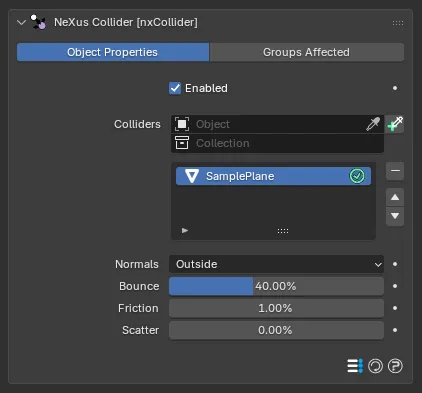
The nxCollider panel in Properties ▸ Physics, with a collision object added to the list.
Enabled
Section titled “Enabled”Turns the whole nxCollider on or off. Disable it to switch off all of its colliders at once without deleting them.
Colliders
Section titled “Colliders”The list of objects that particles will collide with.
Add objects to the list, then select an entry to reveal its settings below. Each entry has an enable toggle on the right of its row, so you can switch individual colliders on or off without removing them from the list.
You can add both Mesh and Curves objects as colliders.
Collider settings
Section titled “Collider settings”These settings apply to the currently selected collider in the list.
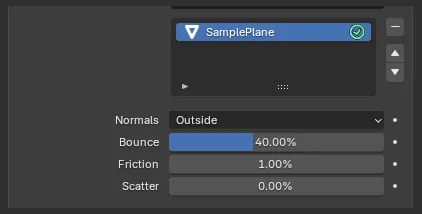
The settings below the Colliders list, applying to the selected collider. Each entry in the list carries its own Normals, Bounce, Friction and Scatter.
Normals
Section titled “Normals”Sets which side of the mesh surface a particle collides with. Mesh normals usually point outward, so the inside of an object is the opposite direction to its normals.
- Outside: any particle found inside the mesh is pushed back out. This is the default and is what you want for particles landing on or bouncing off a solid object.
- Inside: any particle found outside the mesh is pushed back in. Use this to keep particles contained within a volume, for example inside a bowl or a box.
- Any: the inside and outside are ignored and the particle simply collides with the polygons it hits.
Here the collider is a bowl. With Normals set to Outside the particles fall straight through it. Switching to Inside catches them and keeps them contained within the bowl.
Bounce
Section titled “Bounce”Controls the speed at which a particle rebounds from the surface. A value of 100% means the particle leaves the surface at the same speed it arrived, for a fully elastic bounce. At 0% the particle keeps none of its speed and settles against the surface. Defaults to 40%.
The Bounce value is raised partway through, from 5% to 95%. The low setting lets particles settle against the surface. The high setting sends them rebounding well clear of it.
Friction
Section titled “Friction”Adds friction between the particle and the surface it hits. Friction slows particles as they slide or roll across the surface, and brings rolling particles to a halt. The higher the value, the more quickly they stop. Defaults to 1%.
The Friction value is raised partway through, from 1% to 100%. At the low setting particles skid a long way across the surface. At the high setting they come to rest soon after landing.
Scatter
Section titled “Scatter”When a particle bounces from a flat surface it rebounds at the reflected angle. This is geometrically correct but can look too uniform. Scatter adds a random spread to the rebound direction, breaking up that uniform bounce for a more natural, varied result. Defaults to 0%.
The Scatter value is raised partway through, from 0% to 45%. At zero the particles rebound in a tight, uniform stream. Raising it spreads them into a wider, more varied spray.
Groups Affected
Section titled “Groups Affected”Use the Groups Affected tab to restrict the collider to particles in specific nxGroup groups, rather than affecting every particle.
Copyright © 2026 INSYDIUM LTD. All Rights Reserved.